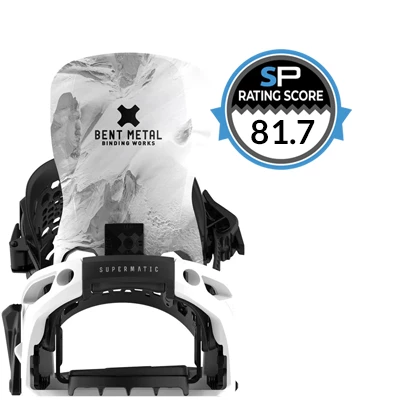
Hello and welcome to my Bent Metal Lightning Supermatic bindings review. Overall, I found the Lightning Supermatic to be fairly stiff, responsive bindings with solid but not amazing shock absorption, decent board feel and a quick-entry system that worked - but took some patience to dial in.
In this review I will take a look at the Lightning Supermatic as all-mountain snowboard bindings.
As per tradition here at SnowboardingProfiles.com I will give the Lightning Supermatic a score out of 100 (based on several factors) and see how they compare with other all-mountain bindings.
Overall Rating
Bindings: Bent Metal Binding Works Lightning Supermatic
Price: $449 (USD recommended retail)
Style: All-Mountain
Flex Rating: Stiff (8/10)
Flex Feel: Mid-Stiff (7/10)
Rating Score: 81.7/100
Compared to other Men’s All-Mountain Bindings
Of the 30 current model men's all-mountain bindings that we tested:
❄️ The Lightning Supermatic ranked 24th out of 30
Overview of the Lightning Supermatic’s Specs
Check out the tables for the Lightning Supermatic’s specs and available sizes.
Specs
STYLE:
All-Mountain
PRICE:
$449 - BUYING OPTIONS
Ability Level:

flex:

weight:
FELT HEAVIER THAN normal
Mounts to:
2x4 | 4x4 | Channel
Sizing
SIZE | US BOOT SIZE | EURO BOOT SIZE | MONDO |
|---|---|---|---|
M | 5.5-8 | 37.5-41 | 23.5-26 |
L | 8.5-10.5 | 42-44 | 26.5-28.5 |
XL | 11-13 | 44-48 | 29-31 |
Who are the Lightning Supermatic Most Suited To?
Bent Metal's Lightning Supermatic are best suited to riders who want a stiffer, more supportive binding with the convenience of a rear-entry/Supermatic-style system.
They’re a good match for riders who like the idea of being able to step in quickly, but still want a binding that feels more like a regular two-strap binding once they’re riding. They had enough response for carving and riding faster, and they felt more supportive than softer, freestyle-oriented bindings.
I wouldn’t say they were the most effortless bindings at slower speeds. They took a little more work than others I rode on the same day, and getting the step-in tension just right took some tweaking. So, I’d say they’re best suited to intermediate and up riders who are willing to spend a bit of time dialing in the fit.
Best matched to boards in the 5/10 to 8/10 flex range, and particularly well suited to boards around that 6/10 to 7/10 flex range, IMO.
Test/review details for the Lightning Supermatic

O.k. let’s take a more detailed look at what the Lightning Supermatic are capable of.
Demo Info
Binding: BMBW Lightning Supermatic, M/L
Date: February 24, 2025
Entry / Exit
This was naturally one of the biggest parts of the test, given the Supermatic-style design.
When I first got my boot into them, it went in nice and easy. Too easy, actually. I had set them up the night before, but once I got my boot in properly on snow, they were definitely not tight enough. My foot was able to move around a lot and lift up quite a bit.
After some adjusting, I got them to the point where they were good to ride in. But once I tightened them enough to feel secure, they became noticeably harder to get into. That seemed to be the main thing with these: finding the sweet spot.
Too loose and they were really easy to get into, but the hold wasn’t good enough. Tight enough to ride properly, and they took more effort to step into.
In the end, I found myself getting into them and then tightening the straps a little more afterwards. That worked, but it also meant getting out was harder. With more time and tweaking, I think I could have got them dialed in better, but they definitely didn’t feel perfectly plug-and-play straight away.
Flex
In hand, the Lightning Supermatic felt on the stiffer side.
The highback twist flex was fairly stiff. It wasn’t the stiffest of all the Bent Metal bindings I compared it with, but it was definitely stiffer than softer models like the Logic and Joint. It felt similar to the Transfer and not too far off the Axtion.
Highback pullback flex was minimal. There was just a tiny bit of give, but virtually none. It felt really supportive in that direction and didn’t have much movement when pulling back on it.
The ankle strap was quite stiff too. It was noticeably stiffer than the Transfer and Axtion straps, and not far off some of the more supportive straps I’ve tested. It wasn’t quite as stiff as the Jones Mercury FASE ankle strap (bindings I also had on hand at the time), but it was definitely more supportive feeling than the softer Bent Metal options I had.
The toe strap was also quite stiff, though with a bit more give than the ankle strap. Overall, in hand, these felt like they were built more for support and response than forgiveness or surfy freedom.
On snow, they didn’t feel quite as stiff as an 8/10 to me, but they were certainly stiffer than mid-flexing bindings. I’d put the feel more in that 7/10-ish range.
Responsiveness
Responsiveness was solid, but not perfect.
At slower speeds, I found the Lightning Supermatic a little harder work than the other bindings I rode that day. Not by a huge amount, but enough to notice. They weren’t sluggish or difficult, but they didn’t have that easy, quick, agile feel that some bindings give you when you’re making slower, tighter turns.
Some of that may have been from the fit. Because I was still tweaking the entry/exit tension and strap feel, I don’t think I had them 100% perfectly dialed. But some of it also felt like it came from the flex and overall feel of the binding. They were supportive, but not super easygoing.
At higher speeds and on stronger turns, they felt better. They had decent power and transferred energy well. They felt stiffer and more supportive than softer freestyle bindings and gave a good amount of drive from edge-to-edge.
They weren’t ultra-aggressive or lightning-fast, despite the name, but they had enough response for stronger all-mountain riding.
Carving
For carving, the Lightning Supermatic were good.
Compared to my control bindings (Burton Malavita), they felt a touch better. Not massively better, but there was a bit more support and power there when leaning into a carve.
They didn’t blow me away as a carving binding, though. Given the stiffness and more supportive build, I was expecting them to maybe feel a little more powerful. They were good, and certainly capable, but not super high-end in terms of carving performance.
They felt best when I was riding more deliberately and giving them a bit more input. They weren’t the kind of bindings that instantly made everything feel sharper, but they did provide a stable, supportive platform.
Board Feel / Butterability
Board feel was middle of the road.
They weren’t dead feeling underfoot, but they also didn’t give me that really connected, natural feel that I get from some more minimal or softer bindings.
For butters and presses, they weren’t the easiest. The stiffer overall feel and the slightly more locked-in nature of the system made them feel more suited to carving and cruising than getting playful.
You could still butter in them, of course, but if board feel and tweakability are high priorities, these wouldn’t be my first choice.
Shock Absorption
Shock absorption was OK, without being amazing.
They weren’t harsh, and I didn’t feel like they transmitted every little bit of chatter straight into my feet. But they also didn’t feel super cush or ultra-damp.
I’d put them just above middle of the road here.
For rougher snow or longer days, I think they’d do the job well enough, but there are bindings out there that feel more damp and absorbent.
Adjustability
Adjustability was important with these, because the entry/exit system depended quite a bit on getting the fit right.
The main thing I noticed was how much the setup mattered. Small adjustments made a pretty big difference to how easy they were to get into versus how secure they felt when riding.
That’s not necessarily a bad thing, but it did mean they required more patience than a traditional two-strap binding. With regular bindings, if the straps feel too loose, you just crank them down a little more and go. With these, tightening them enough for riding also affected how easy they were to step into.
So, while they were adjustable enough to get working, I felt like they required more fine-tuning to get ideal.
Comfort
Comfort was decent overall.
Once I had them tightened enough to ride, I didn’t notice any major pressure points or anything painful. The straps felt supportive and held well, though because the ankle strap was quite stiff, it didn’t have the same soft, cushy wrap as some more comfort-focused bindings.
The overall feel was more secure and structured than plush and forgiving.
Ankle Support
Ankle support was good.
The stiffer ankle strap and supportive highback helped give a pretty secure feeling once everything was dialed in. Compared to softer Bent Metal bindings, these felt much more supportive and more suited to stronger riding.
The challenge was getting that support while still keeping entry and exit easy enough. Once I tightened them to where the support felt good, the convenience factor took a bit of a hit.
But purely in terms of support while riding, they did well.
Score Breakdown and Final Verdict
Check out the breakdown of the score in the table below.
| Factor | Rating (/5) | Weighted |
|---|---|---|
| Carving | 4 | 16/20 |
| Slow Speed Response | 3.5 | 14/20 |
| Board Feel | 3.5 | 10.5/15 |
| Shock Absorption | 4 | 8/10 |
| Adjustability | 3.5 | 7/10 |
| Comfort | 4 | 8/10 |
| Ankle Support | 4 | 8/10 |
| Entry/Exit | 4.5 | 4.5/5 |
| TOTAL (after normalizing): | 81.7/100 |
The Lightning Supermatic were a bit of a mixed bag for me, but with a lot of upside for the right rider.
On the plus side, they felt supportive, fairly stiff and responsive enough for stronger all-mountain riding. They carved well, had good ankle support and felt quite powerful.
The Supermatic-style entry system also worked, but it required some dialing in. Initially, they were way too loose. Once I tightened them enough to ride confidently, they became harder to get into and out of. With more tweaking, I think I could have found a better balance, but it wasn’t instantly perfect.
Performance-wise, they were a little harder work at slow speeds than others I tested that day, and board feel and shock absorption were both more middle of the road than standout.
Overall, I’d say the Lightning Supermatic are best for intermediate to advanced riders who want a supportive, medium-stiff binding and like the idea of faster entry, but don’t mind spending some time getting the setup right.
They wouldn’t be my top pick for beginners, playful freestyle riders or anyone who wants maximum board feel. But for someone wanting a stronger, more supportive binding with step-in style convenience, they make sense.
More Info, Current Prices and Where to Buy Online
If you want to learn more about the Lightning Supermatic, are ready to buy or want to research prices and availability, check out the links below.
If you want to see how the Lightning Supermatic compares to other men’s all-mountain bindings or want to check out some other options in that category, check out the next link.

Leave a Reply