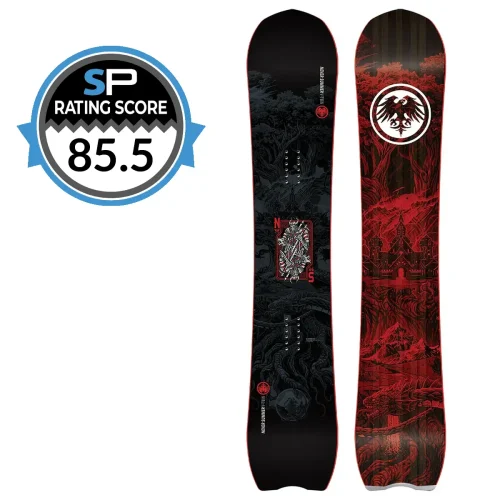
The redesigned Never Summer V-Twin felt noticeably more stable and capable at speed than the previous version I tested. It also felt less playful, more demanding and a little more prone to catching an edge.
Some of that was slightly exaggerated by the size I rode. I tested the V-Twin in a 160, which felt a little too big for me for this particular board. I suspect the 157 would have given me a better balance of agility, pop and stability.
In this review, I will take a look at the V-Twin as an all-mountain snowboard, which we define as the do-it-all swiss-army knives of boards.
As per tradition here at SnowboardingProfiles.com I will give the V-Twin a score out of 100 (based on several factors) and see how it compares with other men's all-mountain snowboards.
Overall Rating
Board: Never Summer V Twin 2027
Price: $669
Style: All-Mountain
Flex Rating: Medium (6/10)
Flex Feel on Snow: Medium (6/10)
Rating Score: 85.5/100
Compared to other Men's All-Mountain Boards
Of the 30 current model men's all-mountain snowboards that we tested:
❄️ The V-Twin ranked 16th= out of 30
Overview of the V-Twin'S Specs
Check out the tables for the V-Twin's specs and available sizes.
STYLE
All-Mountain
PRICE
$669 - BUYING OPTIONS
Ability Level
flex
feel
DAMPNESS
SMOOTH /SNAPPY
Playful /aggressive
Edge-hold
camber profile

Traditional Camber
Traditional Camber - But not quite, with some small rocker sections, but with camber in the middle and under the feet to the contact points with just small rocker sections in between, it's closest to trad camber, IMO. Never Summer's "Triple Camber Recurve".
SHAPE
DIRECTIONAL TWIN - Never Summer calls it "Directional True Twin"
setback stance
Centered
BASE
SINTERED - Never Summer's "Durasurf XT Sintered 5501 Base"
weight
Camber Height
10.5mm
Sizing
LENGTH (cm) | Waist Width (mm) | Rec Rider Weight (lb) | Rec Rider Weight (kg) |
|---|---|---|---|
153 | 254 | 100-150 | 45-68 |
157 | 256 | 140-180 | 63-81 |
160 | 258 | 150-220+ | 68-100+ |
156X | 263 | 140-220 | 63-100 |
159X | 265 | 150-220+ | 68-100+ |
162X | 267 | 170-240+ | 77-108+ |
Who is the V-Twin Most Suited To?
The V-Twin is best suited to intermediate to advanced riders looking for a stable, medium-stiff all-mountain board and value stability and a more planted feel, over effortless playfulness/maneuverability.
It could work as a one-board quiver for someone who likes riding the whole mountain with a freestyle influence but didn't spend much, or any, of their time jibbing and weren't looking for something with a surfier or more playful feel.
It favors a more deliberate and assertive riding style rather than a relaxed, playful one. Riders who spend most of their time carving around the mountain, hitting side hits and like a bit of speed - but still want something reasonably capable in variable snow - should get the most from it.
It's less suited to riders looking for a loose, easygoing freestyle board for butters, jibs and quick, spontaneous ollies. It also wouldn't be my first choice for tight trees.
Not for beginners, IMO. Not forgiving or confidence building enough for learning on or early progression, IMO.
V-Twin DetailS
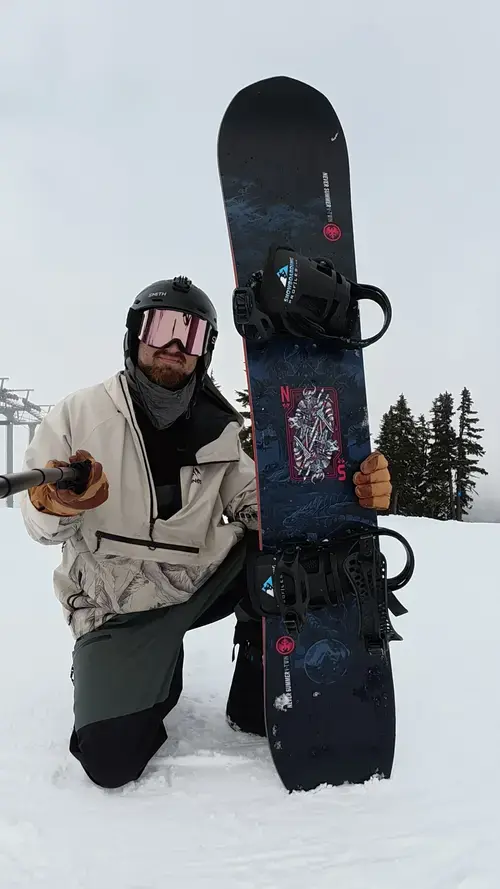
O.k. let's take a more detailed look at what the V-Twin is capable of.
Demo Info
Board: Never Summer V-Twin 2027, 160cm (258mm waist width)
Date: March 5, 2026
Note that because I rode this in a size slightly bigger than what I would consider my ideal size, there will be a lot of reference below as to how I suspect the board would differ has I tested the 157 vs the 160. While it's not possible to complete account for the size difference, I have had a lot of experience riding the same board in two different sizes, so I have a pretty good feel of how sizing generally changes the feel of the board.
Keep in mind that when I refer to the 160 being too big, that this is relative to me personally. For some the 160 might be just the right size. Also note that according to Never Summer's weight recommendations, the 160 is actually the most suitable for my weight, if I was just going off weight recommendations. However, I know for my personal preferences that I tend to enjoy this style of board in the 156 to 159 range and if I ever prefer 160+ it's typically only for a directional freeride board.
Board Feel
The V-Twin felt heavier than my control board, both when carrying it and when riding it.
On snow, the V-Twin had a predominantly stable feel, bordering on semi-locked-in at times. It was noticeably less loose and playful than the previous V-Twin and required a more deliberate riding style.
It wasn't ultra-aggressive, but I found I had to ride it fairly assertively to get the best from it.
Flex
I felt the 160 at around a 6.5 out of 10 for flex. Certainly stiffer than I remember the older V-Twin feeling, even after accounting for the extra length. In the 157, I imagine it would have felt closer to a 5.5 or 6 out of 10.
The nose and tail weren't exceptionally difficult to flex, but the board didn't have an especially soft or playful personality overall. There was enough structure to support landings and higher-speed riding without making it brutally demanding.
Turning
I didn't find the V-Twin super difficult to turn or anything, but it took noticeably more effort to initiate turns than my control board.
At slower speeds, it was reasonably maneuverable but not especially quick or effortless. Tight turns required more input, and I didn't find it that well suited to weaving through confined terrain.
Once again, the 160 length played a role here. The 157 would likely have been noticeably easier to move from edge to edge but while a 3cm makes a noticeable difference, it's not a world of difference, so I don't think it would present a highly sharp turning feel even in the smaller size. It would likely be a decent enough improvement, but I couldn't see it getting to the sharp turning levels of the previous V-Twin iteration.
I experienced some catch threat, particularly when transitioning onto the toe edge. It was nothing extreme and didn't make the board unrideable, but it was present often enough to affect how relaxed I felt when riding it.
Carving
Carving was one of the areas where the additional length, and the additional stiffness of the new version, helped.
The 160 provided a long, supportive platform and held up reasonably well when I leaned it over. It carved better than the older, looser V-Twin and felt more composed when carrying speed through a turn.
However, I still wouldn't call carving one of its standout strengths. It was decent without being particularly powerful, precise or exciting.
With less effective edge, the 157s high speed carving stability would drop slightly, but, for me personally, might have presented a better balance between stability/edge-hold and spring/liveliness.
Speed
The V-Twin felt stable up to reasonably fast speeds. It wasn't a full-speed bomber but it handled speed well enough for most all-mountain riding. It stayed more composed than the older model and didn't become excessively nervous when I opened it up.
The board also felt reasonably damp. Slightly damper than my control board and slightly damper than the average board.
The extra surface area of the 160 probably helped with both stability and dampness, so the 157 would probably feel relatively livelier and less planted.
Uneven Terrain
Its weight, flex and overall stability helped the V-Twin remain composed when conditions became messy. It wasn't completely unshakeable, but it didn't get thrown around too easily either.
The 160 likely performed better in crud than the smaller sizes would have. However, the trade-off came in tighter terrain.
In trees and moguls, it was okay but not great. Its slower turning response and extra length made navigating narrow lines harder than I would have preferred. The 157 would likely have been a considerably better fit for trees and bumps, for me.
Powder
I didn't get enough meaningful powder to properly test the V-Twin's float. But based on its feel and specs, I'd say it wouldn't be great. It should perform better than a full true-twin. However, it still didn't feel and doesn't look, based on specs, like a board designed primarily for deep snow.
It should have be fine for occasional moderate powder days, but I wouldn't choose it as a dedicated powder board.
Jumps
The V-Twin was a decent jump board, particularly when it came to approaches and landings.
It provided a good balance of agility and stability when approaching jumps. I'd personally prefer something slightly more maneuverable, but it felt composed and predictable enough when lining up a feature.
Landings felt solid. However, its slightly catchy feel meant it didn't feel especially forgiving when I landed off-centre.
Overall pop was respectable but not effortless. It took more work to load the nose and tail than it does on my control board. Once loaded, the overall amount of pop was similar, but accessing it required more input.
Ollies
Ollies required more effort than they did on my control board. The V-Twin had decent pop once I loaded it properly, but initiating that load wasn't especially easy or quick. The shape of and reduced volume in the tail may have contributed to that feeling?
It wasn't hard to ollie, but it didn't have that immediate, low-effort spring that tends to make a board especially fun for spontaneous side hits.
Switch
Despite being designed around freestyle versatility, I didn't find the V-Twin exceptional for riding switch.
The different nose and tail shapes were noticeable, and the catch threat made transitions more difficult than normal. Once I was riding switch, it felt reasonably natural, but changing direction required a little more care.
It was perfectly capable of switch riding, but it didn't provide the completely balanced, carefree feeling I prefer.
Spins
Spins were another area where the 160 size worked against me. The board had more swing weight than I preferred, and the additional effort required to load the nose and tail made generating enough height harder. The slight catchiness also came into play during takeoffs and landings (if I under rotated).
The 157 likely would have improved its spinning performance considerably, but on the 160, spins weren't a major strength, for me.
Butters
The nose and tail weren't overly stiff, so pressing them wasn't especially difficult. However, I could feel the difference in shape and volume between the two ends of the board. That made butters feel less balanced than they did on my control board.
The slight catch threat during transitions also reduced my confidence when moving between presses or rotating out of them.
It was still reasonably pressable, but it didn't have the loose, easygoing butterability I found with the previous V-Twin.
Jibbing
The V-Twin was capable on jibs but wouldn't be my first choice for regular rail or box riding.
The catchier feel was a bit of a turn-off, and I would have preferred easier access to its pop. Its more stable personality and medium flex were better suited to jumps and all-mountain riding than technical jibbing, IMO. But this isn't what this board is positioned for, of course.
Edge Hold
Edge hold was decent, but it wasn't quite as strong as my control board in the hard and icy patches I encountered. It held well enough for general riding, but I didn't feel completely confident pushing it hard on firmer snow. This was slightly surprising given the more stable, locked-in direction the new model had taken.
Score Breakdown and Final Verdict
Check out the breakdown of the score in the table below.
| Factor | Rating (/5) | Weighted |
|---|---|---|
| Powder | 3 | 9/15 |
| Carving | 3.5 | 7/10 |
| Turns | 4 | 8/10 |
| Speed | 3.5 | 7/10 |
| Crud | 3.5 | 7/10 |
| Trees | 3.5 | 7/10 |
| Switch | 4 | 8/10 |
| Jumps | 4 | 8/10 |
| Spins | 3.5 | 3.5/5 |
| Butters | 3.5 | 3.5/5 |
| Rails | 3 | 3/5 |
| TOTAL (after normalizing): | 85.5/100 |
I wasn't the biggest fan of the redesigned V-Twin, if I'm being honest, despite it scoring pretty well as an all-mountain board.
It has become a more stable and solid ride than the older version. It carved better, handled speed more confidently and performed better in crud.
However, it did that at a good portion of the loose, playful personality that previously helped it stand out. The new board felt heavier, more demanding and slightly catchier without becoming exceptional at carving or high-speed riding. I feel like it gave up more at one end of the spectrum than it gained at the other end.
The 160 was a touch too big for me for this particular board, and that did have some affect. The added length helped its stability, carving, crud performance and landings, but hurt its agility, ollies, spins, side hits, trees and general playfulness. These things were likely more amplified in the 160 vs if I'd ridden it in the 157, which would likely have been my more preferred size for this board.
Current Availability/Buying Options
To learn more about the V-Twin, or if you're ready to buy, or if you just want to research prices and availability, check out the links below:
To check out some other men's all-mountain snowboard options, or to see how the V-Twin compares to others, check out our top rated all-mountain snowboards by clicking the button below.

Leave a Reply