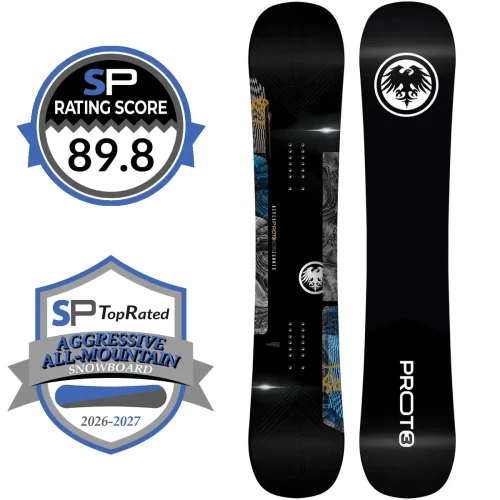
The Never Summer Proto T3 Ultra is a powerful, damp and seriously aggressive all-mountain board that rewarded commitment with excellent carving, edge hold, speed and chop stability.
It wasn’t a board that encouraged me to relax, casually cruise around or get lazy with my technique. It wanted me to get on the front foot, build some speed and ride it with purpose. When I did that, it delivered oodles of performance. When I became tentative or tried to casually steer it around at slower speeds, it felt considerably less cooperative.
In other words, this was the kind of board that wanted you to commit. If you were too cautious on it, it felt like it might chew you up and spit you out!
In this review, I will take a look at the Proto T3 Ultra as an aggressive all-mountain snowboard.
As per tradition here at SnowboardingProfiles.com I will give the Proto T3 Ultra a score out of 100 (based on several factors) and see how it compares with other aggressive all-mtn snowboard snowboards.
Overall Rating
Board: Never Summer Proto T3 Ultra 2027
Price: $719
Style: Aggressive All-Mountain
Flex Rating: Mid-Stiff (7/10)
Flex Feel on Snow: Stiff (8/10)
Rating Score: 89.8/100
Compared to other Men’s Aggressive All-Mountain Boards
Of the 19 current model aggressive all-mtn snowboards that we tested:
❄️ The Proto T3 Ultra ranked 5th out of 19
Overview of the Proto T3 Ultra’S Specs
Check out the tables for the Proto T3 Ultra’s specs and available sizes.
STYLE:
aggressive all-mountain
PRICE:
$719 - BUYING OPTIONS
Ability Level:

flex:

feel:

DAMPNESS:

SMOOTH /SNAPPY:

Playful /aggressive:

Edge-hold:

camber profile:

Traditional Camber
TRAD CAMBer - But not quite, with some small rocker sections, but with camber in the middle and under the feet to the contact points with just small rocker sections in between, it's closest to trad camber, IMO. Never Summer's "Recurve Triple Camber".
SHAPE:
setback stance:
Centered
BASE:
Sintered- Never Summer's "Durasurf XT Sintered 5501 Base"
weight:
FELT A LITTLE HEAVIER THAN Normal
Sizing
LENGTH (cm) | Waist Width (mm) | Rec Rider Weight (lb) | Rec Rider Weight (kg) |
|---|---|---|---|
154 | 260 | 130-170 | 54-72 |
157 | 262 | 140-200 | 53-82 |
160 | 264 | 160-230 | 72-90 |
163 | 266 | 180-220+ | 91-100+ |
Who is the Proto T3 Ultra Most Suited To?
The Proto T3 Ultra is best suited to an advanced or expert rider who wants a powerful, aggressive twin for bombing groomers, railing carves, charging through rough snow and hitting larger jumps.
It could work as a one-board quiver for someone who rides aggressively most of the time and values stability, grip and power more than easy maneuverability, effortless pop or deep-powder performance.
Not recommended for beginners, or even intermediate riders, or anyone who wants a mellow and forgiving ride. Also not ideal for riders who spent most of their time jibbing, buttering or weaving through tight trees at slower speeds.
As a quiver board, it would pair well with a softer, more playful freestyle board or a more directional, powder-focused option.
TEST/REVIEW DetailS FOR THE Proto T3 Ultra
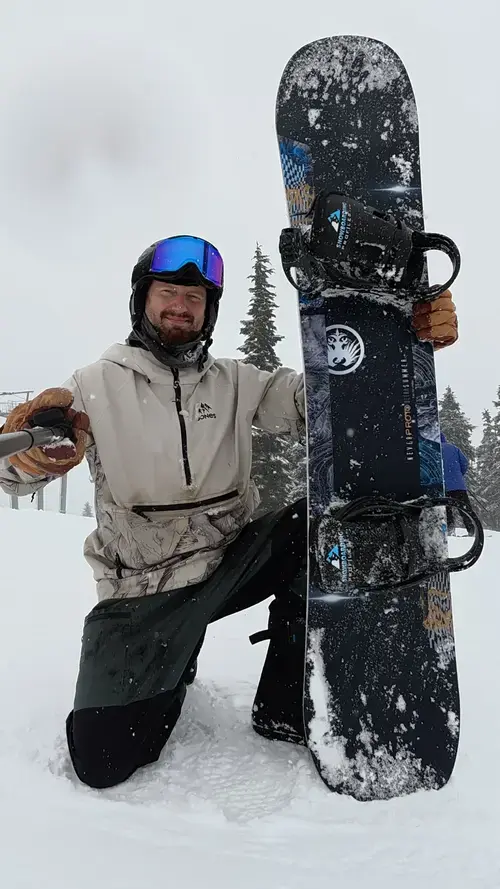
O.k. let’s take a more detailed look at what the Proto T3 Ultra is capable of.
Demo Info
Board: Never Summer Proto T3 Ultra 2027, 157cm (262mm waist width)
Date: March 25, 2026
First Impressions
The first thing I noticed was how much stiffer it felt than my control board, particularly torsionally.
It felt mildly heavier in hand and a little more noticeably so once I was riding it. That combination of weight, stiffness and dampness immediately gave it a more serious personality.
The Proto T3 Ultra didn’t feel completely locked in, but it sat very close to that end of the spectrum. I could release the tail when I needed to, but it required deliberate input. It clearly preferred gripping an edge and staying there rather than being casually slashed and pivoted around.
Carving
Carving was one of the Proto T3 Ultra’s biggest strengths. Once I got its edge engaged, it dug in and held on really well. I could lean into it and rail some satisfyingly deep carves without feeling like the board wanted to fold, chatter or wash out.
That was particularly impressive given that the conditions were bumpier and messier than ideal for carving. The board remained composed and allowed me to hold a cleaner line than I could on my control board – or most boards for that matter.
It had plenty of support through the middle of a carve and remained dependable as I pushed harder. This wasn’t a board that needed to be babied. The more aggressively I rode it, the more appropriate it felt.
Turning
Ease of Turning and Slashing
The Proto T3 Ultra took a bit of effort to initiate turns on. It wasn’t painfully difficult to turn or anything, but it expected accurate technique and strong input. Slashing the tail out also required some caution and effort because the board naturally wanted to remain locked into its edge.
If I got lazy and allowed the board to drift back toward a flat base without properly controlling it, I could feel some edge-catching vulnerability. It wasn’t brutally catchy, but a beginner or lower intermediate rider using less-than-perfect technique could have caught edges fairly regularly.
Maneuverability at Slow Speeds
Slow-speed maneuverability was adequate rather than outstanding. I could get it through tighter turns, and I wouldn’t have called it a complete slouch, but it took more effort and wasn’t as quick edge-to-edge as my control board.
That extra work could have become tiring during a full day spent riding moguls or constantly ducking into tight trees. It could handle those situations, but they weren’t where it felt most natural.
Speed and Edge Hold
The Proto T3 Ultra felt stable and composed when I opened it up. It was noticeably more stable than my control board and showed very little desire to become nervous or twitchy at speed. Its weight, stiffness and dampness all contributed to a smooth, planted ride.
Its edge hold was even more impressive. It gripped the icy crust underneath the thin layer of fresh snow better than any other board I rode that day. And that’s saying something, because my control board is very good in hard/icy conditions. Where I had to be cautious on other boards, the Proto T3 Ultra gave me the confidence to keep pushing.
That grip combined with its stability and carving ability made it a particularly strong option for aggressive riding in firm or inconsistent resort conditions.
Uneven Terrain
Crud and Chunder
The Proto T3 Ultra was sick in crud. It handled chopped-up and messy snow considerably better than my control board and was the best of the Never Summer boards I rode that day for sure.
It was extremely difficult to knock off course. The extra stiffness and slightly heavier feel helped it remain calm and stable when other boards were being bounced around.
Rather than dancing over rough snow, it smashed through it. For riders who regularly deal with tracked-out afternoon conditions, this was one of its standout qualities.
Trees and Moguls
It gripped well through icy patches and wasn’t excessively slow edge-to-edge, but it still required more effort than I would ideally want in tight terrain.
I could get it through trees and moguls, but I needed to remain switched on and physically involved. Over an extended period, that could have become fatiguing.
It wouldn’t have been my first choice for a day when I planned to spend most of my time ducking in and out of tight trees.
Powder
The Proto T3 Ultra did well in the moderate amount of fresh snow I experienced, but the conditions weren’t deep enough to properly expose its limitations.
Based on its overall feel and centered twin personality, I suspected it would have required considerably more back-leg effort in deeper powder. It was capable enough for shallower resort powder, but it’s not something I would choose for deep days.
Jumps
The Proto T3 Ultra was a strong jump board, particularly when I committed properly.
Its pop took some effort to access. It was more difficult to initiate an ollie on than my control board, but when I put that extra effort in, it rewarded me with more total pop.
Approaches felt stable and confidence-inspiring. It tracked well and gave me a dependable platform when carrying speed toward a feature. Speed checks came with a little catch threat, but its overall approach performance was very solid.
Landings were similarly strong. When I landed straight and cleanly, it felt like a proper stomper. It also supported tail-heavy landings well without feeling like the tail wanted to fold.
It wasn’t especially forgiving when I landed crooked, though. The same edge grip that made it so good for carving could punish a sloppy landing.
For side hits, I would normally have preferred something more agile with easier-access pop. However, the Proto T3 Ultra was still very capable when I didn’t hesitate and simply went for it.
Switch and Spins
Riding switch felt good because of the board’s balanced twin shape and even nose-to-tail flex.
The actual switch riding felt natural, though transitions carried a little catch threat. It wasn’t a board that allowed me to become completely careless during edge changes.
Spins were solid. I had no trouble getting the rotation around, and the board felt stable on landings without even a whisper of spin-continuation after landing.
There was some catch threat during takeoffs and landings, particularly if I needed to correct an under-rotation after touching down. But overall, it felt predictable and dependable for spins when my technique was clean.
Jibbing and Butters
Jibbing wasn’t where I wanted to spend my time on this board. I would definitely have preferred something less catchy, easier to maneuver and with more accessible pop. Physically strong, advanced jib riders could certainly have made it work, but it wasn’t designed to make rails and boxes easy, IMO.
Buttering was possible but took real effort. The nose and tail felt evenly balanced, which was good, but both were noticeably stiffer than those on my control board.
It wasn’t oppressively stiff, and I could get into a press when I committed enough weight and leverage. It just wasn’t something that happened casually or effortlessly.
Overall Feel
The Proto T3 Ultra felt semi-locked-in, bordering on fully locked-in.
It was also very damp feeling and it did the best job of any board I rode that day at deadening chatter.
Overall, it leaned more toward smooth than snappy. There was snap and energy in there, but I had to muscle it out. It didn’t effortlessly spring from edge to edge, pop into ollies or launch from side hits.
Its personality sat firmly on the aggressive side. Riding too slowly or casually made it feel awkward, demanding and more vulnerable to catching an edge. Building speed and increasing the intensity transformed it into a powerful, confidence-inspiring ride.
Score Breakdown and Final Verdict
Check out the breakdown of the score in the table below.
| FACTOR | Rating (/5) | Weighted |
|---|---|---|
| Speed | 4.5 | 18/20 |
| Carving | 4.5 | 18/20 |
| Turns | 3.5 | 3.5/5 |
| Jumps | 3.5 | 10.5/15 |
| Powder | 2.5 | 5/10 |
| Crud | 4.5 | 9/10 |
| Trees | 3 | 3/5 |
| Switch | 4 | 8/10 |
| Spins | 4 | 4/5 |
| TOTAL (after normalizing): | 89.8/100 |
The Proto T3 Ultra was the kind of board I wanted to point downhill and ride without hesitation. It rewarded commitment with excellent grip, stability, carving performance, powerful pop and outstanding crud handling.
It demanded strength and sound technique, but for the right rider, the performance it gave back was well worth the effort.
More Info, Current Prices and Where to Buy Online
To learn more about the Proto T3 Ultra, or if you're ready to buy, or if you just want to research prices and availability, check out the links below.
To check out some other aggressive all-mtn snowboard options, or to see how the Proto T3 Ultra compares to others, check out our top rated aggressive all-mtn snowboards by clicking the button below.

Leave a Reply