
I found the Burton Photon Boa to be supportive 6.5/10 flex snowboard boots with good heel hold, easy adjustability and strong carving performance.
In this review I will take a look at the Photon Boa as all-mountain snowboard boots.
As per tradition here at SnowboardingProfiles.com I will give the Photon Boa a score out of 100 (based on several factors) and see how they compare with other all-mountain boots.
Overall Rating
Boots: Burton Photon Boa
Price: $479 (USD recommended retail)
Style: All-Mountain
Flex Rating: In-between "Happy Medium" and "Stiff and Aggressive"
Flex Feel: Medium bordering on Mid-Stiff (6.5/10)
Rating Score: 86.4/100
Compared to other All-Mountain Boots
Of the 25 current model men's all-mountain snowboard boots that we tested:
❄️ The Photon Boa ranked 8th out of 25
Overview of the Photon Boa’s Specs
Check out the tables for the Photon Boa's specs and available sizes.
Specs
STYLE:
ALL-MOUNTAIN
PRICE:
$479
Ability Level:

flex:

weight:
Felt normal
LACING SYSTEM:
Double Boa
Sizes
US MEN'S SIZE | UK SIZE | EURO SIZE | MONDOPOINT |
|---|---|---|---|
7 | 6 | 40 | 25 |
7.5 | 6.5 | 40.5 | 25.5 |
8 | 7 | 41 | 26 |
8.5 | 7.5 | 41.5 | 26.5 |
9 | 8 | 42 | 27 |
9.5 | 8.5 | 42.5 | 27.5 |
10 | 9 | 43 | 28 |
10.5 | 9.5 | 43.5 | 28.5 |
11 | 10 | 44 | 29 |
11.5 | 10.5 | 44.5 | 29.5 |
12 | 11 | 45 | 30 |
13 | 12 | 46 | 31 |
14 | 13 | 47 | 32 |
15 | 14 | 48 | 33 |
Who are the Photon Boa Most Suited to?
The Burton Photon Boa are best suited to riders who want a boot that’s just a little stiffer than medium, with good support for carving and higher-speed riding, but without feeling overly aggressive or restrictive.
With a 6.5/10 flex, they’re a good match for someone who wants a bit more power and security than a standard medium-flex boot, but still wants decent board feel and comfort.
They’d be a good fit for all-mountain riders who like to carve, ride a bit faster and want reliable heel hold and adjustability, but who still want a boot that’s easy enough to live with day-to-day.
They’re likely best matched with boards in the 5/10 to 7/10 flex range, but could work with anything from around 4/10 to 8/10.
Not ideal for beginners, IMO, but a really solid option for intermediate and up riders.
THE Photon Boa IN MORE DETAIL
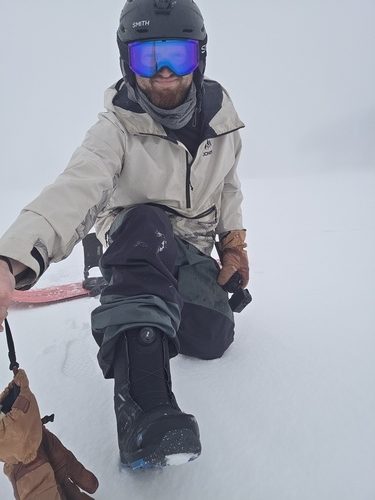
O.k. let’s take a more detailed look at what the Photon Boa are capable of.
Demo Info
Boots: Burton Photon Boa 2026
Size: 10 (US Men's Sizing)
Date: January 28, 2026 (plus were used as my control boots for 26/27 testing)
On-Snow Testing
Foot to Boot Fit
Felt just right to me, length-wise. My toes were able to just brush the ends but no more. Some minor pressure points, but no more than what I typically get from most boots when they're brand new. No major hot spots.
Boot to Binding Fit
They fit nicely in my control bindings and fit the same as my control boots - I didn't have to make any strap adjustments. See in-house testing for particulars.
Carving/Slow Speed Response
I found that they were better for carves than my control boots. They offered a bit more support, which made carves feel more secure at higher speeds and allowed me to get deeper into the carve.
Flex
They were a little stiffer than my control boots. Not quite enough to get them to a 7/10 but just a little stiffer than medium. Which is why I settled on 6.5/10 for these.
Heel Hold
Not the ultimate in heel hold, but really decent and as much as I like to have. I could have cranked them tighter for more heel hold.
But I like to have a little bit of room for movement and I don't like to crank too tight around the bottom half of my feet, as I feel like my feet start to cramp up when I do. But I found these were able to give good heel hold, even with a looser fit toward the toe end of the foot/boot.
Adjustability
They feature the standard double boa adjustability. The front boa to tighten the upper half of the boot and the side boa to tighten the lower half.
A couple of things I did notice.
a. They didn't take much to tighten, particularly the side boa - they don't "de-coil" that far compared to some boots, so tightening them was quicker than the average boa boots. But this somehow didn't make them difficult in terms of getting my feet into them.
b. The side boa only operates on the last (closest to the toes) two cables. The front boa controls the rest (4) of them, including the crossovers at the ankle. I liked this as it meant that I could keep the front end fairly loose, with the rest of the boot tighter.
And because the two cables at the toe end were a good distance from the ankle, it meant I didn't have to tighten the front of the boot to try to get more heel hold, because those cables didn't feel like they would affect the heel hold.
Comfort
Overall nice and comfortable. As mentioned above, some minor pressure points, but no more than you'd expect from a typical pair of boots when they're brand new.
Shock Absorption
They felt decent to me, when landing from ollies/jumps and for general chatter absorption but nothing amazing or anything. I would say a touch less shock absorbing than my control boots, but not far off.
Board Feel
Again, pretty decent without being amazing. Normal/average for this would be the best way to describe it.
Entry/Exit
For the liner, there were two velcro straps at the top of the liner and then a typical lacing harness. This felt familiar to operate and I felt I could get things as tight as I'd ever need to here. Didn't take too long. I mean, a touch more time having the velcro straps compared to those that don't but very little extra time. And I like the feel of that extra security at the tops of the shins.
Then the outer shell was a typical double boa system, with the two boas being independent of each other. As mentioned above in the adjustability section, the boas didn't seem to uncoil that much, so it was a little quicker than normal to get them tight.
This was particularly so with the side boa (which controls the two cables closest to the the toe end of the boot). I found I only needed to give it a quick crank and it was as tight as I wanted it (I do like that part of my boots to be looser fitting though, but even so they were very quick to get to a point of tightness.
Given that the boas didn't uncoil that much, you'd think it would be a tight squeeze to get your feet in. However, somehow, I found that it was easy to slip my feet into these boots.
In-House Testing
Test Setup: K2 Overdraft (control boot) on left foot), Burton Photon Boa (test boot) on right foot).
Note that the Photon Boa became my control boot after this.
Entry Exit
Getting Feet In
A little bit of a push to get feet in. But no more than the typical boot. I would say average in terms of getting feet into them.
Compared to the Overdraft a little more of a push needed, but my feet go into overdraft super easily.
Inner boot closure
Standard lacing harness with Velcro closures at the top of the liner. Simply pull them tight and slide the toggle down to lock the laces in. I find doing some extra short pulls, followed by sliding the toggle down a bit more, then repeating a few times helps to get them tighter than trying to do it all in one pull.
Nothing special here but works well and the lacing and toggle feel good quality.
Outer boot closure
Again very standard for double boa boots. The side boa operates the two boa cables (which are more like laces than cables – new England rope to be precise) closest to the toes. The front boa operates the remaining 4 cables (including the ones that cross over around the ankle area.
So, the lower shell and upper shell are fully independent of each other (no overlapping cable that’s controlled by either boa), which is good, so you can dial in the fit depending on how you like it and the shape of your foot. I personally like to leave the bottom two cables not too tight, but have a tighter fit around the ankle and shins.
Note that, like a vast majority of double boa boots, the front boa, which controls the upper part of the shell, is a self coiler, so you can just pop it out and it will coil up a certain amount of the way, saving you time and effort. Then you can just pop it back in and tighten it the rest of the way, to your liking.
I only mention this because I get quite a few people who try on the demo boots I sell who aren’t aware of this and start winding the boa without letting it do the self coil part.
Entry/Exit Ease & Quickness
Overall, nice and easy to get these boots ready for action. And pretty fast too.
For the liner you just need to do the Velcro parts, then tighten the liner. Then for the shell, the side boa only tends to take a few cranks before it’s tight enough. It starts pretty tight as it is. Then the front boa takes a little more time to get it dialled in, but once you let the self coiling happen, it’s pretty quick – and super easy.
Foot to Boot Fit
Overall, they fit nice and snug overall without being too tight or having any major pressure points or anything.
Length
My toes just brush the ends when standing in them normally and then pull back just slightly when bending my knees. This is usually a pretty good indication that they’re a really good fit.
Tops of toes
A good bit of wiggle room which I like. No pressure on the tops of my toes.
In-step Pressure
There’s a bit of a pressure point on my in-step. It’s nothing super uncomfortable or anything, but it’s the most noticeable area of discomfort for me in these boots. Slightly more pressure there vs my control boots but nothing that’s too concerning. And it’s typical for me to have a pressure point in that spot, particularly with new boots.
Wide or Narrow
My toes have plenty of room to the sides – they’re not being squished from the sides at all, which I like. Also no pressure on my fore-feet, but snug enough there. So, while I wouldn’t say they were wide (I have average width feet) I would say they are a little wider than the average boot – so I’d say normal bordering on mid-wide.
Ankle pressure
There’s a tiny bit of pressure there, but it’s minimal and I’m only noticing it when I really think about it. And it’s the same feeling on my control boot too.
True to size or Small or Large: I would say true to size on these. They feel just right in the 10 for me and 10 is my typical size.
Update
Update: Because these became my control boots for 2026-2027 testing, I’ve had a good number of days in them now. And they’ve held up to being true to size and still fit just right after breaking in. And still fit pretty much the same. Still a slight bit of instep pressure. But that’s reduced over time.
Bindings Fit
Heel width: Really nice fit in the heel of my control bindings. My control bindings are also Burton, so that’s no surprise. No issues having to squeeze them in – they go into the heel cup nice and easily but there’s also not too much space, so no danger of the heel being able to move around too much in there when riding.
Toe width: As is typical, there’s a bit more space at the front of the bindings. But nothing excessive. Average amount.
Ankle Strap: Fits over the boot nicely. A touch less bulky around the ankle area of the boot vs my control bindings.
Toe Strap: Again fits nicely and again a touch less bulky at toe than my control boots.
Adjustability
Upper lower separation: fully independent
Ease of tightening the inner boot: standard
Heel hold kit: no
Tongue stiffener removable: no
Arch support additions: no
Nothing special but just works well and nice and easy.
Flex
Feel a little bit stiffer than my control boots. A little less give in them. But not by a whole lot. On-Snow test needed in conjunction with this to get a full reading.
Heel Hold
Feels really good on first impressions. A touch better heel hold vs my control boots. Again, this needs to be on snow tested to get a full reading as well.
Shock Absorption
Again, this is predominantly determined on snow, but we do a stomp test in-house to get some initial indication.
Stomp Test: Vs my control boots they felt fairly similar and pretty good. A fairly dull thud on the floor, which is a good sign.
Traction/Sole Quality
The quality of the sole feels really good. Feels like a good percentage of the sole is rubber and feels grippy. And there’s a good variety of tread pattern and tred depth is medium/normal. It’s a Vibram sole, and they tend to make good soles and this one appears to be no exception.
Comfort
Apart from that in-step pressure, which isn’t terrible by any means, they are nice and comfortable all round.
Board Feel
Like a lot of things here, the on-snow test will be the real test, but looking at the sole and the feel of my feet in the boots, it should be decent.
The sole is flat across the bottom – no real arch to speak of – which tends to help with board feel in my experience. Flexing the boot, they also feel like they flex naturally.
Score Breakdown and Final Verdict
Check out the breakdown of the score in the table below.
| Factor | Rating (/5) | Weighted |
|---|---|---|
| Carving | 4 | 12/15 |
| Slow Speed Response | 4 | 8/10 |
| Heel Hold | 4 | 12/15 |
| Adjustability | 4 | 12/15 |
| Comfort | 4.5 | 13.5/15 |
| Shock Absorption | 3.5 | 10.5/15 |
| Traction | 3.5 | 7/10 |
| Reduced Footprint | 4.5 | 4.5/5 |
| TOTAL (after normalizing): | 86.4/100 |
Overall, the Burton Photon Boa came across as a really solid all-mountain boot with a supportive, slightly stiffer-than-medium flex. At around 6.5/10, it offered more carving support and high-speed security than a typical medium-flex boot, without feeling too stiff or overly demanding.
Heel hold was really decent, especially given that I didn’t feel the need to crank the lower boot overly tight, and the independent double BOA setup made it easy to dial in the fit how I wanted it.
Comfort was good overall, with only some minor pressure points typical of a new boot, and the fit felt true to size with a normal bordering on mid-wide width. Shock absorption and board feel were both decent, without being standout features.
Overall, the Photon Boa felt best suited to intermediate and up riders wanting a comfortable, supportive, easy-to-use boot for all-mountain riding, carving and riding at speed.
More Info, Current Prices and Where to Buy Online
If you’re interested in learning more about the Photon Boa, are ready to buy or want to research current prices and sizing availability, check out the links below.

If you want to see how the Photon Boa compared to other all-mountain boots, or want to check out some other options, check out the link below.

Leave a Reply