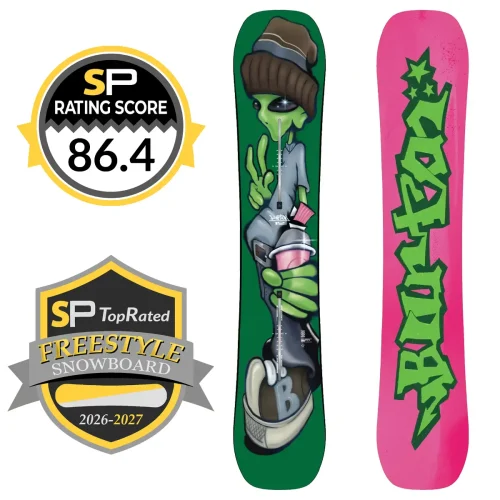
The Burton Good Company was really fun for getting airborne. Its pop was easy to access, spins came around comfortably and landings had a good mix of stability and forgiveness.
It wasn't completely loose or ultra soft, though. There was a little more of a locked-in feel than its flex might suggest, particularly on the first few turns. But once I got a feel for it, the softer flex, quick turning and easy pop made it a really enjoyable board for freestyle riding.
In this review, I will take a look at the Good Company as a freestyle snowboard.
As per tradition here at SnowboardingProfiles.com I will give the Good Company a score out of 100 (based on several factors) and see how it compares with other freestyle snowboards.
Overall Rating
Board: Burton Good Company 2027
Price: $449
Style: Freestyle
Flex Rating: Mid-Soft
Flex Feel on Snow: Mid-Soft (4/10)
Rating Score: 86.4/100
Compared to other Men's Freestyle Boards
Of the 27 current model freestyle snowboards that we tested:
❄️ The Good Company ranked 7th= out of 27
Overview of the Good Companyâ Specs
Check out the tables for the Good Company's specs and available sizes.
STYLE
Freestyle
PRICE
$449 - BUYING OPTIONS
Ability Level
flex
feel
DAMPNESS
SMOOTH /SNAPPY
Playful /aggressive
Edge-hold
camber profile

Traditional Camber
SHAPE
setback stance
Centered
BASE
SINTERED
weight
Camber Height
9mm
Sizing
LENGTH (cm) | Waist Width (mm) | Rec Rider Weight (lb) | Rec Rider Weight (kg) |
|---|---|---|---|
135 | 235 | 80-120 | 36-54 |
140 | 240 | 80-120 | 36-54 |
145 | 245 | 100-150 | 45-68 |
148 | 248 | 100-150 | 45-68 |
152 | 250 | 120-180 | 54-82 |
155 | 252 | 120-180 | 54-82 |
159 | 255 | 150-200 | 68-91 |
155W | 260 | 120-180 | 54-82 |
159W | 263 | 150-200 | 68-91 |
162W | 268 | 180-260+ | 82-118+ |
Who is the Good Company Most Suited To?
The Good Company is best suited to intermediate to expert riders who want a park-focused board, particularly for small to medium jumps, spins and switch riding. It's also a good option if you like taking that freestyle style outside the park, seeking out side hits and mixing some butters into your runs.
It can carve decently well at slower speeds, but I wouldn't choose it for high-speed carving, bombing or powder. If those are big parts of your riding, I see it working better as your park board alongside something more suited to freeriding.
For someone who mostly rides freestyle, it could be a daily driver.
The softer flex makes it manageable, but its full camber profile and some catch threat mean I wouldn't recommend it as a beginner board.
TEST/REVIEW DetailS FOR THE Good Company

O.k. let's take a more detailed look at what the Good Company is capable of.
Demo Info
Board: Burton Good Company 2027, 155cm (252mm waist width)
Date: February 13, 2026
First Impressions and Board Feel
I rode the 155 and in hand it felt similar in weight to my YES Greats (my control board), or perhaps a touch heavier. On snow, it felt like a normal weight and again pretty similar to my control board.
The first few turns felt a little less playful and more locked in than my control board. There was a mild tendency to want to return to a flat base if I didn't get enough weight onto the edge, but it wasn't a big issue.
I felt the flex at around 4 to 4.5/10. Noticeably softer than my control board. This was a brand-new board too, so I'd expect it to soften a little with more riding.
Overall, the feel sat somewhere between stable and semi-locked-in. It leaned toward playful without being ultra playful, and felt a little more playful than my control board overall, despite that initial impression.
It wasn't particularly damp. Not super chattery, but a little below average for dampness. There was a decent amount of snap, without it feeling ultra springy through turns or when popping.
Carving
The Good Company was really decent for slower-speed carves. For a softer, predominantly park board, it was fun to put it on an edge.
It had its limits when I pushed into higher-speed carves, though. It didn't hold on as well in that situation, and wasn't as good for carving as my control board overall. I preferred keeping the speed down a bit and mixing carves into a more playful run.
Turning
Ease of Turning and Slashing
Turn initiation and slashing were pretty easy. That initial feeling of it wanting to return to a flat base was mild, and didn't make the board difficult to turn. And it dissipated as I got used to how it rode.
It wasn't completely effortless, but I didn't need to put a lot into it to get it coming around.
Maneuverability at Slow Speeds
The Good Company was really nice for quick, sharp turns at slower speeds. It took a little input, but the effort was low and it changed direction quickly.
That was useful for lining up side hits and making tighter turns without needing to carry a lot of speed.
Catchiness
I initially thought it might be a little catchy, but it wasn't as catchy as those first few turns suggested. It wasn't catch-free, but the catch threat was decently low.
Speed
Stability at speed was decent enough for a softer 155, but it wasn't a strong point. It couldn't match my control board here, and I wouldn't choose it for spending the day riding fast.
Glide was pretty good overall. I rode it with the factory wax, so that was the setup for this impression.
Uneven Terrain
Crud and Chunder
The Good Company wasn't amazing in rough snow, but it held up pretty well for its flex. Not something I'd choose for charging through messy terrain, but it handled it decently well.
Trees and Moguls
The agility was really good for tighter terrain. Quick turns took little effort, so it was easy to maneuver in that situation.
The limitation is powder. That quick turning makes it appealing for trees and bumps when the snow isn't deep, but its float would hold it back in powder through trees.
Powder
The powder wasn't deep enough to cause a major problem, but the nose did go under sometimes when I found a slightly deeper section. It was shallow enough that I could ride through it, but I could see nose diving being an issue in deeper powder.
Its true twin shape and traditional camber profile suit freestyle much more than float. I wouldn't choose the Good Company, as your only board, if powder performance is important to you.
Jumps
Jumps were one of the Good Company's strongest qualities. Easy pop, good maneuverability on the approach and stable, forgiving landings made it really fun to get airborne.
For me, it was best suited to small to medium air, particularly when throwing rotations.
Pop
Pop was really easy to access. I didn't need a big effort to get it lifting off the snow, and it felt just as easy to pop as my control board.
There was a good amount of total pop too. A little more than my control board, which was a nice combination with how easily I could access it.
Approach
Approaches had a good balance of stability and maneuverability. I could feel secure coming in while still being able to adjust my line when I needed to.
That suited smaller and medium jumps well. For bigger jumps requiring more speed, I'd want something with more stability at speed.
Landings
Landings felt stable, but had a good amount of forgiveness too. I could get a solid landing without it feeling overly punishing when I didn't get things quite right.
Side Hits
The Good Company was really good for side hits. The quick turning made it easy to get lined up, the pop didn't need much effort and the landings felt dependable.
It was a fun board for finding opportunities to get airborne around the mountain, rather than needing to spend every run in the park.
Switch
Switch felt really good. Transitions were good too, and changing from nose first to tail first felt comfortable.
The true twin setup makes sense for this kind of riding, and switch was something I could happily make a regular part of a run.
Spins
Spins were another standout. The pop and swing weight felt good, and there was minimal catch threat on takeoff.
Landings felt stable, and I didn't notice it wanting to continue spinning after landing. Completing an under-rotation on the snow was easy too.
It was particularly fun for rotations off small to medium jumps. I liked being able to get it around without having to work hard, while still having that solid landing underneath me.
Butters
The nose and tail weren't ultra soft, but they were easy enough to press. I'd put them a touch softer and easier to press than my control board.
It didn't just fold into a press without any effort, but buttering was really enjoyable and fit well with its overall freestyle feel.
Jibbing
The Good Company was pretty good for jibbing. Not perfect, but certainly something I felt comfortable mixing into my park laps.
Edge Hold
Edge hold felt pretty decent without being amazing. I did wash out a couple of times when I hit icy patches underneath the snow.
I wouldn't call it a top choice for really icy conditions, but the grip was decent overall for the riding I was doing.
Score Breakdown and Final Verdict
Check out the breakdown of the score in the table below.
| FACTOR | Rating (/5) | Weighted |
|---|---|---|
| Jumps | 4.5 | 18/20 |
| Jibbing | 3.5 | 14/20 |
| Spins | 4.5 | 13.5/15 |
| Switch | 4.5 | 9/10 |
| Butters | 4.5 | 9/10 |
| Uneven Terrain | 3.5 | 3.5/5 |
| Pow | 2 | 2/5 |
| Speed | 3 | 3/5 |
| Carving | 3.5 | 3.5/5 |
| Turns | 4 | 4/5 |
| TOTAL (after normalizing): | 86.4/100 |
The Good Company was a really fun freestyle board, with easy pop, great switch performance and spins that came around comfortably. Small to medium jumps and side hits were where I enjoyed it most, and the softer flex made some buttering easy to mix in too.
It wasn't as strong for carving or speed as my control board, and powder was a clear limitation. But for a predominantly park board, it could still hold its own for slower carves and riding around the mountain.
If your priority is freestyle, the Good Company could make a really enjoyable daily driver. If you want more speed, carving or powder performance from the rest of your riding, I see it working well as the park and freestyle board in a quiver.
Current Availability/Buying Options
To learn more about the Good Company, or if you're ready to buy, or if you just want to research prices and availability, check out the links below.
Prices and availability can change. Please confirm size and stock with the retailer.US $439.95 US $307.97 US $439.95 US $307.97 US $449.95 US $314.97 US $439.95 US $351.96
To check out some other freestyle snowboard options, or to see how the Good Company compares to others, check out our top rated freestyle snowboards by clicking the button below.

Leave a Reply