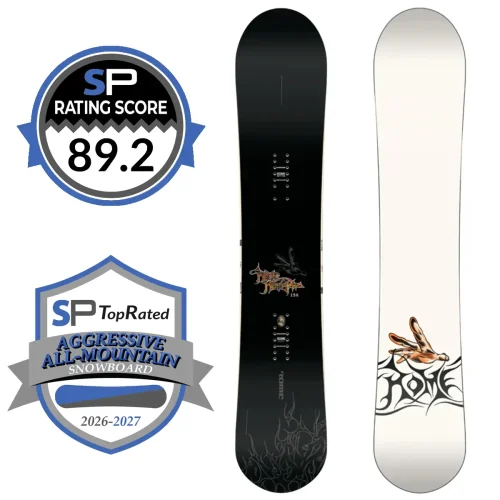
The Rome Rene Pro is a powerful, damp and stable aggressive all-mountain board that felt particularly strong for carving, riding at speed and charging through messy snow.
In this review, I will take a look at the Rene Pro as an aggressive all-mountain snowboard.
As per tradition here at SnowboardingProfiles.com I will give the Rene Pro a score out of 100 (based on several factors) and see how it compares with other aggressive all-mtn snowboard snowboards.
Overall Rating
Board: Rome Rene Pro 2027
Price: $649
Style: Aggressive All-Mountain
Flex Rating: Stiff (9/10)
Flex Feel on Snow: Stiff (8/10)
Rating Score: 89.2/100
The Rene Pro replaces the outgoing Rene-Gade in Rome’s 2026-2027 lineup. It felt very similar to the Rene-Gade, whereas the new ‘regular’ Rene offers a softer, more easygoing alternative.
While the regular Rene has a hybrid camber profile with rocker toward the tip and tail, the Rene Pro maintains the traditional full-camber profile and more powerful personality the Rene-Gade had.
The result was a board that preferred a stronger riding style and rewarded aggressive input, but the undersized 153 I tested was still more manageable than I had expected.
Compared to other Men’s Aggressive All-Mountain Boards
Of the 19 current model aggressive all-mtn snowboards that we tested:
❄️ The Rene Pro ranked 7th out of 19
Overview of the Rene Pro’S Specs
Check out the tables for the Rene Pro’s specs and available sizes.
STYLE
Aggressive All-Mountain
PRICE
$649 - BUYING OPTIONS
Ability Level
flex
feel
DAMPNESS
SMOOTH /SNAPPY
Playful /aggressive
Edge-hold
camber profile

Traditional Camber
Traditional Camber - Rome's "Stay Positive Camber"
SHAPE
setback stance
Centered
BASE
SINTERED - Rome's "SinterSpeed" Base
weight
Camber Height
11.5mm
Sizing
LENGTH (cm) | Waist Width (mm) | Rec Rider Weight (lb) | Rec Rider Weight (kg) |
|---|---|---|---|
153 | 253 | 118-158 | 54-72 |
156 | 255 | 130-170 | 59-77 |
159 | 257 | 142-182 | 64-83 |
157W | 266 | 148-188 | 67-85 |
160W | 267 | 160-200+ | 73-91+ |
Who is the Rene Pro Most Suited To?
The Rene Pro is best suited to advanced to expert riders who want a powerful all-mountain board for carving, speed, bigger jumps and something really stable and composed when riding through rough, chopped-up snow.
It has enough freestyle ability for spins, switch, side hits etc, but was something you need to commit on and not be hesitant. With a board this aggressive, it’s shouldn’t come as a surprise that I would choose it primarily for jibbing or relaxed, playful riding.
It could work well as a one-board quiver for a stronger rider who spent most of their time charging groomers, hitting natural features and riding the whole mountain.
Those looking for a mellower, easier-turning version would likely be better matched to the regular Rene.
Too stiff and aggressive for beginners and I’d avoid it as an intermediate rider too.
TEST/REVIEW DetailS FOR THE Rene Pro
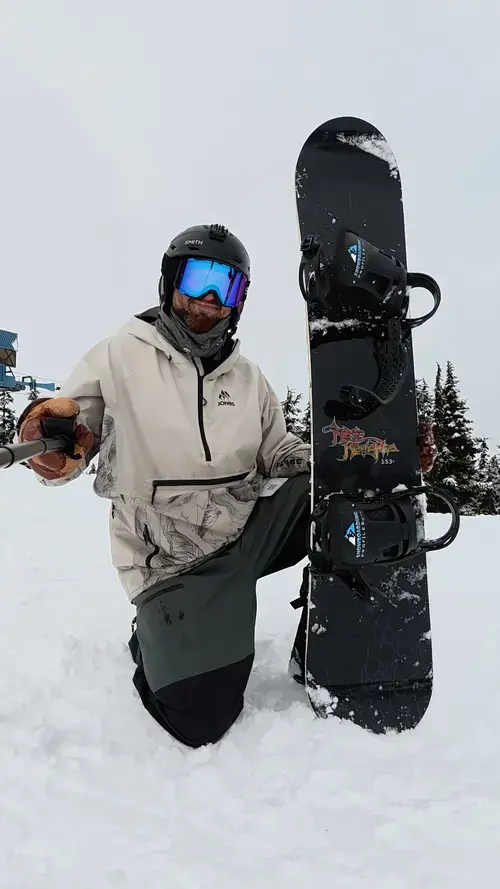
O.k. let’s take a more detailed look at what the Rene Pro is capable of.
Demo Info
Board: Rome Rene Pro 2027, 153cm (253mm waist width)
Date: April 1, 2026
First Impressions
The first thing I noticed was the Rene Pro’s torsional stiffness. It felt noticeably stiffer torsionally than my control board. The tip and tail flex was also stiffer, but not as drastically different.
It felt grippy through the wet, sticky snow lower down the mountain (when riding from carpark to get to Gondola).
I rode this in a 153, which is smaller than I’d typically ride. I’d usually ride this style of board anywhere from 156 to 159. So that made a noticeable difference to how it felt vs how it would have felt in a longer size. Throughout this review and for scoring, notes are made regarding the size and how I’d expect it to differ in a longer size.
Part of a smaller size is that they tend to feel (and be) lighter than their longer equivalents. In the 153, the Rene Pro felt a little lighter than my control board, both in hand and while riding. That wasn’t surprising given its shorter length, but the reduced swing weight helped make it much easier to throw around than I I’d expected.
Overall, it had a semi-locked-in feel that bordered on stable. In a longer size, I’d say it would move further toward the locked-in end of the scale.
Carving
Carving was one of the Rene Pro’s biggest strengths, unsurprisingly. Even in the smaller 153, I could really rail carves on it. It provided plenty of support through its carving arc and held on confidently when I applied more and more pressure.
It also carved surprisingly well through chopped-up conditions, which I had plenty of on the day. Where some boards might become unsettled or struggle to maintain a clean line, the Rene Pro remained composed and continued to track well.
It was a step up from my control board for carving, even though my control board was longer and already a decent carver. In a larger size, the Rene Pro would provide even more stability and power through longer, higher-speed carves.
Turning
Ease of Turning and Slashing
In the 153, the Rene Pro was relatively easy to initiate turns on. It still wasn’t effortless or anything but it wasn’t as demanding as I would normally expect from a stiff, full-camber board.
The shorter length played a large part in that. I could move it around without having to force it too much, but the longer sizes would require noticeably more effort, particularly when initiating short, sharp turns.
Slashes were manageable, though the board naturally preferred carving through a turn rather than casually releasing its edges.
Maneuverability at Slow Speeds
The Rene Pro was averagely agile for a 153. It responded quickly enough and didn’t feel cumbersome, but it wasn’t exceptionally nimble when judged purely against other boards of the same length.
Again, its size made it easier to ride slowly than a longer version would have been. The torsional stiffness would likely become more apparent in a larger size, requiring more deliberate edge pressure through trees, moguls and other tight terrain.
Catchiness
It wasn’t overly catchy, particularly considering the full-camber profile.
Transitions generally felt predictable, and I was confident moving from edge to edge. However, I did notice a little catch in the tail during some slower, short-radius turns.
It was nothing major in the 153, but I expected that catchiness to become a little more noticeable in a longer size. It wasn’t a board that severely punished every mistake, but it still preferred accurate technique and committed inputs.
Speed
The Rene Pro felt impressively stable at speed, especially given it was undersized for me. Most 153s would have started to feel nervous or unsettled when ridden faster, but the Rene Pro remained composed. Its stiffness and damp construction seemed to help keep everything calm and controlled.
It felt more stable than the majority of boards I’ve ridden in this length.
In a longer size, I speed would become an even greater strength. The board already felt stable and like it preferred an aggressive input, and giving it more effective edge and surface area, would make it even more hard charging.
Uneven Terrain
Crud and Chunder
The Rene Pro handled crud extremely well. Despite being a 153, it was more stable through messy snow than my longer control board. It stayed composed when riding through tracked-up and inconsistent conditions and didn’t get deflected as easily as its size suggested it should.
Its damp feel was noticeable here. There was some feedback through the board, but it absorbed vibrations well and didn’t become overly chattery.
A longer version would likely have been even more composed, making this a strong option for riders who regularly encounter afternoon chop and rough resort snow and want to crush through it, rather than try to navigate it.
Trees and Moguls
It performed better in trees and moguls than I had expected, though the shorter length was likely a significant part of that. The 153 was quick enough to redirect through tighter sections, but it still required a reasonably active riding style. I wouldn’t expect a longer version to feel as easy in slow, technical terrain.
The stiff torsional flex meant that sharper turns with more edge engagement required deliberate input. It could certainly handle trees and bumps, but it wouldn’t be my first choice for someone who prioritized effortless maneuverability.
Powder
I didn’t get enough deep powder to properly test the Rene Pro’s float. But based on specs and feel, I’d say it would be average at best in deeper fresh.
It felt fine in the shallow pow I found, but its full-camber, aggressive personality didn’t suggest that deep powder would be its strongest area.
Capable in moderate amounts of fresh snow, particularly with a good amount of speed under it, but riders who regularly chase deeper days would likely want something more directional and powder-focused – or have this as part of a quiver paired with a more powder oriented board.
Jumps
The Rene Pro was really solid for jumps. Its pop was relatively easy to access in the 153, and there was a good amount of total pop available once I loaded it up properly. A larger size would likely require more effort to flex, but it would probably also produce a little more total pop. Personally I found the amount of total pop in the 153 was plenty and would prefer the easier to access pop it produced over something with a bit more pop that was harder to access. This is one area I think I’d prefer the 153 over a longer size. And one of the reasons I feel like the 156, at the lower end of my range, rather than the 159, would be my choice for this particular board.
Approaches felt stable without being excessively difficult to adjust. That provided a good balance for lining up larger jumps and natural features.
Landings felt solid and supportive. The board’s dampness and stability helped it absorb impact, while the low-to-moderate level of catch made slightly imperfect landings manageable.
Switch
Switch riding felt better than I’d expected. I felt confident through transitions, and the board maintained a balanced feel between the nose and tail. They weren’t completely identical, but they were similar enough that riding it tail-first didn’t feel awkward.
There was a small amount of catch-risk, particularly in the tail, but it wasn’t anything that caused major problems – just couldn’t get too lazy or sloppy.
Spins
Spins were easy to initiate on the 153, partly because of its low swing weight. Getting the board around required very little effort.
I didn’t experience any major issues with spin-continuation after landing. Completing slightly under-rotated spins on the snow also felt manageable.
Taking off or landing switch felt solid, and the board provided a good platform without feeling excessively catchy.
The experience would likely be different in a longer size. The added swing weight and more aggressive feel would make rotations require more effort, though the additional stability would be good for landing larger tricks.
Ollies
The tip and tail required some input, but they weren’t excessively difficult to load. Once flexed, the board provided a satisfying amount of rebound and decent total pop.
A longer version would take more effort to initiate, particularly for lighter riders. However, it would likely reward that extra effort with more power.
Butters
The Rene Pro had a surprisingly decent amount of flex in its tip and tail. I found it easier to butter than its aggressive reputation might suggest, but again, the shorter length would have helped here – I find shorter boards are typically easier to butter with personally.
The tip and tail weren’t identical, but they felt reasonably similar and transitions through presses were predictable.
Torsionally, both ends felt much stiffer. That meant it didn’t have the loose, easy-twisting feel of a freestyle board, and a longer size would likely be significantly more demanding to press.
Jibs
Jibbing wasn’t a strength, even in the 153. The 153 made it less difficult than it would have been in a longer size, but the full camber, torsional stiffness and semi-locked-in personality weren’t ideal for rails and boxes.
Score Breakdown and Final Verdict
Check out the breakdown of the score in the table below.
| FACTOR | Rating (/5) | Weighted |
|---|---|---|
| Speed | 4.5 | 18/20 |
| Carving | 4.5 | 18/20 |
| Turns | 3 | 3/5 |
| Jumps | 4 | 12/15 |
| Powder | 2.5 | 5/10 |
| Crud | 4.5 | 9/10 |
| Trees | 3 | 3/5 |
| Switch | 3.5 | 7/10 |
| Spins | 3.5 | 3.5/5 |
| TOTAL (after normalizing): | 89.2/100 |
The Rome Rene Pro is an aggressive, stable and damp board that performs particularly well for carving, speed and riding through chopped up, messy snow, based on my time with it.
Testing the 153 showed me a more manageable and playful version of the board than I would likely have experienced in my usual size. It was easy enough to spin, butter and maneuver, while still maintaining impressive stability and edge hold.
However, even in the 153, I could feel that it preferred aggressive inputs. Its strong torsional flex, full-camber profile and solid feel meant it came alive most when I rode it with purpose.
In a longer size, I would expect it to become stiffer, smoother, more stable and more locked in - but also less agile and forgiving.
For strong riders who liked to carve hard, ride fast, hit bigger features and charge through rough snow, the Rene Pro offers a powerful and confidence-inspiring ride. It’s essentially the continuation of the Rene-Gade, with a new name, but in this case, that’s not a bad thing at all – as the Rene-Gade was a sick board for hard charging too. The regular Rene provides a mellower alternative for riders who want a similar concept with an easier going feel.
Current Availability/Buying Options
To learn more about the Rene Pro, or if you're ready to buy, or if you just want to research prices and availability, check out the links below.
Prices and availability can change. Please confirm size and stock with the retailer.US $649.95 US $617.45
To check out some other aggressive all-mtn snowboard options, or to see how the Rene Pro compares to others, check out our top rated aggressive all-mtn snowboards by clicking the button below.

Leave a Reply