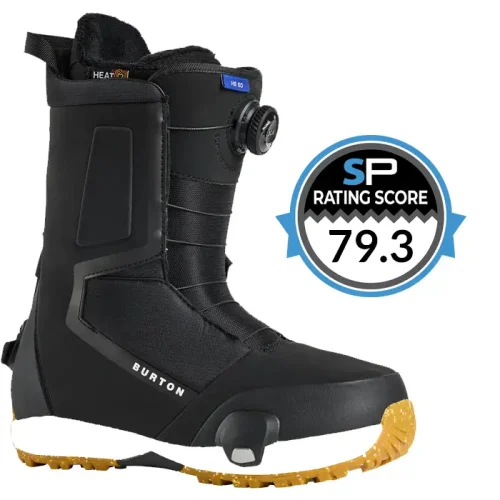
Compared to other boots I’ve tested, I found the Burton HighShot Step-On to be a stiffer, more locked-in feeling boot that performed best when carving, riding with a bit of speed and absorbing chatter/landings.
They weren’t quite as good for board feel or slower speed maneuverability, and the biggest thing that held them back for me was their lack of tongue articulation, which created a bit of pressure on the top of my foot when flexing into them as well as issues with feel.
In this review I will take a look at the Highshot Step On as all-mountain snowboard boots.
As per tradition here at SnowboardingProfiles.com I will give the Highshot Step On a score out of 100 (based on several factors) and see how they compare with other all-mountain boots.
Overall Rating
Boots: Burton Highshot Step On
Price: $379 (USD recommended retail)
Style: All-Mountain
Flex Rating: "Happy Medium"
Flex Feel: Mid-Stiff (7/10)
Rating Score: 79.3/100
Compared to other All-Mountain Boots
Of the 25 current model men's all-mountain snowboard boots that we tested:
❄️ The Highshot Step On ranked 23rd out of 25
Overview of the Highshot Step On’s Specs
Check out the tables for the Highshot Step On's specs and available sizes.
Specs
STYLE:
ALL-MOUNTAIN
PRICE:
$379
Ability Level:

flex:

weight:
Felt normal
LACING SYSTEM:
SINGLE Boa
Sizes
US MEN'S SIZE | UK SIZE | EURO SIZE | MONDOPOINT |
|---|---|---|---|
7 | 6 | 40 | 25 |
7.5 | 6.5 | 40.5 | 25.5 |
8 | 7 | 41 | 26 |
8.5 | 7.5 | 41.5 | 26.5 |
9 | 8 | 42 | 27 |
9.5 | 8.5 | 42.5 | 27.5 |
10 | 9 | 43 | 28 |
10.5 | 9.5 | 43.5 | 28.5 |
11 | 10 | 44 | 29 |
11.5 | 10.5 | 44.5 | 29.5 |
12 | 11 | 45 | 30 |
13 | 12 | 46 | 31 |
14 | 13 | 47 | 32 |
15 | 14 | 48 | 33 |
Who are the Highshot Step On Most Suited to?
The Burton HighShot Step-On are best suited to riders who want a mid-stiff Step-On boot that feels supportive, damp and strong on carves.
They’re a good match for riders who value heel hold, shock absorption and a locked-in feel over maximum board feel and playful flex. They’d work well for all-mountain riders who like to carve, ride with a bit of speed and want something more supportive than soft and forgiving.
They’re also a really good option for those worried about boot drag, because their reduced footprint is a big plus.
I wouldn’t put them high on the list for riders who prioritize tweakability, presses, butters or a really natural flexing feel. And if you’re sensitive to instep pressure, I’d be cautious, because of the tongue articulation issue I experienced.
For intermediate and up riders looking for a supportive Step-On boot, they’re worth considering. But for me, they were held back by that lack of articulation and lack of adjustability.
THE Highshot Step On IN MORE DETAIL
O.k. let’s take a more detailed look at what the Highshot Step On are capable of.
Demo Info
Boots: Burton Highshot Step On 2026
Size: 10 (US Men's Sizing)
Date: February 6, 2026
On-Snow Testing
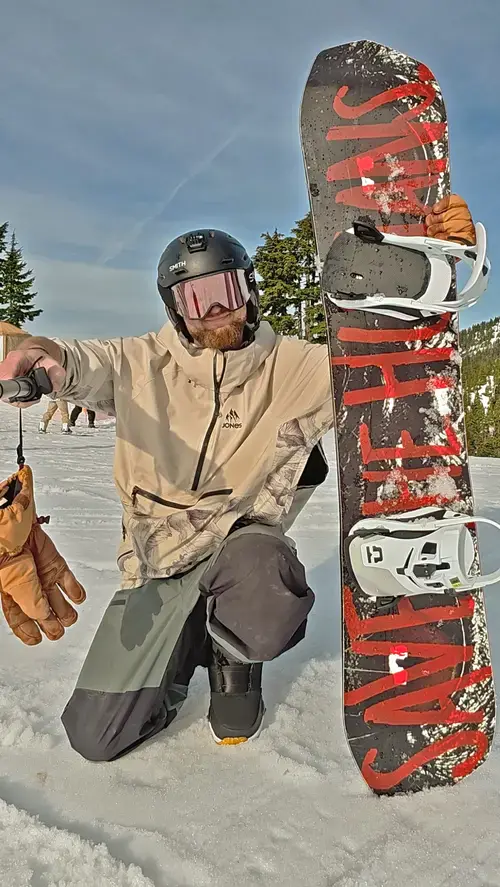
Testing Notes
With regular snowboard boot testing, I typically try to keep as many variables the same as possible. I ride my control setup first, then switch only the boots, so I can get a clearer idea of how much difference the test boots are making.
But testing Step-On boots are a little different. Because the HighShot Step-On had to be tested with Step-On bindings, I had to change both the boots and bindings from my control setup.
That makes this review a little less controlled than our regular snowboard boot reviews. It was harder to separate what was coming from the boots and what was coming from the bindings. And with Step-On, the boot/binding relationship is even more connected than normal anyway, because the boot locks directly into the binding at the heel and toes.
So, some of what I’m describing here is the feel of the overall HighShot Step-On setup, rather than being able to isolate the boots perfectly. But I also did some in-house comparisons against my control boots to help get a better feel for what the boots themselves were doing.
Fit
The HighShot Step-On fit me really well overall in a size 10.
Length
Length-wise, they were right where I like them. My toes were just brushing the end when standing upright, and then pulled back slightly when I bent my knees. So, in terms of length, they felt true to size and pretty much ideal for me.
Room around Toes
There was enough room over the tops of my toes and enough space around the sides of my toes that they didn’t feel like they were being squeezed together. This meant I was able to wiggle my toes, which I like to be able to do or else I feel too cramped and feel like I lose a bit of control.
Width
Around the widest part of my forefoot, they were snug but without pressure. No big gaps or sloppy feeling, but also no pinching.
Width-wise, I’d call them close to medium/average. Maybe very slightly wider than normal, but not what I’d call properly wide. In-house, compared to the Photon Boa, they felt just a touch narrower through the toes and forefoot, but not enough to cause any discomfort. The plusher feel helped to keep them comfortable too, despite being a little snugger.
Ankles
Around the ankles, they felt really good. Snug, but with the pressure spread out nicely. The liner had a plush feel to it, and around the ankles and calves they felt really comfortable.
In-Step
The one fit issue I had was over the top of the foot/in-step. When I was just standing in them, there was actually very little pressure there. Less than I felt with the Photon Boa. But once I bent into them, the tongue seemed to fold into a corner rather than flexing naturally. That corner pressed into the top of my foot, and that became uncomfortable.
Not deal-breaker uncomfortable, but definitely noticeable. And once I’d flexed into them and then stood upright again, some of that discomfort seemed to stick around.
Overall Fit
So overall, the fit was really good, but the tongue articulation issue stopped them from being top-tier comfortable for me.
Ease of Entry/Exit
Getting my feet into the HighShot Step-On boots was nice and easy.
They were slightly easier to get into than the Photon Boa, which itself doesn’t take much effort. Once my foot was in, they felt snug and secure, but not like I had to battle to get into them.
Liner Closure
The liner setup was pretty typical Burton. The inner harness felt very similar to the Photon Boa, with a liner lace and velcro closure at the top of the liner.
The liner tongue felt thicker and maybe a bit wider than the Photon Boa’s. That gave the boot a slightly plusher feel, but it also meant there was still a gap between the two sides that wrap around the tongue when I did the velcro up.
For me, that wasn’t an issue. It actually means those with skinnier calves should still be able to tighten them enough. But I could see riders with particularly big calves potentially finding that velcro closure a little more limited, though I think you’d need pretty large calves for that to become a real problem.
Shell Closure
The outer shell used a single Boa on the front of the boot. That made them quick and easy to tighten. Definitely simpler and a little faster than a dual Boa setup.
But the downside was adjustability. You don’t get independent upper and lower adjustment. Personally, I’d rather take a little longer getting them on and have the ability to fine-tune the upper and lower boot separately.
Adjustability
This was one of the weaker areas of the HighShot Step-On, in my opinion.
They had no upper/lower separation in the outer boot, which meant you couldn’t tighten the lower foot differently from the upper cuff. For some riders, that won’t matter much. But I like being able to dial those areas in separately.
The single Boa did make things easy, but it also made the boot feel less customizable.
For those who like a simple setup and don’t want to mess around too much, that could be a good thing. But for those who are fussy about boot fit, especially in terms of upper/lower tension, it’s a limitation.
Flex
I felt the HighShot Step-On at around a 7/10 flex.
They felt slightly stiffer than my control boots overall, though some of that may have been from them not being fully broken in. Some of it also seemed to come from the way the tongue flexed — or, more accurately, didn’t flex very naturally.
Because the tongue folded into more of a sharp corner rather than articulating smoothly, the boot felt stiffer when bending into it. So, the actual shell might not be massively stiff, but the overall feel was mid-stiff.
They weren’t ultra-aggressive, but they definitely leaned more supportive and locked-in than soft/playful.
Looking back at specs, it looks like Burton had them softer than the Photon on paper, at the time of writing, but that’s not how they felt to me in practice. In-house, and on snow, they felt a little stiffer than the Photon Boa.
Responsiveness
Slow Speed Agility
For slower speed riding, I found them good, but not amazing.
Edge-to-edge, they weren’t quite as quick or easy as my control setup. Not slow or sluggish, but they didn’t have that effortless slow-speed agility that you get from more medium flexing or more articulated boots.
Part of that was likely the Step-On setup as a whole. With Step-On, you feel more locked into the binding, and that can make things feel a little less free and surfy. But the boot stiffness and lack of articulation likely contributed as well.
Higher Speeds & Carving
At higher speeds and on carves, they were much more in their element.
Carving felt like one of their stronger areas. I rode them with both the Union Atlas Step-On and Union Atlas Pro Step-On. With the regular Atlas Step-On, carving was already better than my control setup. With the Atlas Pro Step-On, it stepped up again.
I’d say they felt around 4/5 for carving with the Atlas Step-On and around 4.5/5 with the Atlas Pro Step-On setup.
They supported deeper carves well and felt like they had good power and stability when leaning into turns.
Heel Hold
Heel hold was really good. It felt very similar to my control boots and was as much heel hold as I feel I need. In-house, when comparing one foot in the Photon Boa and the other in the HighShot Step-On, I’d say the HighShot was maybe just marginally better, but it was really close.
On snow, I had no real complaints. My heel felt secure and there wasn’t anything distracting going on there.
The Step-On setup naturally helps create a locked-in feel too, because the boot is physically locked into the binding at the heel and toes. But in terms of the boot itself, heel hold felt strong.
Board Feel
Board feel was not one of the HighShot Step-On’s stronger points.
Again, this is one of the hardest things to isolate with Step-On boots, because the boot and binding setup work so closely together. But overall, board feel felt more compromised than what I’m used to.
I found presses, ollies and general underfoot feel weren’t as natural or connected as with my control setup.
In-house, the sole didn’t feel like the most board-feel-friendly design either. There was a slight arch through the middle of the sole, and I tend to find flatter soles give better board feel. There also wasn’t much tread through the middle of the foot, so the feel underfoot wasn’t super consistent front-to-back.
Add in the lack of tongue articulation and the fact that Step-On boots lock into the highback, and it wasn’t surprising that board feel wasn’t a standout.
Shock Absorption
Shock absorption was one of the HighShot Step-On’s better areas.
On snow, the overall setup absorbed shock similarly to my control setup. But based on my experience with the non-Step-On Atlas and Atlas Pro bindings, which tend to be less shock absorbing than my control bindings, I suspect the boots themselves were actually doing a good amount of work here.
So, my educated guess is that the HighShot Step-On boots were more shock absorbing than my control boots, and that helped balance out the overall setup.
That was backed up by the in-house stomp test too. Compared to the Photon Boa, the HighShot felt a little damper. Not by a massive amount, but enough to notice.
Comfort
Comfort was a bit of a mixed bag. In a lot of ways, they were really comfortable. The liner felt plush, the ankle area felt great and the toe/forefoot fit was snug but with enough space and no pinching or crushing.
But the tongue folding issue took them down a notch. When I bent into them, that sharper corner pressing into the top of my foot became uncomfortable. It wasn’t enough to make me want to stop riding them, but it was enough that I kept noticing it.
Without that issue, they could have been right up there for comfort. With it, I’d still call them comfortable overall, but not top-tier comfortable for my feet.
It’s possible that would improve as they broke in more. But because the Photon Boa had better articulation straight out of the box, I wouldn’t expect the HighShot to fully catch up there, even after some break-in time.
Traction/Sole Quality
The sole seemed decent overall, but not super high-end. The tan and black areas felt like rubber, but the white areas, including some of the protruding grip sections, didn’t feel like rubber to me.
Tread depth was pretty normal and the pattern had decent variety. I wouldn’t call it bad by any means, but also wouldn’t call the soles premium.
Reduced Footprint
One really strong area for the HighShot Step-On was footprint reduction. They had a really small footprint.
That’s a big plus if you’re worried about boot drag. If you’re on the edge between needing a wide board and being able to ride a regular width board, boots like these can help you get away with the narrower option.
For riders with bigger feet, this could be a big selling point for these boots.
Score Breakdown and Final Verdict
Check out the breakdown of the score in the table below.
| Factor | Rating (/5) | Weighted |
|---|---|---|
| Carving | 4 | 12/15 |
| Slow Speed Response | 3.5 | 7/10 |
| Heel Hold | 4 | 12/15 |
| Adjustability | 2 | 6/15 |
| Comfort | 4 | 12/15 |
| Shock Absorption | 4 | 12/15 |
| Traction | 3.5 | 7/10 |
| Reduced Footprint | 5 | 5/5 |
| TOTAL (after normalizing): | 79.3/100 |
Overall, the Burton HighShot Step-On felt like a solid option but with enough issues, that I would step up to the X version or go Photon Step On if you can wing the extra dollars.
Their strongest areas were carving, heel hold, shock absorption and reduced footprint. They felt supportive, damp and locked-in, and they worked best when riding faster, laying into carves and wanting a more powerful setup.
They weren’t as strong for board feel or slow speed agility, and I didn’t love the lack of independent upper/lower adjustability.
But the biggest issue for me was the lack of articulation through the tongue. They had a plush, comfortable liner and a really good fit overall, but that folding tongue created pressure on the top of my foot and stopped them from being as comfortable as they otherwise could have been.
More Info, Current Prices and Where to Buy Online
If you’re interested in learning more about the Highshot Step On, are ready to buy or want to research current prices and sizing availability, check out the links below.
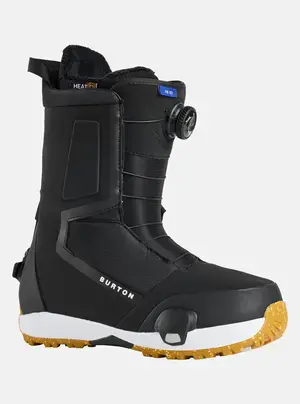
If you want to see how the Highshot Step On compared to other all-mountain boots, or want to check out some other options, check out the link below.

Leave a Reply