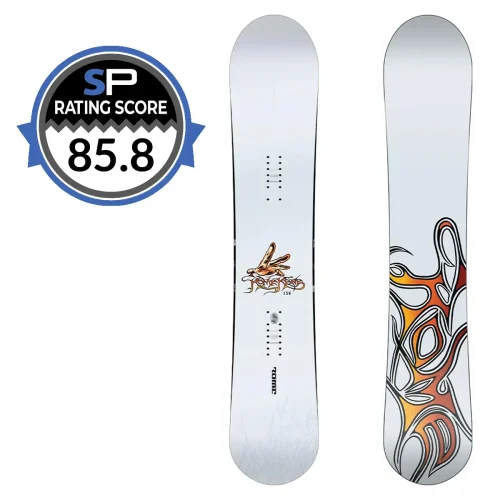
The Rome Rene felt like a mellower, more approachable version of the outgoing Rene-Gade. It still had plenty of aggression in it and responded best when I rode it with some intent, but it wasn’t as stiff, demanding or locked-in as the Rene Pro.
For Rome’s 2026-2027 lineup, the old Rene-Gade concept had effectively been divided into two boards. The Rene Pro felt like a direct replacement for the Rene-Gade, while the regular Rene felt more forgiving.
In this review, I will take a look at the Rene as an aggressive all-mountain snowboard.
As per tradition here at SnowboardingProfiles.com I will give the Rene a score out of 100 (based on several factors) and see how it compares with other aggressive all-mtn snowboard snowboards.
Overall Rating
Board: Rome Rene 2027
Price: $569
Style: Aggressive All-Mountain
Flex Rating: Mid-Stiff (7/10)
Flex Feel on Snow: Mid-Stiff (7/10)
Rating Score: 85.8/100
Compared to other Men’s Aggressive All-Mountain Boards
Of the 19 current model aggressive all-mtn snowboards that we tested:
❄️ The Rene ranked 11th out of 19
Overview of the Rene’S Specs
Check out the tables for the Rene’s specs and available sizes.
STYLE
Semi-Aggressive All-Mountain
PRICE
$569 - BUYING OPTIONS
Ability Level
flex
feel
DAMPNESS
SMOOTH /SNAPPY
Playful /aggressive
Edge-hold
camber profile
HYBRID CAMBER
HYBRID CAMBer - Rome's "Fusion Camber". Predominantly camber. Small rocker sections.
SHAPE
setback stance
Centered (0mm)
BASE
SINTERED - Rome's "SinterStrong" Base
weight
Camber Height
8mm
Sizing
LENGTH (cm) | Waist Width (mm) | Rec Rider Weight (lb) | Rec Rider Weight (kg) |
|---|---|---|---|
153 | 253 | 118-158 | 54-72 |
156 | 255 | 130-170 | 59-77 |
159 | 257 | 142-182 | 64-83 |
157W | 266 | 148-188 | 67-85 |
160W | 267 | 160-200+ | 73-91+ |
Who is the Rene Most Suited To?
The Rene is best suited to strong intermediate to advanced riders who want a board that can carve well, handle speed, hit jumps and remain composed in rough snow, but who isn’t after something quite as stiff or demanding as the Rene Pro.
It still felt more aggressive than playful and preferred being ridden with a bit of commitment. However, it was considerably more manageable than the outgoing Rene-Gade and felt less punishing when I wasn’t riding at full throttle.
It could work well as a one-board quiver for someone who spends most of their time riding the whole mountain but still want to hit jumps, side hits and drop into the park for an occasional park lap. I wouldn’t choose it primarily for jibbing, super-relaxed cruising or low-effort buttering.
Not suitable for beginners or low intermediate riders, IMO.
TEST/REVIEW DetailS FOR THE Rene

O.k. let’s take a more detailed look at what the Rene is capable of.
Demo Info
Board: Rome Rene 2027, 156cm (255mm waist width)
Date: April 1, 2026
First Impressions
My first impression was that the Rene felt noticeably less locked-in and more easy-going than the Rene Pro. It felt less stiff and less demanding, with an easier to manipulate flex, both torsionally and longitudinally.
In hand, it felt very similar in weight to the Rene Pro, perhaps marginally heavier. On snow, it also felt pretty similar, with a weight feel that was around the mid-range/normal feeling.
It immediately and obviously came across as the more accessible of the two Rene models.
Flex
I felt the flex at around a 6.5 out of 10. It was still a reasonably powerful board, but, as I’ve mentioned, it felt more mellow than the old Rene-Gade and the 2027 Rene-Pro (which are pretty much one in the same).
That applied both torsionally and when flexing it nose to tail. It still had enough backbone to ride aggressively and stay composed, but it didn’t feel like it constantly demanded maximum input.
Carving
Carving was one of the Rene’s stronger areas. It wasn’t quite as powerful or locked-in on edge as the Rene Pro, but it still held a carve confidently.
I could put a good amount of onto the edges without it folding or feeling unstable. The slightly mellower flex, which makes it easier to manage for more casual turns and slower speed riding, meant it sacrificed a little of the Rene Pro’s power and precision in return.
For riders who want good carving performance without having to wrestle with an especially stiff board, I thought the balance worked well.
Turning
Ease of Turning and Slashing
The Rene was reasonably easy to initiate turns on. Certainly not an ultra-loose or surfy board, but I didn’t have to fight it to start a turn or release the tail into a quick slash.
Maneuverability at Slower Speeds
Slow-speed maneuverability was also pretty good for a board with this much stability. It wasn’t effortless, but it was manageable enough in tighter areas and didn’t require me to keep higher speeds to make it respond without forcing it.
Catchiness
There was some consequence there, but the Rene never felt excessively catchy.
Transitions felt fine - I didn’t experience any major issues when moving between edges. The hybrid camber profile helped keep it from feeling as locked-in as the Rene Pro/old Rene-Gade, which helped to reduce catch-risk.
Speed
The Rene felt stable at speed and handled faster riding well. Not as composed at speed as the Rene Pro,naturally, and I wouldn’t describe it at a full-on straight-line missile, but it had enough composure for really decent stability at speed for bombing and for larger jumps.
Edge Hold
Edge hold was really solid in harder and icier patches. It felt very similar to my control board and gave me enough grip to ride confidently in the conditions I encountered. The Rene Pro had a little more bite and security, but the regular Rene still performed well.
I wouldn’t necessarily call its edge hold top tierr, but it was dependable and suitable for the kind of aggressive all-mountain riding the board was designed for.
Uneven Terrain
Crud and Chunder
The Rene handled chopped-up snow well, too. It was more stable through crud than my control board, and its damper-than-average construction helped reduce how much chatter transferred through to my feet.
It wasn’t quite as powerful or composed as the Rene Pro, of course, but it still did a good job of holding its line and avoiding being thrown around too easily.
Trees and Moguls
I found it decent through trees and bumps. The combination of decent maneuverability and reliable edge hold meant I could make quick adjustments without the board feeling nervous and without feeling like I had to use too much energy to do it.
It wouldn’t be my first choice for spending all day in tight trees, but it was capable enough that trees and moguls didn’t feel like a significant weakness or a chore or anything.
Powder
I only had shallow powder during the test, and the Rene felt fine in what was available.
Its hybrid camber profile had rocker zones towards the nose and tail, which should have given it a little more assistance in powder than the full-camber Rene Pro.
However, while its directional-twin shape helps a little more than a true twin, it’s still not a particularly powder-focused design. I’d expect it to handle occasional deeper snow better than the Rene Pro. Better than a freestyle focused board, but nothing nearing high-end powder performance either, IMO.
Jumps
The Rene was a really solid all-round jump board. It offered a good balance between pop, stability, maneuverability and forgiveness. There was enough stability for confident approaches and landings, but it wasn’t so locked-in that making adjustments or correcting mistakes became difficult.
The pop wasn’t completely effortless to access, but it didn’t require excessive work either. Once I put enough energy into it, the total pop was good.
It also worked well on side hits. The combination of accessible-enough pop and a reasonably forgiving feel made it easy to have fun without removing the support needed for larger features.
Ollies and Butters
Ollies weren’t effortless, but the amount of effort needed certainly wasn’t huge. There was good pop available once I loaded it properly, but it wasn’t the kind of board that launched me with almost no input.
Butters and presses were similar. They required a bit of effort, and the Rene wasn’t as easy to press as my control board but it was still workable and noticeably less demanding than I felt from the old Rene-Gade.
Switch and Spins
The Rene rode switch well overall. The longer nose meant it didn’t feel perfectly symmetrical, but really close. Transitions weren’t effortless but they were smooth enough and it didn’t feel awkward once I was riding tail first.
Spins were also solid. Swing weight wasn’t a problem, and I didn’t have issues with the board wanting to continue rotating after landing. When I landed slightly under-rotated, it was easy enough to finish the spin on the snow, though some concentration was needed there.
The reasonably accessible pop and relatively low catch risk also helped make spinning feel predictable and nothing that felt like you had to put in too much effort – and there was enough solidity there to handle larger air tricks too.
Jibbing
The Rene was a little better on jibs than the Rene Pro, but it still wasn’t a board I would choose for regular laps down the jib line.
It had enough forgiveness to hit occasional boxes or rails, but its overall personality remained too aggressive and performance-focused to make jibbing a major strength, IMO.
Overall Feel
The Rene felt stable, bordering on semi-locked-in, but it sat further from the locked-in side than the Rene Pro.
It felt damper than my control board and damper than the average board, but it didn’t mute rough snow quite as effectively as the Rene Pro.
Its personality leaned more smooth than snappy, but there was still enough snap to keep it feeling energetic. It responded best to with a little more of an aggressive approach, just not to the same extent as the Pro and wasn’t something that needed super high energy input to feel responsive.
Score Breakdown and Final Verdict
Check out the breakdown of the score in the table below.
| FACTOR | Rating (/5) | Weighted |
|---|---|---|
| Speed | 4 | 16/20 |
| Carving | 4 | 16/20 |
| Turns | 3.5 | 3.5/5 |
| Jumps | 4 | 12/15 |
| Powder | 3 | 6/10 |
| Crud | 4 | 8/10 |
| Trees | 3.5 | 3.5/5 |
| Switch | 3.5 | 7/10 |
| Spins | 3.5 | 3.5/5 |
| TOTAL (after normalizing): | 85.8/100 |
Based on my experience with the two boards, the Rene Pro felt pretty much like a replacement for the old Rene-Gade (which its specs seem to confirm). The regular Rene felt more like a mellowed-out alternative.
It retained a lot, but of course not all, of the stability, carving ability, jump performance and all-mountain capability of the more aggressive model, but packaged those qualities in a board that was easier to turn, less locked-in and more forgiving.
But still not a particularly playful or beginner-friendly board. But for someone who wants to ride on the more aggresse side without committing to the stiffness and intensity of something like the Rene Pro, I thought the Rene struck a nice balance.
More Info, Current Prices and Where to Buy Online
To learn more about the Rene, or if you're ready to buy, or if you just want to research prices and availability, check out the links below.

Prices and availability can change. Please confirm size and stock with the retailer.US $569.95 US $541.45
To check out some other aggressive all-mtn snowboard options, or to see how the Rene compares to others, check out our top rated aggressive all-mtn snowboards by clicking the button below.

Leave a Reply