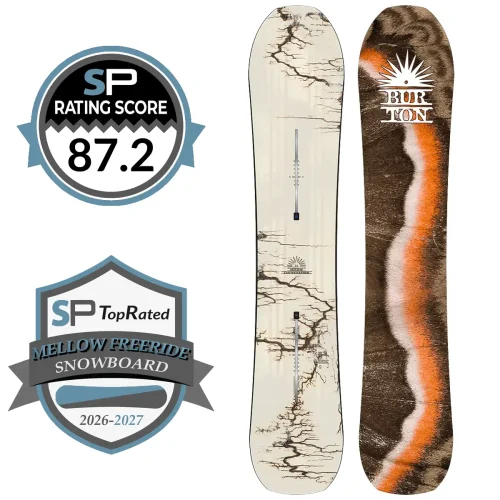
I found the Burton Cartographer to be a mellow, easygoing freeride board that was quick and uncomplicated to turn but still provided enough stability and edge hold for riding at decent speed.
It wasn’t a hard-charging freeride deck, and it didn’t offer the same carving power or high-speed composure as the Burton Full Nelson, which I tested on the same day. But it was much less demanding, more maneuverable and more forgiving.
That combination made it particularly well suited to trees, slower-speed riding and riders who want some directional freeride performance without having to aggressively drive their board all day.
In this review, I will take a look at the Cartographer as a mellow freeride snowboard.
As per tradition here at SnowboardingProfiles.com I will give the Cartographer a score out of 100 (based on several factors) and see how it compares with other mellow freeride snowboards.
Overall Rating
Board: Burton Cartographer 2027
Price: $529
Style: Mellow Freeride
Flex Rating: Medium
Flex Feel on Snow: Medium (5.5/10)
Rating Score: 87.2/100
Compared to other Men’s Mellow Freeride Boards
Of the 28 current model mellow freeride snowboards that we tested:
❄️ The Cartographer ranked 10th= out of 28
Overview of the Cartographer'S Specs
Check out the tables for the Cartographer's specs and available sizes.
STYLE
Mellow Freeride
PRICE
$529 - BUYING OPTIONS
Ability Level
flex
feel
DAMPNESS
SMOOTH /SNAPPY
Playful /aggressive
Edge-hold
camber profile

Directional Hybrid Camber
Directional Hybrid CAMBer - Burton's "Directional Camber".
SHAPE
TAPERED DIRECTIONAL (5mm taper)
setback stance
Setback 1" (25mm)
BASE
SINTERED - Burton's "Sintered".
weight
Camber Height
7.5mm
Sizing
LENGTH (cm) | Waist Width (mm) | Rec Rider Weight (lb) | Rec Rider Weight (kg) |
|---|---|---|---|
144 | 245 | 100-150 | 45-68 |
149 | 250 | 100-150 | 45-68 |
154 | 255 | 120-180 | 54-82 |
159 | 258 | 150-200 | 68-91 |
162 | 260 | 180-260+ | 82-118+ |
154W | 263 | 120-180 | 54-82 |
159W | 266 | 150-200 | 68-91 |
Who is the Cartographer Most Suited To?
The Cartographer is best suited to intermediate and up riders looking for an easygoing, directional board for trees, powder, groomer cruising and general resort riding.
It worked particularly well for someone who values maneuverability more than outright stability. It was quick and effortless through tighter areas, but it still felt stable enough that I could open it up to moderately high speeds without it becoming nervous.
Still, it wouldn’t be my first choice for someone who wanted to charge hard, bomb at maximum speed or lay down really aggressive carves.
But the Cartographer took little effort to ride and was forgiving and responded well without having to ride it aggressively. It struck a nice balance between directional freeride performance and everyday accessibility.
TEST/REVIEW DetailS FOR THE Cartographer
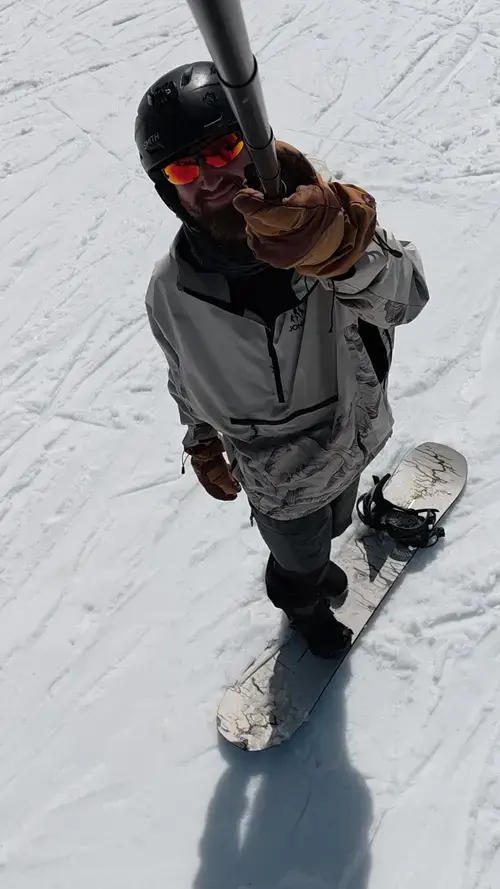
O.k. let’s take a more detailed look at what the Cartographer is capable of.
Demo Info
Board: Burton Cartographer 2027, 154cm (255mm waist width)
Date: April 10, 2026
Board Feel
The Cartographer felt like a normal-weight board, both when I picked it up and while I was riding it. It didn’t have an ultra-light or particularly heavy feel, and its swing weight was never something I noticed in a negative way.
Overall, it had a stable feel. It wasn’t overly locked-in or demanding but it also wasn’t loose feeling. I wouldn’t call it a particularly playful board, but it was fairly easygoing and didn’t need much aggression from me to perform well.
I’d say it sits somewhere around the middle of the playful-to-aggressive scale. There was enough structure to keep it composed, but it wasn’t the type of board that constantly wanted to be ridden hard.
Flex
I felt the Cartographer at around a 5/10 flex. It was noticeably softer than the Full Nelson and felt a little softer than my control board too.
However, the 154 was smaller than the size I would normally choose for this board. I would most likely have ridden the 159 as my regular size, and I imagined that size would have felt closer to a 5.5 or 6 out of 10.
The softer torsional flex played a big role in how easily the Cartographer turned. I didn’t have to put much effort into twisting the board or moving it from one edge to the other, particularly at slower speeds.
Turning
Ease of Turning and Slashing
The Cartographer was nice and easy to initiate turns on. It responded quickly to relatively light inputs and never made me work particularly hard to get it onto an edge.
Because of the amount of camber in its profile, slashing the tail didn’t feel quite as effortless or naturally loose as it would have on a board with more rocker through the back end. But it was still fairly easy to release the tail when I wanted to.
That relatively soft torsional flex helped considerably and stopped the camber-dominant profile from feeling overly demanding.
Maneuverability at Slow Speeds
Slow-speed maneuverability was one of the Cartographer’s strongest attributes.
It felt quick edge to edge and required very little effort to make short, tight turns. The fact that I was riding the 154 certainly helped, but I still expect it would remain quick and agile in the 159.
That easy maneuverability made it a board I could ride casually without needing to maintain a lot of speed to make it feel good.
Catchiness
Despite having plenty of camber and no rocker through the tail, the Cartographer wasn’t particularly catchy.
I could feel a small amount of catch potential when I deliberately searched for it, but during normal riding it was quite forgiving. Transitions felt easy, and I didn’t feel like I needed to remain completely switched on at every moment to avoid catching an edge.
Carving
The Cartographer was decent on a carve, but this was one area where it fell noticeably short of the Full Nelson.
Its camber-dominant profile gave it enough support to hold a respectable carve at moderate speeds, and it didn’t feel washy or lacking in grip. But it wasn’t especially powerful, and it didn’t have the same confidence when I tried to really drive through a deeper, higher-speed carve.
It was much happier making relaxed or moderately aggressive turns than being pushed to its limit.
High speed/aggressive carves was where the softer torsional flex went against it, rather than for it.
Speed
The Cartographer remained decently stable when I picked up speed, but it wasn’t a speed demon.
It handled moderately high speeds without any major issues and felt a little damper than the average board. However, it didn’t have the same composed and planted feel as the Full Nelson when things got faster.
There was a bit of chatter, but not enough to make it feel nervous or unpleasant. It simply had a clear speed limit beyond which it stopped feeling as comfortable.
Uneven Terrain
Crud and Chunder
The Cartographer handled crud reasonably well.
It wasn’t as stable or powerful through chopped-up snow as the Full Nelson, and it could be knocked around when the terrain became particularly rough. But it remained easy to redirect, so correcting my line after being bounced around didn’t require much effort.
Its slightly damper-than-average feel also helped keep vibrations from becoming too harsh.
Trees and Moguls
Trees were one of the best places to ride the Cartographer.
Its quick edge-to-edge response and low-effort turning made it easy to change direction in confined spaces. I could focus on choosing my line rather than having to muscle the board through every turn.
Its directional shape and powder-friendly profile should also make it a good option for deeper days in the trees, where maneuverability and float need to work together.
Powder
I didn’t get the opportunity to properly test the Cartographer in deep powder, but its specifications suggest it should perform well.
It has a directional camber profile with rocker towards the nose, a longer nose than tail, a setback stance and a modest amount of taper. Combined with its directional flex and shorter tail, those features should help the nose stay up and help make the board easier to steer through deeper snow.
Not what I’d call an extreme powder specialist, but I expect it would provide good float for a board that still feels versatile and comfortable on groomers.
Jumps
The Cartographer was a surprisingly capable board for jumps and side hits.
Its pop was easy to access, and the total amount of pop was pretty decent too. It was noticeably easier to ollie than the Full Nelson and probably a little easier than my control board even.
It offered a good balance of maneuverability and stability on the approach. Landings felt stable enough to inspire confidence but still had enough forgiveness to deal with small mistakes.
Overall, it worked well for side hits and small-to-medium jumps. Its directional shape meant it wasn’t the most natural option for freestyle-focused riding, but for adding some airtime into a freeride lap, it did a good job.
Switch
The Cartographer’s transitions into switch were easy and relatively catch-free, but once I was riding tail-first its directional nature became pretty obvious.
The shorter, slightly stiffer tail felt noticeably different when it was leading. The taper, directional camber and uneven nose and tail lengths also made switch feel less natural than it would have on a twin or directional twin.
It was manageable for short periods, but it wasn’t a board I would choose if riding switch regularly was a major priority.
Spins
The Cartographer was easy enough to spin, and its swing weight felt normal and well balanced.
Setups were uncomplicated, and I didn’t experience any tendency towards spin continuation after landing. It was also easy to make small corrections when I landed slightly under-rotated.
Its biggest limitation was its directional shape. Spins that involved taking off or landing switch didn’t feel as natural.
Butters
The nose and tail were both reasonably easy to press, and buttering was noticeably easier than it had been on the Full Nelson.
The overall difficulty was similar to my control board, though the nose and tail felt clearly different from one another. The shorter, slightly stiffer tail required a different input than the longer nose.
Transitions between presses felt easy and didn’t come with much catch risk. It wasn’t a dedicated butter board, but it was more accommodating than I would have thought.
Score Breakdown and Final Verdict
Check out the breakdown of the score in the table below.
| FACTOR | Rating (/5) | Weighted |
|---|---|---|
| Powder | 4.5 | 27/30 |
| Turns | 4 | 12/15 |
| Carving | 3.5 | 7/10 |
| Trees | 4 | 12/15 |
| Crud | 3.5 | 7/10 |
| Speed | 3.5 | 7/10 |
| Jumps | 4 | 4/5 |
| Switch | 2.5 | 2.5/5 |
| TOTAL (after normalizing): | 87.2/100 |
The Burton Cartographer had a mellow, uncomplicated personality that made it easy to get along with.
It didn’t have the carving power, crud-destroying ability or high-speed stability of the Full Nelson, but it was more maneuverable, more forgiving and noticeably easier to ride.
Its strongest areas were tight turns, trees, straight air side hits and general resort cruising. It should also offer good powder performance thanks to its directional profile and shape.
Overall, it’s a versatile mellow freeride board for riders who want a directional ride without the demanding personality that often comes with more aggressive freeride boards. It offered enough performance to keep things interesting, but it didn’t require me to charge hard to get the best out of it.
More Info, Current Prices and Where to Buy Online
To learn more about the Cartographer, or if you're ready to buy, or if you just want to research prices and availability, check out the links below.
To check out some other mellow freeride snowboard options, or to see how the Cartographer compares to others, check out our top rated mellow freeride snowboards by clicking the button below.

Leave a Reply