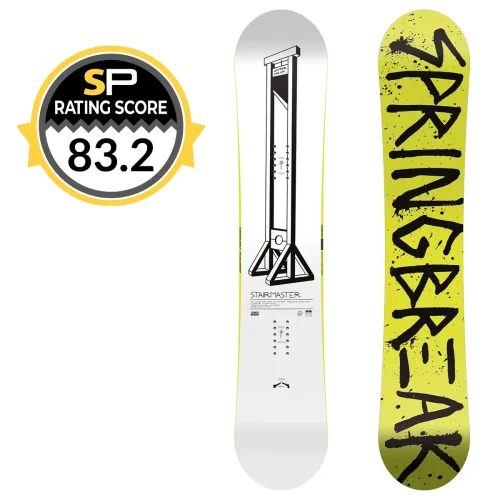
After riding the CAPiTA Spring Break Stairmaster, I came away feeling like it was a balanced, dependable freestyle board that did pretty much everything well without being especially exciting or explosive.
Compared with the Sidewinder, which I rode on the same day, the Stairmaster felt a little heavier (strangely, given how light it came up on the scales!), more stable and more predictable. But it also had less snap and didn’t feel quite as playful or lively.
It sat right around the middle of the playful-to-aggressive scale and had a fairly neutral personality overall. It wasn’t a loose, buttery noodle, but it wasn’t a demanding, hard-charging beast either.
In this review, I will take a look at the Stairmaster as a freestyle snowboard.
As per tradition here at SnowboardingProfiles.com I will give the Stairmaster a score out of 100 (based on several factors) and see how it compares with other freestyle snowboards.
Overall Rating
Board: Capita Spring Break Stairmaster 2027
Price: $479
Style: Freestyle
Flex Rating: Medium (5.5/10)
Flex Feel on Snow: Medium (5/10)
Rating Score: 83.2/100
Compared to other Men’s Freestyle Boards
Of the 28 current model freestyle snowboards that we tested:
❄️ The Stairmaster ranked 18th out of 28
Overview of the Stairmaster’ Specs
Check out the tables for the Stairmaster’s specs and available sizes.
STYLE:
freestyle
PRICE:
$479 - BUYING OPTIONS
Ability Level:

flex:

feel:

DAMPNESS:

SMOOTH /SNAPPY:

Playful /aggressive:

Edge-hold:

camber profile:

Traditional Camber
Traditional Camber - But with some flat zones just before the contact points | Capita's "Park V1"
SHAPE:
setback stance:
CENTERED
BASE:
SinTRUDED - Capita's "SUPERDRIVE™ ADV"
weight:
Felt normal
Camber Height:
3mm
Sizing
LENGTH (cm) | Waist Width (mm) | Rec Rider Weight (lb) | Rec Rider Weight (kg) |
|---|---|---|---|
152 | 252 | 100-160 | 45-72 |
154 | 253 | 120-180 | 54-81 |
156 | 255 | 130-190 | 59-86 |
158 | 256 | 140-200 | 63-90 |
156W | 260 | 150-210 | 68-95 |
158W | 264 | 160-220 | 72-99 |
Who is the Stairmaster Most Suited To?
The Stairmaster was best suited to freestyle riders who wanted a stable, predictable park board that could handle a bit of everything.
It worked well for jumps, switch riding, spins, presses, jibs and side hits without being heavily specialized toward any one of those things. It wasn’t the most explosive board and it didn’t have a super-light, hyperactive personality, but it felt consistent.
It could also work for someone who wanted a freestyle-focused daily driver for cruising groomers, riding trees and playing around the resort. However, carving, high-speed charging and powder weren’t its strongest areas.
It felt accessible enough for an intermediate rider, in my experience, while still offering enough stability and freestyle performance for more advanced riders.
TEST/REVIEW DetailS FOR THE Stairmaster

O.k. let’s take a more detailed look at what the Stairmaster is capable of.
Demo Info
Board: Capita Spring Break Stairmaster 2027, 156cm (255mm waist width)
Date: February 4, 2026
Weight and Flex
I found the Stairmaster felt heavier than the Sidewinder (which I also rode on the day) and felt pretty normal overall. It wasn’t cumbersome or difficult to move around, but it didn’t have that featherweight feel that made every movement feel instant.
So you wouldn’t be surprised to learn how surprised I was when I weighed them and the Stairmaster came in as considerably lighter on the scales, despite feeling heavier on snow. In fact, it turned out the Stairmaster ending up being the lightest (adjusted for size) men’s/gender neutral board I weighed all season and one of the lighter boards I’ve weighed over the last few years.
Its flex felt around medium, bordering on just softer than medium. It felt similar to the Sidewinder but I’d say just a touch stiffer.
Either way, there was enough flex to press and manipulate it while also not feeling excessively soft or unstable.
Turning
Ease of Turning and Slashing
The Stairmaster was reasonably easy to initiate turns on. It wasn’t quite as effortless or quick to move around as the Sidewinder, but it still required relatively little effort.
I could release the tail and slash without having to force it, and it didn’t feel overly locked into its line. At the same time, the more stable personality meant it wasn’t as immediately pivotable as the Sidewinder.
It offered a good middle ground for riders who want relatively easy turn initiation without an overly loose feel.
Slow-Speed Maneuverability
At slower speeds, the Stairmaster was decently maneuverable. It wasn’t super agile, but it was still quick enough to make short turns, adjust my line and move through tighter terrain without too much effort.
I never felt like I had to muscle it around. The slightly heavier and more stable feel just meant it took a fraction more input than the Sidewinder.
Catchiness
There was some catchiness present, particularly in one section of the mountain where the conditions seemed to exaggerate it.
It wasn’t completely catch-free, but I didn’t find it excessively punishing either. As with most camber-dominant freestyle boards, I still had to use reasonably clean technique and avoid getting too lazy with my edges.
Carving
Carving was decent but wasn’t one of the Stairmaster’s standout qualities. But it did have a calm , predictable feel when getting it on edge.
However, it didn’t have much explosive energy coming out of a carve. I could lay over moderate carves and have a good time, but it didn’t encourage me to drive deeper or have a lot of confidence of it for higher speed carves.
For casual and moderate-speed carving, it did the job well enough. Riders looking for powerful, aggressive carving performance would likely want something with more energy and support.
Speed and Edge Hold
It felt reasonably composed at moderate speeds but when I pushed it faster, I found its limit fairly quickly - but it didn’t feel nervous straight away when gathering speed or anything.
Its slightly damper and more stable personality helped here, though it still wasn’t a board I would choose primarily for bombing steep groomers.
Edge hold in harder and icier conditions was decent. It wasn’t as strong as my control board but I’d say it held slightly better than the Sidewinder.
Uneven Terrain
Crud and Chunder
The Stairmaster struggled a little when the snow became rougher and more chopped up. Its reasonably stable feel helped, but it didn’t have enough weight, stiffness or dampness to plough through messy snow unphased.
I could get it through chop without too much trouble, but I needed to stay active and absorb what was happening underneath me.
Trees and Moguls
Outside of powder, I found it pretty capable in trees and moguls. It was maneuverable enough to make quick corrections and short turns, while its stable feel made it predictable when the terrain became awkward.
It wouldn’t be my first choice for deep, tight powder trees, but in firm or lightly covered trees it handled itself well enough.
Powder
I didn’t get the opportunity to test the Stairmaster in any powder but based on its shape and overall design, I wouldn’t expect powder to be a strength, in any way. It would likely be manageable in a shallow covering, but doesn’t really have much going for it for deeper powder – but certainly not what its designed for.
Center stance, true twin, camber dominant boards don’t tend to excel when it gets deep.
Jumps
Jumps were one of the Stairmaster’s strongest areas, mostly because it performed consistently through every part of the process.
Its pop was easy to access. I didn’t have to put a huge amount of effort into loading it up, and it worked well for ollies, park jumps and side hits.
Its total pop was good rather than exceptional. It wasn’t overly explosive though and didn’t have the same lively release as the Sidewinder, but it still provided enough energy to be fun.
Approaches felt stable and predictable. It held its line well without becoming difficult to adjust, which gave me confidence when setting up for takeoffs.
Landings were similarly dependable. The board’s stable personality helped it feel composed on touchdown, and there was enough flex to offer some forgiveness when I didn’t land perfectly.
It was a very consistent jumping board but nothing about it completely blew me away or anything.
Switch and Spins
Switch riding felt very natural, as you’d expect from a true twin. It transitioned smoothly and didn’t feel noticeably different once I was riding the opposite way.
Spins were also easy and predictable. It wasn’t as light feeling or quick to rotate as the Sidewinder, but it still came around without much effort. The stable feel helped with setting up and landing rotations, even if it didn’t have the super-light, lively sensation of some freestyle boards.
Again, very predictable and dependable, but not overly exciting.
Jibs and Butters
I found the Stairmaster a pretty capable jib board. I wouldn’t call it a rail specialist or anything like that, but it had enough flex and forgiveness to work well on boxes and rails. Its stable platform also made it feel predictable when balancing through features.
Butters and presses were relatively easy. It wasn’t quite as effortless as the Sidewinder, but it was fairly easy and had a good balance between being easy but not something you could easily over flex. The nose and tail provided enough resistance to feel supportive rather than folding immediately, but they didn’t require excessive force to press.
Overall Feel
The defining characteristic of the Stairmaster was stability and predictability.
It felt a little damper than the Sidewinder, although it wasn’t as damp as something like the Black Snowboard of Death or Matriarch. It absorbed a reasonable amount of vibration without feeling heavily muted.
Its smooth-to-snappy feel sat right in the middle. It wasn’t especially lively or energetic, but it wasn’t completely lifeless either. I felt a hint of dead-plank at times, though not to a huge extent.
The same applied to its playful-to-aggressive personality. It sat almost exactly in the middle. But in the middle as being neither overly playful, but also not something that could be ridden too aggressively – as opposed to being able to go both ways.
Score Breakdown and Final Verdict
Check out the breakdown of the score in the table below.
| FACTOR | Rating (/5) | Weighted |
|---|---|---|
| Jumps | 4 | 16/20 |
| Jibbing | 4 | 16/20 |
| Spins | 4 | 12/15 |
| Switch | 4.5 | 9/10 |
| Butters | 4 | 8/10 |
| Uneven Terrain | 3.5 | 3.5/5 |
| Pow | 2 | 2/5 |
| Speed | 3 | 3/5 |
| Carving | 3 | 3/5 |
| Turns | 4 | 4/5 |
| TOTAL (after normalizing): | 83.2/100 |
The Stairmaster was less exciting and playful than I’d been expecting, but also more stable and predictable. It didn’t have a standout area where it completely dominated, but it performed consistently well for jumps, switch riding, spins, butters and jibs.
Overall, I saw it as a balanced freestyle board for riders who valued stability and predictability more than an ultra-energetic, explosive feel or versus a super playful, super easy going feel. It could handle most park features and remained versatile enough for general resort riding, so long as carving, charging and powder weren’t the main priorities.
More Info, Current Prices and Where to Buy Online
To learn more about the Stairmaster, or if you're ready to buy, or if you just want to research prices and availability, check out the links below.
To check out some other freestyle snowboard options, or to see how the Stairmaster compares to others, check out our top rated freestyle snowboards by clicking the button below.

Leave a Reply