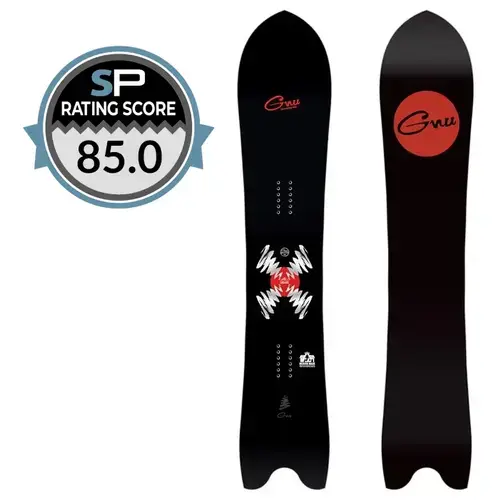
The GNU Something GNU is at its best when there's powder and when it gets itself into trees and other tight situations.
For most this will be a board that compliments their quiver, rather than a one-quiver board, but would work really well as your powder/tree board. That said, it's great for low-effort cruising on groomers too.
In this review, I will take a look at the Something GNU as a mellow freeride snowboard.
As per tradition here at SnowboardingProfiles.com I will give the Something GNU a score out of 100 (based on several factors) and see how it compares with other mellow freeride snowboards.
Overall Rating
Board: GNU Something GNU 2026
Price: $629
Style: Mellow Freeride
Flex Rating: Mid-Stiff
Flex Feel on Snow: Medium (6/10)
Rating Score: 85.0/100
Compared to other Men’s Mellow Freeride Boards
Of the 28 current model mellow freeride snowboards that we tested:
❄️ The Something GNU ranked 17th out of 28
Overview of the Something GNU’S Specs
Check out the tables for the Something GNU’s specs and available sizes.
STYLE:
mellow freeride
PRICE:
$629 - BUYING OPTIONS
Ability Level:

flex:

feel:

DAMPNESS:

SMOOTH /SNAPPY:

Playful /aggressive:

Edge-hold:

camber profile:

Directional Hybrid Rocker
Directional Hybrid CAMBer - GNU's "C2 Directional"
SHAPE:
setback stance:
Setback 100mm (4")
BASE:
Sintered- GNU's "Sintered Knife Cut"
weight:
FELT Normal
Camber Height:
4mm
Sizing
LENGTH (cm) | Waist Width (mm) | Rec Rider Weight (lb) | Rec Rider Weight (kg) |
|---|---|---|---|
151 | 250 | 100+ | 45+ |
156 | 253 | 115+ | 50+ |
161 | 261 | 145+ | 65+ |
169 | 265 | 150+ | 70+ |
Who is the Something GNU Most Suited To?
The Something GNU is best suited to those who seek powder and want something they can ride all day when the snow is deep and not have to burn out their back leg to do it. If trees tend to feature a lot in your day, then it becomes even more suitable.
For most this will be part of a quiver, rather than a one-quiver board. It would be the board to bring out on deep days and fogged-in days when the trees offer the best visibility. It would match well with a freestyle/park board and/or all-mountain board, depending on what you like to do when there's no powder.
Not for beginners, though it is a pretty easy going ride, so lower-end intermediate riders (and up) should have no issues controlling this board.
TEST/REVIEW DetailS FOR THE Something GNU
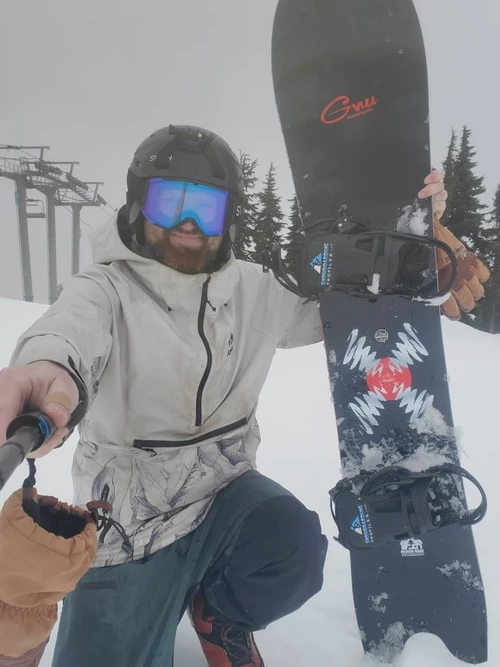
O.k. let’s take a more detailed look at what the Something GNU is capable of.
Demo Info
Board: GNU Something GNU, 161cm (261mm waist width)
Date: February 27, 2025
Carving
I found the GNU Something GNU to be decent on a carve, but not something I’d reach for if laying trenches was my top priority. It held an edge well enough, but the overall shape and pretty aggressive taper made it feel like it wanted to release the tail earlier than ideal.
At moderate speeds, I could get a satisfying arc going, but when I tried to really drive it harder and push higher speeds, it didn’t feel super locked in. It wasn’t bad by any means. I’d say it sat somewhere in that average range for carving, with moments of fun but not a ton of confidence when really pushing it.
Turning
Ease of Turning/Slashing: This was one of the better aspects of the Something GNU. From my first few turns, it felt quick and easy to initiate. For a 161 (which is longer than I typically ride), it surprised me with how agile it felt edge-to-edge. Slashing the tail was effortless, to the point where it encouraged a more playful, surfy style of riding rather than anything too aggressive.
Maneuverability at slow speeds: I really enjoyed how it behaved at slower speeds. It felt nimble and responsive without needing much input. I could make quick adjustments to my line without thinking too much about it, which made it a good board for weaving through tighter terrain or just cruising casually.
Catchiness: Overall, it was pretty forgiving. I only really noticed any catchiness in softer, slushier conditions, which is fairly normal. Outside of that, it felt smooth and predictable, and I didn’t feel like it was punishing me for small mistakes.
Speed
At speed, the GNU Something GNU was fine, but not something I’d describe as super confidence-inspiring. It held things together reasonably well up to moderately fast speeds. But when I started really opening it out, it felt a bit less stable than I would have liked. Not overly chattery, but not ultra damp either—kind of sitting in that middle ground.
I never felt completely out of control, but I also didn’t feel like I could just bomb without thinking about it. It leaned more toward controlled cruising than flat-out charging.
Uneven Terrain
Crud/Chunder: In messy snow, it held its own fairly well. It wasn’t smashing through crud like a tank, but that big nose helped for sure - it tended to ride up and over uneven patches rather than plowing through them. When I did get knocked off line, it was easy to recover. Dampness felt about average - some chatter, but nothing excessive.
Trees/Bumps: This was where I had the most fun with the Something GNU. Its agility really shined in tighter spaces. It felt quick, easy to pivot, and super maneuverable for its size. I could see this being an absolute weapon in the trees, especially on a powder day.
Even without deep snow, it was enjoyable weaving through bumps and tighter lines, and I never felt like I was fighting it. The 156 would have been even more agile, though the 161 did have the advantage of more surface area for deeper powder days.
Powder
Speaking of powder.
This felt like the board’s true calling. Even though I didn’t get it in super deep conditions, everything about it suggested it would thrive there. The long nose, directional shape, and taper all worked together to keep it floating effortlessly. In the softer snow I did ride, it felt smooth, surfy, and natural - like it wanted to stay on top without any effort from me. I’d be very surprised if this wasn’t a top-tier powder performer in deeper conditions.
Jumps
Overall, jumps weren’t really its thing. It was rideable, but not particularly inspiring.
Pop: The pop was interesting - it was fairly easy to access, but there just wasn’t a ton of total power there. I could load it up without too much effort, but it didn’t give a huge boost in return.
Approach: Approaches were fine at moderate speeds. It felt stable enough for smaller features, and I could make adjustments easily. But for bigger jumps or faster approaches, it didn’t feel quite solid enough to give full confidence.
Landing: Landings were a bit of a weak point, especially when landing tail-heavy. That smaller tail didn’t offer a lot of support, and it showed. It was forgiving enough on smaller jumps, but anything bigger and there wasn’t as much stability as I’d want.
Switch
As expected, riding switch wasn’t great. The directional shape and that noticeable difference between nose and tail made it feel pretty awkward going tail first. It was doable for short periods or quick transitions, but I wouldn’t want to spend much time riding switch on this. Transitions themselves were smooth enough, though, and I didn’t feel like it was overly catchy when swapping directions.
Spins
Spins were a bit of a mixed bag. On one hand, it didn’t feel catchy on takeoff or landing, which was nice. But on the other hand, the overall shape, length, and smaller tail made things feel a bit awkward - especially when setting up or landing switch. I noticed a slight tendency to over-rotate at times, but it wasn’t too pronounced. Overall, it was manageable, but definitely not a board I’d pick if spinning was a priority.
Jibbing
Not really its scene. I could take it through some basic jib features, but it didn’t feel particularly comfortable or confidence-inspiring. Between the shape and flex, it just wasn’t designed for that kind of riding. It wasn’t terrible, but it wasn’t something I’d look forward to either.
Butters
Buttering was also a bit tricky. The flex itself wasn’t overly stiff, so in theory it should have been approachable - but the shape made things more difficult. The long nose and smaller tail created an imbalance that took some getting used to. But even individually the nose and tail were a bit awkward to press, given the tail didn’t have much surface area to balance on and the nose was too long to feel properly in control of.
I could get presses going, but it didn’t feel natural.
Score Breakdown and Final Verdict
Check out the breakdown of the score in the table below.
| FACTOR | Rating (/5) | Weighted |
|---|---|---|
| Powder | 4.5 | 27/30 |
| Turns | 4 | 12/15 |
| Carving | 3.5 | 7/10 |
| Trees | 4.5 | 13.5/15 |
| Crud | 4 | 8/10 |
| Speed | 3 | 6/10 |
| Jumps | 2 | 2/5 |
| Switch | 1 | 1/5 |
| TOTAL (after normalizing): | 85/100 |
Coming away from the GNU Something GNU, I felt like it was a solid mellow freeride board with a clear strength in powder and tight terrain. It didn’t really excel in freestyle areas like jumps, jibs, or switch riding - but that wasn’t really what it was built for. Carving was decent up to moderate speeds, but wasn’t a standout feature either.
Where it did shine was in its easy turning, nimble feel, and clear powder bias. It felt like a board I could take out on a relaxed day, cruise around, dip into the trees, and really enjoy softer snow conditions. It didn’t blow me away overall, but I could definitely see its appeal—especially as a dedicated powder or freeride complement to a more all-mountain or freestyle-focused board.
If I had one in my quiver, I’d be saving it for those deep days, or when the fog was heavy and the trees were calling.
More Info, Current Prices and Where to Buy Online
To learn more about the Something GNU, or if you're ready to buy, or if you just want to research prices and availability, check out the links below.
To check out some other mellow freeride snowboard options, or to see how the Something GNU compares to others, check out our top rated mellow freeride snowboards by clicking the button below.

Leave a Reply