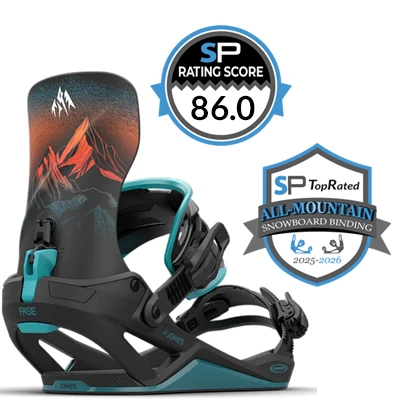
The Jones Mercury FASE are on of the first bindings to get the new FASE fast entry system. Given the popularity of the system in its first year, I expect we will see more models come out in the future.
This review will look at how that system works and what we thought of it, but also, of course, cover the riding qualities of these bindings, not just their entry/exit qualities.
In this review I will take a look at the Mercury FASE as all-mountain snowboard bindings.
As per tradition here at SnowboardingProfiles.com I will give the Mercury FASE a score out of 100 (based on several factors) and see how they compare with other all-mountain bindings.
Overall Rating
Bindings: Jones Mercury FASE
Price: $379 (USD recommended retail)
Style: All-Mountain
Flex Rating: Mid-Stiff (8/10)
Flex Feel: Mid-Stiff (7/10)
Rating Score: 86.0/100
Compared to other Men’s All-Mountain Bindings
Of the 30 current model men's all-mountain bindings that we tested:
❄️ The Mercury FASE ranked 9th out of 30
Overview of the Mercury FASE’s Specs
Check out the tables for the Mercury FASE’s specs and available sizes.
Specs
STYLE:
All-Mountain
PRICE:
$379 - BUYING OPTIONS
Ability Level:

flex:

weight:
FELT normal
Mounts to:
2x4 | 4x4 | Channel
Sizing
SIZE | US BOOT SIZE | EURO BOOT SIZE | MONDO |
|---|---|---|---|
M | 8.5-10.5 | 41.5-44 | 26.5-28.5 |
L | 11-14 | 44.5-48 | 29-31 |
Who are the Mercury FASE Most Suited To?
The Mercury FASE are best suited to those who are looking for relatively stiff bindings, but still want them have a bit of forgiveness and not be oppressively stiff.
More particularly, they are well suited to those looking for mid-stiff bindings with a fast entry system, but still want their bindings to feel like regular two-strap bindings.
Best matched to boards in the 5/10 to 8/10 flex range and even better flex-match to boards in the 6/10 to 7/10 flex range.
Too stiff for beginners, IMO.
Test/review details for the Mercury FASE

Jones Mercury FASE 2025-2026 On Snow Testing
O.k. let’s take a more detailed look at what the Mercury FASE are capable of.
Demo Info
Binding: Jones Mercury FASE, M
Date: February 21, 2025
The Mercury FASE were the most different to their non-FASE counterpart compared to the other two FASE bindings we tested in 2026 models (Rome Katana AW Fase and Bataleon Blaster AW FASE).
This was mostly because the regular Mercury are built on Skate Tech and the FASE Mercury aren't. I'm guessing there wasn't a way to do FASE with Skate Tech or that they haven't figured it out yet.
Flex
First we'll take a look at how the flex in hand felt, then how it felt overall on snow.
In Hand:
The in hand flex below will include comparisons to the Burton Malavita (my control bindings) and some Bent Metal bindings I had at the time (namely, the Transfer, Axtion, Lightning Supermatic, Joint and Logic.
Highback Twist: Fairly stiff. Of all the BMBW bindings I had it was stiffer than all except the Transfer. Not too much stiffer than the Axtion and Lightning Supermatic, but enough to notice. Pretty much the same as the Transfer but maybe a touch more flex than it. Joint and Logic super flexy, so not even close there.
The Malavita was stiffer than all, but not much stiffer than Mercury Fase – just by a touch.
Highback Pull-back: I could get only a tiny bit of pull back on the Mercury FASE's high-back, but virtually none. Transfer and Axtion had none at all, I reckon, so it’s got just that touch more than them, but very little, very subtle. Same as Lightning Supermatic. Less than Joint and Logic. Malavita also has pretty much zero pull back flex, so a touch more than that, but very little still.
Ankle Strap: Quite stiff. A lot stiffer than the Transfer and Axtion, which had quite flexy ankle straps. The Lightning Supermatic is also quite stiff but not quite as stiff as the Mercury FASE. Malavita ankle strap not as stiff as Mercury FASE, but stiffer than all the BMBW ankle straps.
Order of stiffest to most flexible: Mercury FASE; Malavita; Lightning Supermatic; Joint; Logic/Axtion/Transfer (these 3 about the same).
Toe Strap: Quite stiff too, but certainly more flex than the ankle strap. The Lightning Supermatic was similar but maybe a touch softer. The Joint probably actually a little stiffer, but not by much. Then the Axtion is a little softer again. Then the Transfer just a touch softer than Axtion. Then the Logic softer than all the above. But not by too much vs the Transfer. But by quite a bit vs the joint. The Malavita fits in I would say between the Axtion and the Transfer.
Order of stiffest to most flexible: Joint; Mercury FASE; Lightning Supermatic; Axtion; Malavita; Transfer; Logic.
On Snow:
On snow, the Mercury FASE felt the same to the regular Mercury overall. Stiffer than medium but not ultra stiff. Noticeably stiffer than my control bindings Malavita. 7/10 flex (with 10/10 being the stiffest, 1/10 the softest) is right about where I'd put them.
Responsiveness
They had a great balance between high speed support and quick turn response at slow speeds. So, they performed equally as well for aggressive carves and more casual turns.
Board Feel/Butterability
I found they had really decent board feel. Not top-tier, but pretty decent. A little better than Jones' Skate Tech bindings, in my experience.
Pop/Ollie Power
They felt normal in this sense. I find that bindings don't tend to make a big difference here and it's mostly influenced by the board, but some bindings are can help to extract a little more or a little less than average.
Adjustability
Heel Cup: No
Stance Width: You can run its disc horizontal or vertical. When run horizontal you can tweak your stance width with some micro-adjustability (as in, in smaller increments than the 2cm gap between the screw holes).
Highback Lean: Yes – and toolless. A system I haven’t seen before. It’s quite easy to move the thing that makes the adjustments, which isn't always the case with high back lean adjustment.
Ankle Strap Position: No.
Toe Strap Position: Yes – 2 positions.
Ankle and toe strap length: Yes (as always) - toolless.
Gas pedal/toe ramp extension: Yes.
Highback Rotation: No.
Compatible with: 2 x 4 | The Channel | 4 x 4
Shock Absorption
Physical Inspection: Decent amount of padding, particularly in the heel. But felt like they wouldn't be as good as other Jones/YES bindings in terms of shock absorption.
On Snow: Really decent shock and chatter absorption overall but like suspected not at the level of other Jones bindings.
Entry/Exit
This is something that the new FASE system strives to make better. The latest in the new systems coming out for easier or faster binding entry and exit.
I'm not personally sold on the need to make the system any better and perfectly happy with straps and haven't found a system easy enough or fast enough to make me super excited about fast entry bindings.
These still don't make me want to sprint to go and buy a pair, but they are the best so far, IMO. What makes them that?
FASE Vs Step On
FASE have straps. I like straps. And also, they have the same feel as two strap bindings - because, well..... they are two strap bindings. The biggest difference I find with Step On is having my boots locked into the high-back. A feeling some like. I prefer some independent movement possible between my boot and the highback. Also, you have to get step on boots.
If you do like that locked-in feeling and are OK getting specific boots for it, they are nice and light and it is cool not having straps getting in the way.
FASE Vs Supermatic
Supermatic solves the having-to-get-specific-boots part. And you're not locked into the high-back and it has a strap, but not quite the same feel as traditional two strap bindings still. And they tend to be heavier than most bindings.
FASE allows you to have a two strap binding feel with a regular weighing binding, which is a win in my books.
Ease/Speed of Entry
I found these the easiest to use of all the quick entry bindings. I think part of that is that to do them up, you crank the ankle strap, which is something that I've done thousands of times, so it's already second nature. There's nothing new to get used to.
But with the ankle strap already in place and the toe strap setup where you want it, the only thing you have to do is put your foot in and crank the strap down.
Because the strap is there, you do need to put your foot into the binding on a bit of an angle and toe first. Whereas with traditional strap bindings, with the strap out of the way, you would typically come straight down or kick the heel in first. So that's something to get used to that doesn't feel natural, if you're used to regular two strap bindings. And same for getting out.
But overall, I found these the easiest of the fast entry systems to get used to.
Comfort
Overall no issues with the comfort of these bindings.
Ankle Strap: It's a pretty stiff ankle strap and feels quite hard in terms of the material, but I didn't get any pressure points from them and that's always a win in my books.
Toe Strap: Again, quite stiff and quite hard material, but again no pressure point.
Canted Footbed: Yes. At least the eye test it looked like it. And I measured the medial side (inside) of the footbed at the heel to be 1.6cm and the lateral side (outside) at 1.8cm. So it seems to suggest that there's some canting there. Just couldn't find any specs to confirm it.
Padded Footbed: As mentioned in the shock absorption section above, really decent padding and good shock/chatter absorption on the snow too. Not up to typical Jones levels, but still really good.
Highback: The highback had a little padding on the top 1/4, but none over the rest. No calf bite from it, and that's the main thing, IMO.
Ankle Support
This was an important area to focus on for these bindings. I mean, I always check for it of course, but with fast entry bindings it becomes an even more relevant focus. Why? Because you don't want to give up the level of ankle support you want in exchange for faster entry.
Fortunately, the Mercury FASE didn't sacrifice in that area. It took a little bit of tweaking in terms of the toe strap position, which is intended to remain fixed, once you've dialed it in. But because you do actually crank the ankle strap as part of the entry process, it was easy to get the right amount of support, once you had that toe strap in a good position.
Score Breakdown and Final Verdict
Check out the breakdown of the score in the table below.
| Factor | Rating (/5) | Weighted |
|---|---|---|
| Carving | 4 | 16/20 |
| Slow Speed Response | 4 | 16/20 |
| Board Feel | 4 | 12/15 |
| Shock Absorption | 4 | 8/10 |
| Adjustability | 3.5 | 7/10 |
| Comfort | 4 | 8/10 |
| Ankle Support | 4 | 8/10 |
| Entry/Exit | 5 | 5/5 |
| TOTAL (after normalizing): | 86/100 |
It's nice to finally have fast entry bindings that actually feel like two-strap bindings. And why do they feel that way - well because they ARE two-strap bindings!
How valuable you determine the savings in time and effort is a personal thing. It depends on a few things, I would say, including how easy you find regular two-strap bindings. If you need to sit down and strap up, then you'll likely see more value in fast entry bindings like this.
But for some whacking your back foot in and doing up two straps vs one strap might not be enough to get too excited about these. And if you can already unstrap on the move with regular two strap binding, then the exit isn't going to be a huge difference for you either. In fact, I still find regular two strap bindings a little easier to exit personally, because I can lift my foot straight up, not back on an angle.
However, if you like the idea of this kind of entry and it is faster enough and easier enough for you, but you still want a traditional two-strap feel when you're riding, then these are great options.
Note that the Mercury FASE, unlikely the other FASE bindings I've tried (Bataleon Blaster Asym FASE and Rome Katana FASE) are quite different to the regular two-strap bindings they're named after. This was likely forced, given the regular Mercury are built on the Skate Tech platform, as mentioned earlier in the review above.
More Info, Current Prices and Where to Buy Online
If you want to learn more about the Mercury FASE, are ready to buy or want to research prices and availability, check out the links below.
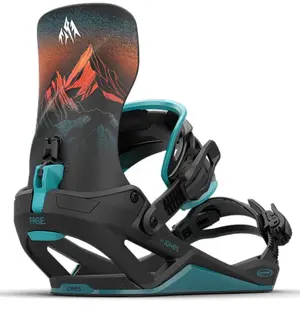
If you want to see how the Mercury FASE compares to other men’s all-mountain bindings or want to check out some other options in that category, check out the next link.
