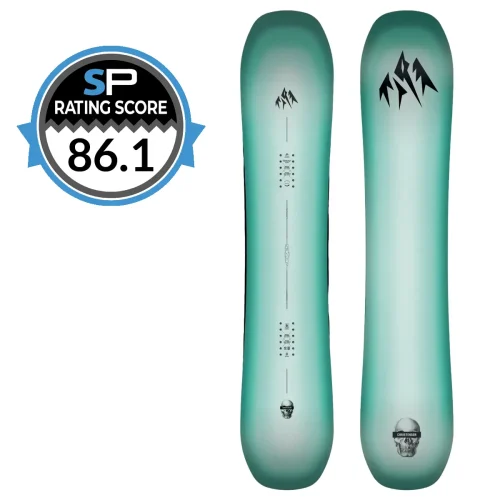
The Jones TwinCraft is a wide, volume-shifted directional twin that blends a surfy shape with a surprisingly balanced freestyle feel.
Jones positions it as a powder-focused directional twin with an extra-wide outline and tight sidecut. It also features traditional camber, a medium flex and a low 3D Contour Base, with 2mm of spoon bevel in the nose and up to 2mm in the tail.
I rode the 158, which measured 268mm at the waist and 279mm under the rear reference insert. That was a lot of board for me, with all that width and a heavier-than-normal construction. Importantly, the board I tested was heavier than the final production version was expected to be (supposed to be 20% lighter), so I had to factor that into my impressions.
Despite its size, it was considerably more maneuverable than I expected and worked particularly well in the soft, slushy conditions I tested it in.
In this review, I will take a look at the Twincraft as an all-mountain snowboard, which we define as the do-it-all swiss-army knives of boards.
As per tradition here at SnowboardingProfiles.com I will give the Twincraft a score out of 100 (based on several factors) and see how it compares with other men's all-mountain snowboards.
Overall Rating
Board: Jones Twincraft 2027
Price: $599
Style: All-Mountain
Flex Rating: Medium (3/5)
Flex Feel on Snow: Medium (6/10)
Rating Score: 86.1/100
Compared to other Men’s All-Mountain Boards
Of the 30 current model men's all-mountain snowboards that we tested:
❄️ The Twincraft ranked 15th= out of 30
Overview of the Twincraft’S Specs
Check out the tables for the Twincraft’s specs and available sizes.
STYLE
All-Mountain
PRICE
$599 - BUYING OPTIONS
Ability Level
flex
feel
DAMPNESS*
SMOOTH /SNAPPY*
Playful /aggressive*
Edge-hold
camber profile

Traditional Camber
Traditional Camber - But didn't feel like traditional camber - most likely because of the 3D Flip Tips and 3D Contour. Jones' "True Camber High Camber with 3D Flip Tips and Low 3D Contour Base"
SHAPE
setback stance
Centered
BASE
SINTERED - Jones' "Sintered 8000".
weight*
Camber Height
6mm
*note that the demo model I rode was heavier than the production model will be. I was told production model should be 20% lighter. I expect the lighter weight lighter weight is likely to reduce the dampess, increase snap and lean it a bit more playful than how I felt it.
Sizing
LENGTH (cm) | Waist Width (mm) | Rec Rider Weight (lb) | Rec Rider Weight (kg) |
|---|---|---|---|
146 | 256 | 110-160 | 49-73 |
150 | 260 | 120-170 | 54-77 |
154 | 264 | 130-180 | 59-82 |
158 | 268 | 150-200+ | 67-91+ |
162 | 272 | 170-220+ | 77-100+ |
Who is the Twincraft Most Suited To?
The TwinCraft is best suited to an intermediate to advanced rider who wants a volume shifted, powder-capable board but doesn’t want to give up too much in terms of switch riding, side hit, spins and general freestyle riding performance.
Not a traditional powder board and it doesn’t have the heavily directional, tapered feel that usually comes with that type of board. Instead, it combines plenty of surface area and a mildly directional setup with the balanced feel of a twin.
It suits someone who likes riding the mountain creatively - slashing softer snow, hunting out side hits, riding switch and taking a freestyle approach to natural terrain.
The 158 I rode felt a little more stable, damp and aggressive because of its additional weight (production model touted to be 20% lighter). I expect the lighter production version, particularly in the 154, would feel more playful, agile and snappy.
Twincraft DetailS
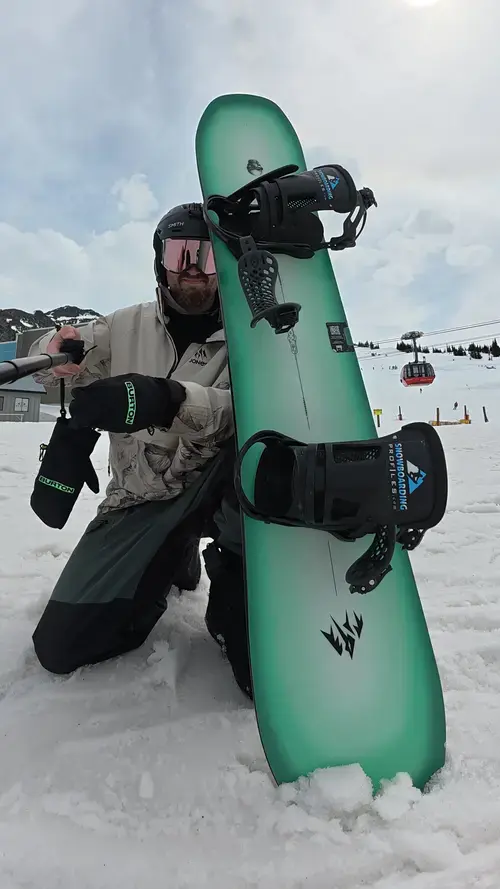
O.k. let’s take a more detailed look at what the Twincraft is capable of.
Demo Info
Board: Jones Twincraft 2027, 158cm (268mm waist width)
Date: April 30, 2026
Powder
I didn’t get the TwinCraft into proper powder, but based on its shape and how it rode in soft snow, I expect it to be comfortably above average.
Its extra-wide outline supplied plenty of surface area, while the directional stance and 3D Contour Base should help it move through powder more easily. Probably not going to produce the effortless rear-leg relief of a fully directional powder board, but it should still float considerably better than a regular twin.
I saw it as roughly a 3.5 out of 5 in powder: capable enough for deeper days but not something I would choose purely as a dedicated powder board.
Carving
The TwinCraft handled moderate carves really well in the conditions. Its extra width helped to create a solid platform, and the heavier test model felt planted when I got it onto an edge. It stayed composed through the softer, bumpier snow and didn’t get pushed around easily.
That additional weight probably helped its carving performance, though. I expect the lighter production model to feel less planted, particularly in the shorter sizes. For that reason, I settled around 3.5 out of 5 rather than rating it purely on how the heavier 158 performed.
Not something I would pick primarily for high-speed, aggressive carving, but it was certainly capable of laying over a decent carve.
Turning and Maneuverability
This was the area that surprised me most. With a 268mm waist and a lot of overall surface area, I expected the 158 to feel boat-like. It didn’t.
It took slightly more effort to initiate a turn than my control board, but the difference wasn’t huge. The relatively tight sidecut likely helped it come around more easily and I could still slash the tail without having to wrestle it.
My control board was a little easier to turn, and release through the tail, but size and weight played a major role in that comparison.
Slow-speed maneuverability was pretty good and would likely improve noticeably with the lighter production construction. In the 154 production model, which is probably the size I’d go for personally in a board this wide, I expect it would feel legit quick and nimble.
Speed
The heavier 158 felt stable at speed. It held itself together nicely when moving faster and stayed composed through the chopped-up slush. It wasn’t locked in, but it had enough weight and platform underneath it to feel reassuring.
Again, the production model would likely have felt a little less damp and stable. I felt closer to a 4 out of 5 on the test model, but 3.5 seemed like the fairest projection for the final board.
Uneven Terrain
Crud and Chunder
The TwinCraft performed well in messy snow during my test. The additional weight allowed it to smash through softer chop rather than getting bounced around. It felt smooth and relatively damp, and its wide platform remained stable when the snow became inconsistent.
A lighter production version probably wouldn’t have bulldozed through crud quite as effectively, so I expected its realistic performance to sit around average to slightly above average.
Trees and Moguls
It was more capable in tighter terrain than its dimensions suggested. The 158 required a little more effort than my control board, but it still turned quickly enough to navigate bumps and tighter lines without feeling cumbersome. A lighter 154 would likely have been considerably more agile.
Its extra width and powder capability should also make it good in powdered trees, where the combination of float and maneuverability could work really well.
Jumps
The TwinCraft felt solid and dependable on jumps. Its approach was stable, and it gave me a secure platform for takeoffs and landings. The extra weight made landings feel planted, though it also made the board slightly less forgiving and harder to move around in the air.
Pop took a little more effort to access than it did on my control board. There was reasonable spring there, but the weight seemed to restrict both how quickly I could load it and how much total pop I could extract.
This is another area that I’d expect the production model to be noticeably better. Reduced weight should make the pop easier to access and create a better balance between stability and maneuverability.
Overall, I had jumps around 3.5 out of 5 for the particular board I rode, but I could see the production model reaching a solid 4.
Ollies, Butters and Presses
Ollies required a little more effort than they did on my control board, but they weren’t difficult.
The board had a fairly substantial platform to load, and the heavier construction took some energy to move. Even so, I could still access its pop without having to throw everything into it.
Presses were similar. The nose and tail had a reasonable amount of flex and didn’t feel excessively stiff, but it took slightly more effort to get them bending. Once flexed, they felt stable enough to hold a press without becoming overly twitchy.
The lighter production version should be easier for both ollies and butters.
Switch and Spins
The TwinCraft rode switch well. It felt balanced enough in either direction. Transitions felt predictable, with no significant catch threat beyond what I would normally expect.
The 3D shaping likely contributed to that smoother, less catchy transition between edges.
The board’s weight didn’t help with spins, but everything else worked well. Setup felt comfortable, edge catch didn’t feel like a major concern and landings were solid. It also stopped rotating cleanly after touching down rather than continuing to spin after landing.
When I under-rotated, it was reasonably easy to complete the rotation on the snow.
Jibs
Jibs weren’t the TwinCraft’s strongest area. The wide shape and heavier feel made it less nimble and it required more effort to make small adjustments. It was stable once it was on a feature, but it wasn’t particularly effortless or playful.
The lighter production version should have improved things, but this still isn’t a board I would choose for someone who spends most of their day riding rails and boxes.
Edge Hold
I didn’t get the conditions required to properly test the TwinCraft on hard or icy snow.
Based on its traditional camber profile, relatively balanced shape and less slashy tail, I expected it to hold an edge better than the more tapered and directional Jones Mind Expander 2.0 (which I also rode that day).
The extra weight of the test model helped it feel planted, but it should still produce decent grip in its lighter production form.
Overall Personality
The TwinCraft had a stable, middle-of-the-road feel. It wasn’t loose, but it didn’t feel locked in either.
The heavier test board leaned more toward smooth, damp and slightly aggressive. I had to give it a reasonably deliberate input to get the best out of it.
The production model will likely shift that personality toward something lighter, snappier and more reactive to a softer touch. It’s still unlikely to be ultra-playful, but I expect it to feel more balanced between playful and aggressive than the model I rode.
Score Breakdown and Final Verdict
Check out the breakdown of the score in the table below.
| Factor | Rating (/5) | Weighted |
|---|---|---|
| Powder | 3.5 | 10.5/15 |
| Carving | 3.5 | 7/10 |
| Turns | 4 | 8/10 |
| Speed | 3.5 | 7/10 |
| Crud | 3.5 | 7/10 |
| Trees | 4 | 8/10 |
| Switch | 3.5 | 7/10 |
| Jumps | 3.5 | 7/10 |
| Spins | 3.5 | 3.5/5 |
| Butters | 3.5 | 3.5/5 |
| Rails | 3 | 3/5 |
| TOTAL (after normalizing): | 86.1/100 |
The biggest surprise with the Jones TwinCraft was how maneuverable it felt despite its width, size and weight.
I went into the test concerned that the 158 would feel like too much board, but it turned more easily than expected and never felt excessively cumbersome. The soft, slushy conditions certainly suited it, but the tight sidecut and balanced shape also played a role.
The heavier demo model enhanced its stability, dampness and ability to smash through chop, while holding back its pop, agility and freestyle performance. The lighter production model will likely trade a little stability for quicker turns, easier pop and a more playful feel.
Overall, it felt like an interesting powder-freestyle hybrid: wide and floaty enough for powder days, but balanced enough for riding switch, spins, side hits and all-mountain creativity.
Current Availability/Buying Options
To learn more about the Twincraft, or if you're ready to buy, or if you just want to research prices and availability, check out the links below:
Prices and availability can change. Please confirm size and stock with the retailer.
To check out some other men's all-mountain snowboard options, or to see how the Twincraft compares to others, check out our top rated all-mountain snowboards by clicking the button below.

Leave a Reply