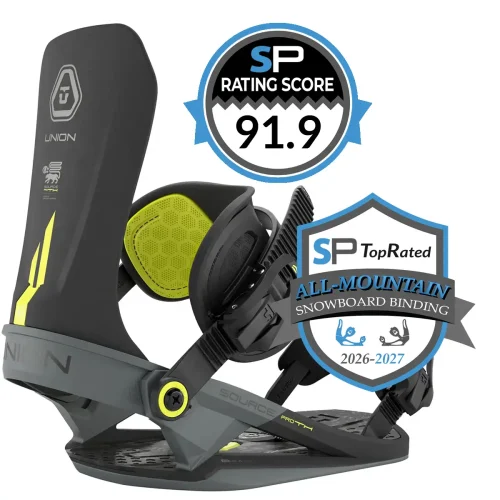
The Union Source Pro TH gave me some of the best board feel and slow-speed control I've experienced. The way I could twist and flex the board underneath me was pretty remarkable, and I noticed it almost immediately.
I could make incredibly tight turns with very little effort. Ordinarily that kind of slow speed control would mean pretty poor carving and higher speed performance. But these are no ordinary bindings! When I started carving and riding faster, there was plenty more support than that easygoing low-speed feel would suggest.
They weren't the most powerful hard-carving bindings or the most cushioned, but the combination of board feel, agility and support made a big impression on me.
In this review I will take a look at the Source Pro TH as all-mountain snowboard bindings.
As per tradition here at SnowboardingProfiles.com I will give the Source Pro TH a score out of 100 (based on several factors) and see how they compare with other all-mountain bindings.
Overall Rating
Bindings: Union Source Pro TH 2027
Price: $699 (USD recommended retail)
Style: All-Mountain
Flex Rating: Mid-Stiff (7/10)
Flex Feel: Medium (6.5/10)
Rating Score: 91.9/100
Compared to other Men's All-Mountain Bindings
Of the 30 current model men's all-mountain bindings that we tested:
❄️ The Source Pro TH ranked 2nd out of 30
Overview of the Source Pro TH's Specs
Check out the tables for the Source Pro TH's specs and available sizes.
STYLE
All-Mountain
PRICE
$699 - BUYING OPTIONS
ENTRY Type:
Traditional Two-Strap
Ability Level
flex
weight
MOUNTING SYSTEM COMPATIBILITY:
Sizing
SIZE | US BOOT SIZE | EURO BOOT SIZE | MONDO |
|---|---|---|---|
M | 8-10 | 41-43 | 26-28 |
L | 10.5-13 | 43.5-46 | 28.5-31 |
Who are the Source Pro TH Most Suited To?
The Source Pro TH are best suited to intermediate to expert riders who want exceptional board feel and quick, low-effort turns, while still having a surprising amount of support for deeper carves and faster riding.
They make a lot of sense for riders who mix freestyle into their all-mountain riding. If you like manipulating the board's flex, pressing, popping ollies and making lots of quick adjustments, those were the areas that really stood out to me.
I wouldn't choose them primarily for maximum carving power or the plushest cushioning. Their appeal is how freely they let the board move while still providing a good amount of support when you push harder.
I would pair them with boards around the 4.5/10 to 7.5/10 flex range, with roughly 5/10 to 7/10 making the most sense to me. Board and binding angle compatibility should be taken into account as well, given their mounting system.
Test/review details for the Source Pro TH

O.k. let's take a more detailed look at what the Source Pro TH are capable of.
Demo Info
Binding: Union Source Pro TH 2027, M
Date: February 5, 2026
Test Details and Weight Feel
I rode the medium Source Pro TH. I rode them alongside my control bindings (Burton Malavitas), plus the Union Neo and Ultra.
They felt light as a feather while riding. That light feel, together with how little effort they took to maneuver, was a big part of the experience.
I could also notice how naturally the board flexed underneath my front foot while one-footing to the chair. The connection to the board stood out before I had even started properly testing them.
Direct Connect Mounting System
The Source Pro TH use Union's Direct Connect system, which mounts each binding with just two screws and nylon triangle washers rather than a conventional disc.
There is no disc cover either. The construction uses a forged-carbon core within a separate baseplate frame, with cushioning beneath the baseplate.
That small mounting area likely played a big role in the board feel I experienced. I couldn't isolate how much came from each part of the construction, but the complete setup let me manipulate the board with very little sense of a dead spot underfoot.
Union lists compatibility with 2x4 inserts and Freedom Groove. They aren't compatible with The Channel, so this isn't a system you can assume will transfer across every board you own. I don’t own any 4 x 4 boards and they are very rare these days, but given there are only 2 screws, I assume they would fit on a 4 x 4 insert pattern, including extra insert packs that sit 4cm behind the main insert pack (e.g. backseat inserts, slambacks etc, depending on brand).
Probably the biggest limitation in terms of compatibility is if you ride with a forward back binding angle greater than 3 degrees – not many do, but if you do, they can’t go more forward on the back binding than that. More on that later.
Flex
In Hand
The highbacks felt stiff when twisting them. There was essentially no pullback flex either.
The ankle straps were the same as those on the Neo. They had a relatively flexible middle, firmer outer sections and a fairly stiff supporting skeleton.
The toe straps were very soft and foldable, with a firmer outer structure. The middle of the skeleton had some flex too, though not quite as much as on the Neo.
On Snow
The overall flex was unusually hard to put a single number on. I felt them around 6 to 7/10, but that doesn't fully explain how they rode.
For slow-speed response and board feel, I could almost have called them 5/10. They were that easy to manipulate. Once I started carving and riding faster, though, the support felt closer to 7/10.
They gave me a much freer feel at slower speeds than I would normally expect from bindings with that amount of support.
Responsiveness
Maneuverability at Slow Speeds
This was exceptional. Probably the best I've experienced.
I could make incredibly tight turns and felt like I had a huge amount of control over the board's torsional movement. It wasn't just quick edge changes. I could really work with how the board was twisting underneath me to shape those slower turns.
The first few turns felt almost ridiculous for how little space I needed to turn. That was an early impression, but the low-speed control remained one of my favorite things about them throughout the test.
Carving and High-Speed Response
The Source Pro TH still gave me a really good amount of support for deeper carves.
They weren't absolute beasts for hard carving, and this wasn't where they stood out most. But they did much better here than their effortless low-speed response might suggest.
For me, that combination was the impressive part: exceptional agility and board feel, with enough support that I didn't feel limited to slower, playful riding.
Board Feel and Butterability
Board feel was as good as I've felt it. The freedom to manipulate what the board was doing underneath me was second to none.
They let me work with the board's flex both torsionally and nose to tail. Pressing and making smaller adjustments felt particularly natural, without a noticeable rigid area under my feet getting in the way.
Pop and Ollie Power
The board feel made initiating ollies super easy. I could flex and load the board without the bindings feeling restrictive.
Total ollie power was normal. Much like the Neo and Ultra, they didn't give me some huge increase in outright power but it was how easy it was to access the pop of the board that was so impressive.
Shock Absorption
Shock absorption wasn't as good as on the Neo or Ultra. It was one of the clearer compromises compared with how strong the Source Pro TH was for everything else.
During the in-house inspection, I noted that there wasn't really a padded footbed sitting above the baseplate. The Neo and Ultra have much more obvious cushioning at the toe and heel.
The Source Pro TH do have cushioning underneath the baseplate, but on snow they didn't give me the same level of impact absorption as the other two. They weren’t terrible for it by any means, but if maximum cushioning is your main priority, there are better options.
Comfort
The Source Pro TH were nice and comfortable. I’d say the lightness and effortless response helped too. They didn't feel cumbersome or demanding to ride.
The highback padding is fairly minimal, covering roughly the lower third rather than the whole highback. There isn't any footbed canting either. Despite that, comfort was really good during the test and the main thing is that I didn’t get any discomfort from them – no calf bite, pressure points or anything like that.
Ankle Support
Ankle support felt good and very similar to the Neo. After the in-house inspection and discovering they shared the same ankle straps, I wasn’t surprised this was the case. The straps gave me a supportive hold without taking away the freedom I enjoyed elsewhere in the bindings.
Adjustability
The heel cups are adjustable, giving some room to center your boots. Highback rotation has two positions and can be adjusted independently of the heel-cup position.
Forward lean uses an integrated three-stage system. It requires a screwdriver to swap the inserts, so it isn't a tool-less adjustment you can quickly change between runs.
Ankle- and toe-strap length adjustments are tool-less. The toe ladder also has two mounting positions, though the strap side didn’t seem to have the same position adjustment.
There isn't an adjustable gas pedal, heel ramp or ankle-strap mounting position.
Overall, a good amount of adjustability, with the main restriction being if you like to ride with a forward stance that has your back binding at greater than +3. They are limited to a max of +3 on your back binding. For most riders this shouldn’t be an issue, but this is an important clarification, if you like to ride with a more aggressive forward stance.
Entry and Exit
Entry and exit were straightforward. The ratchets were smooth, with the toe ratchets feeling a little smoother than some of the other Union models I inspected, though there wasn't much in it.
The hinged ankle straps were a nice feature. Like on the Neo, they moved out of the way to make getting my boot in easier. While not something that I would ever consider a deal breaker it’s a nice-to-have and something I’m used to having (my control bindings have this feature).
They're still regular two-strap bindings for getting in and out. The uniique mounting system changes how they connect to the board, but not how you strap in.
Main Pros
- Next level board feel and slow speed control
- Almost unfair combination of having that plus really decent support for higher speed riding and carves
Main Cons
- Won’t accommodate those with forward stance binding angles that use a positive angle greater than 3 degrees on the back foot
- High price tag
- Not compatible with the Channel
Score Breakdown and Final Verdict
Check out the breakdown of the score in the table below.
| Factor | Rating (/5) | Weighted |
|---|---|---|
| Carving | 4 | 16/20 |
| Slow Speed Response | 5 | 20/20 |
| Board Feel | 5 | 15/15 |
| Shock Absorption | 3.5 | 7/10 |
| Adjustability | 3.5 | 7/10 |
| Comfort | 4 | 8/10 |
| Ankle Support | 4 | 8/10 |
| Entry/Exit | 4.5 | 4.5/5 |
| TOTAL (after normalizing): | 91.9/100 |
The Source Pro TH made a bigger impression on me than most bindings do. Their board feel and low-speed agility were exceptional, and they felt incredibly light while riding.
They also had enough support for deeper carves and faster riding, even though maximum carving power wasn't their strongest quality. Shock absorption was the more obvious limitation compared with the Neo and Ultra but wasn’t a deal breaker, IMO, unless you’re specifically looking for top-tier shock absorption.
For riders who want to feel and manipulate the board underneath them, while keeping the support to ride faster and dig into some fairly deep/aggressive carves, these were something pretty special. The mounting compatibility needs to work for your board, but the ride itself was seriously impressive.
Extra Rant 🙂
The way these bindings excited me, I felt they deserved an extra little rant here. Below is more or less word for word from some notes I took after the test, after I had completed my regular notes - with some spelling/grammar/structural corrections in there.
The Source Pro TH. To say they blew me away is an understatement of epic proportions. And after riding hundreds of pairs of bindings, it takes a lot to genuinely surprise me, but the Source Pro TH are one of the biggest, if not the biggest evolution in snowboard bindings in recent times, IMO, when it comes to performance and certainly where it comes to board feel performance.
A lot of the industry has been focused on entry systems since Step On bindings came back a few years ago. Step-Ons did have a change in terms of performance as well, in the way they feel being locked into the high back in particular. This, in my experience led to better carving performance relative to other factors of the bindings, but comes as the cost of board feel, in my experience, compared to Burton's EST and ReFlex bindings. If that's a feeling that you like, you may prefer that to the more freedom of manipulation that the direct connect system provides.
Other systems have changed how you get in and out of your bindings - and being able to do so, while keeping a similar feeling/performance of traditional two-strap bindings.
The Source series doesn't change how you get in and out of the bindings - they are all about performance improvement and, IMO, they absolutely nailed it, particularly if you're a fan of natural, easy board feel. Really hoping these aren't a flash in the pan that don't get more mainstream because of the price, because of all the changes in snowboard bindings that I've seen over the 12 years I've been testing snowboard gear, these represent my favorite performance improvement, and perhaps the biggest change in terms of actual performance improvement, over any bindings that I've tested in that time.
Current Availability/Buying Options
If you want to learn more about the Source Pro TH, are ready to buy or want to research prices and availability, check out the links below.
Prices and availability can change. Please confirm size and stock with the retailer.
If you want to see how the Source Pro TH compares to other men’s all-mountain bindings or want to check out some other options in that category, check out the next link.

Leave a Reply