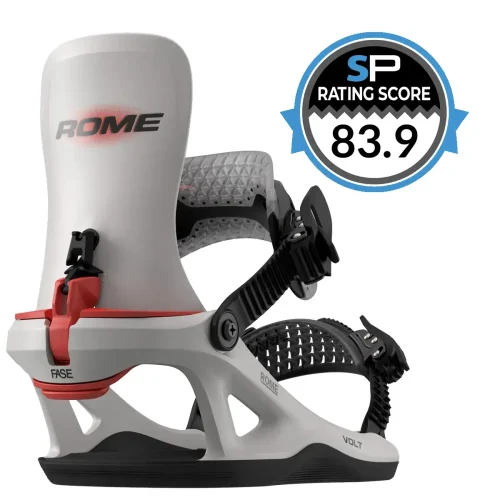
The Rome Volt FASE gave me good support for carving, comfortable straps and really decent cushioning. They felt a little heavier and less agile than my control bindings but allowed me to get a little deeper into carves and hold them for longer.
They were very similar to the Bataleon Ghost FASE that I also tested on the day. A touch stiffer and a little better for carving, with slightly less agility at slower speeds, but those differences were subtle.
The FASE system worked well. A couple of entries felt nice and fast and smooth, though I still prefer regular two-strap bindings overall.
As per tradition here at SnowboardingProfiles.com I will give the Volt FASE a score out of 100 (based on several factors) and see how they compare with other all-mountain bindings.
Overall Rating
Bindings: Rome Volt FASE 2027
Price: $329 (USD recommended retail)
Style: All-Mountain
Flex Rating: Medium (5-6/10)
Flex Feel: Medium (6.5/10)
Rating Score: 83.9/100
Compared to other Men’s All-Mountain Bindings
Of the 30 current model men's all-mountain bindings that we tested:
❄️ The Volt FASE ranked 21st out of 30*
Overview of the Volt FASE’s Specs
Check out the tables for the Volt FASE’s specs and available sizes.
STYLE
All-Mountain
PRICE
$329 - BUYING OPTIONS
ENTRY Type:
FASE
Ability Level
flex
weight
MOUNTING SYSTEM COMPATIBILITY:
Sizing
SIZE | US BOOT SIZE | EURO BOOT SIZE | MONDO |
|---|---|---|---|
XS | 4-6 | 35.5-38 | 23-26 |
S | 5-8 | 36.5-40.5 | 23-26 |
M | 7-11* | 39-44.5* | 25-29* |
L | 10-14* | 43-48.5* | 28-32* |
* US11/mondo 29 borderline for M and Rome recommends sizing up unless you can do a test fit with your particular boots. If you have size 14s highly recommended to test fit with the L to make sure your particular boots fit.
Who are the Volt FASE Most Suited To?
The Volt FASE are best suited to intermediate to expert riders who want supportive but not too stiff all-mountain bindings with the convenience of FASE entry.
I see them working particularly well for riders who like carving and want some extra support when putting more energy into turns but don’t want to pay for more expensive bindings or have to get really stiff bindings. They can handle slower riding too, but wouldn’t be my first choice if quick, low-effort turns and a particularly playful feel are your priorities.
I would pair them with boards around the 5/10 to 7.5/10 flex range, with roughly 5.5/10 to 6.5/10 being the best match, IMO.
They also make sense if you’re interested in speed-entry bindings but still want an ankle strap that you tighten to your preferred tension each time.
Test/review details for the Volt FASE

O.k. let’s take a more detailed look at what the Volt FASE are capable of.
Demo Info
Binding: Rome Volt FASE 2027, M
Date: April 2, 2026
Test Details and Weight Feel
I rode the medium Volt FASE, comparing them with my control bindings (Burton Malavita) and the Bataleon Ghost FASE.
The Volt felt a little heavier than my control bindings. I noticed it both on the chairlift and while riding, so it wasn’t just something apparent when carrying the setup.
They maybe felt a touch heavier than the Ghost too, though that difference was much less noticeable.
Flex
In Hand
The highbacks felt pretty stiff when twisting them. They were very close to my control bindings (which overall feel medium on snow but have a stiffer twist flex than you’d think), though I’d say my control bindings had a touch less twist flex. The Volt had less twist (i.e. stiffer) than the Ghost.
There was a very small amount of pullback flex. About the same as the Ghost, and a little more than my control bindings, which barely move in that direction.
The ankle straps were softer through the middle when twisting them than both the Ghost’s and my control bindings’ straps. They had more structure around the outside than the Ghost’s straps, though, and felt firm lengthwise.
The toe straps were noticeably stiffer through the middle when twisting them than the Ghost’s. Lengthwise, they were very flexible and could be folded over easily.
On Snow
Rome lists the Volt FASE at 5/10, but they felt closer to 6.5/10 to me on snow. A touch stiffer than my control bindings and the Ghost, without a huge difference in either case.
Responsiveness
Carving and High-Speed Response
Carving was one of the Volt FASE’s stronger qualities. They were noticeably better than my control bindings here.
I could get a little deeper into a carve and hold it for longer, with more support coming back from the bindings. That extra support was useful when I wanted to put more into a turn.
They felt very similar to the Ghost, but I’d give the Volt a small advantage for carving. Not a massive difference. Just a little more support when pushing harder.
Maneuverability at Slow Speeds
At slower speeds, they weren’t as agile as my control bindings. They took a little more input and didn’t have quite the same easy response for quick turns.
They were maybe a touch down on the Ghost too, but that difference was barely noticeable.
I wouldn’t describe them as terrible at slower speeds by any means. They were perfectly usable for tighter turns, but carving was more of a strength than low-speed maneuverability.
Board Feel and Butterability
Board feel was decent, though noticeably down vs my control bindings.
They didn’t feel completely disconnected from the board, but I couldn’t manipulate its flex quite as freely. For presses and more playful riding, I preferred my control bindings.
The Volt maybe felt a touch down on the Ghost in this area too, but they were very similar. The difference between either of those and my control bindings was much clearer than the difference between the two FASE models.
Pop and Ollie Power
Total ollie power felt about the same as my control bindings, but it wasn’t quite as easy to access.
I could get a good amount out of the board when I put the effort in. It just took a little more to initiate than with my control bindings.
The Volt and Ghost felt the same to me here, both for total power and how easily I could get to it.
Shock Absorption
Shock absorption felt really decent. I didn’t notice any meaningful difference between the Volt, Ghost and my control bindings on snow.
The in-house inspection helped explain where the cushioning was. The removable footbed section was hard plastic, but there was good padding through the heel and underneath the toe area.
Much of that cushioning was in the baseplate beneath the removable section. It felt like good-quality, springy padding when pressed.
On snow, the cushioning worked well and was one of the more positive parts of the ride.
Comfort
I had no comfort issues with the Volt FASE during the test. No calf bite, strap pressure points or discomfort elsewhere.
The highbacks don’t have padding, but that didn’t cause me any problems. The footbeds are canted too.
Overall, they felt comfortable and supportive without anything drawing my attention away from riding.
Ankle Support
Ankle support felt good. A touch better than my control bindings.
My control bindings have a higher strap setting that gives more support, though. With that setting taken into account, I’d put them about even.
The Volt also felt the same as the Ghost for ankle support. I couldn’t choose between those two based on this area.
Adjustability
The Volt FASE have some useful adjustment options, alongside a few limitations.
They use a full-sized disc, but the adjustment slots are fairly short, with three positions available. So, there isn’t as much stance-width adjustment as the disc size alone might suggest but still a good amount and you’re unlikely to need any more micro-adjustment than they offer.
Forward lean is adjustable without tools, though the range of angles didn’t seem particularly large during the in-house inspection.
The toe straps have three mounting positions, giving an extra option compared with the two positions commonly available. There’s also an adjustable gas pedal, and strap-length adjustments are tool-less.
There’s no adjustable heel cup, heel ramp, ankle-strap mounting position or highback rotation. They are compatible with The Channel as well as 2 x 4 and 4 x 4 insert patterns.
Entry and Exit
FASE was good overall, and a couple of times getting in felt really fast, easy and smooth.
The toe strap stays set after the initial adjustment. The ankle strap also stays attached to its ladder, sitting open and ready for your boot.
To get in, I needed to slide my foot in at an angle. It wasn’t a straight-down movement. From there, I could push the ankle strap most of the way onto my boot without needing to use the ratchet – then then only needing the ratchet to finish tightening it.
The ankle ratchets were nice and smooth. Being able to push the strap down freely was useful, because it reduced how much cranking I needed to do – which made it faster.
The toe ratchets weren’t quite as smooth, but were smooth enough. And not as necessary to be as smooth, given that I wasn’t adjusting them every run.
Getting out of them worked well on snow. Lifting the ankle buckle released the tension, then I could lift the strap and pull my foot back and out at an angle. That movement still felt a little awkward at times, though I’d expect it to become more natural with practice.
I also tried getting in while moving, but couldn’t quite manage it during this test. With a bit of practice I could see how you could learn to do this though. Getting in while stopped was good.
For me, FASE is still the best of the speed-entry systems I’ve tried. I’d still rather have regular two-strap bindings overall, but if I was choosing a speed-entry system, FASE would be my preference.
Score Breakdown and Final Verdict
Check out the breakdown of the score in the table below.
| Factor | Rating (/5) | Weighted |
|---|---|---|
| Carving | 4 | 16/20 |
| Slow Speed Response | 3.5 | 14/20 |
| Board Feel | 4 | 12/15 |
| Shock Absorption | 4 | 8/10 |
| Adjustability | 3.5 | 7/10 |
| Comfort | 4 | 8/10 |
| Ankle Support | 4 | 8/10 |
| Entry/Exit | 5 | 5/5 |
| TOTAL (after normalizing): | 83.9/100 |
The Volt FASE were comfortable, supportive all-mountain bindings with good carving response and really decent shock absorption.
They gave up some low-speed agility and board feel compared with my control bindings, and the extra weight was noticeable. But they gave me more support for deeper, longer-held carves.
Compared with the Ghost FASE, the differences were subtle. The Volt felt a little stiffer and slightly better for carving, while the Ghost had a small advantage for slower-speed riding.
For riders who want FASE entry and put more emphasis on carving support than a particularly light, playful feel, the Volt FASE make a decent all-mountain option.
Current Availability/Buying Options
If you want to learn more about the Volt FASE, are ready to buy or want to research prices and availability, check out the links below.
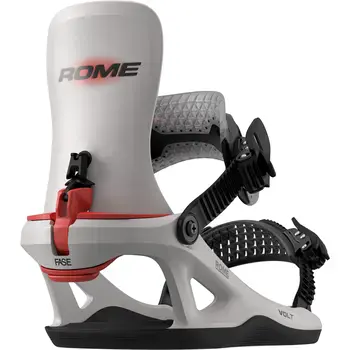
Prices and availability can change. Please confirm size and stock with the retailer.
If you want to see how the Volt FASE compares to other men’s all-mountain bindings or want to check out some other options in that category, check out the next link.

Leave a Reply