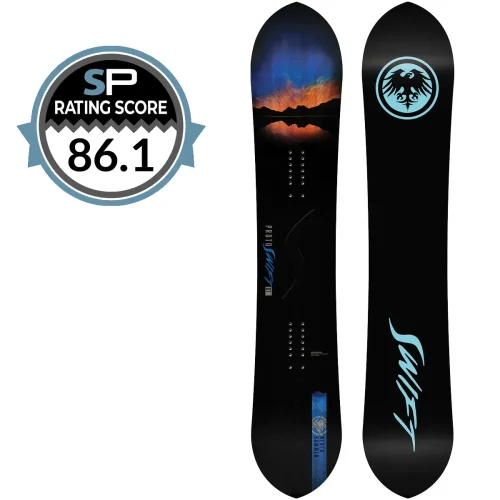
The Never Summer Proto Swift DT was super easy to turn and slash, with a surfy feel that made slower riding really enjoyable. Quick edge changes took very little effort, and I didn't have to ride aggressively to get a good response.
It felt similar to the Proto T3 Eclipse, but a little softer, quicker and more easygoing. The trade-off was a little less stability through rough snow and slightly less carving ability, though there was still enough support that it didn't feel like a noodle or anything.
In this review, I'll take a closer look at the Proto Swift DT as a medium-flexing mellow freeride snowboard.
In this review, I will take a look at the Proto Swift DT as a mellow freeride snowboard.
As per tradition here at SnowboardingProfiles.com I will give the Proto Swift DT a score out of 100 (based on several factors) and see how it compares with other mellow freeride snowboards.
Overall Rating
Board: Never Summer Proto Swift DT 2027
Price: $739
Style: Mellow Freeride
Flex Rating: Medium (5/10)
Flex Feel on Snow: Medium (5/10)
Rating Score: 86.1/100
Compared to other Men’s Mellow Freeride Boards
Of the 27 current model mellow freeride snowboards that we tested:
❄️ The Proto Swift DT ranked 12th= out of 27
Overview of the Proto Swift DT'S Specs
Check out the tables for the Proto Swift DT's specs and available sizes.
STYLE
Mellow Freeride
PRICE
$739 - BUYING OPTIONS
Ability Level
flex
feel
DAMPNESS
SMOOTH /SNAPPY
Playful /aggressive
Edge-hold
camber profile

Directional Hybrid Rocker
Directional Hybrid Rocker - more camber than rocker dominant - Never Summer's "Triple Camer Recurve with early rise float mechanics".
SHAPE
setback stance
Centered
BASE
SINTERED - Never Summer's "Durasurf XT Sintered 5501 Base".
weight
Camber Height
9mm
Sizing
LENGTH (cm) | Waist Width (mm) | Rec Rider Weight (lb) | Rec Rider Weight (kg) |
|---|---|---|---|
156 | 259 | 140-200 | 63-90 |
160 | 260 | 150-220+ | 68-99+ |
161X | 267 | 150-220+ | 68-99+ |
Who is the Proto Swift DT Most Suited To?
The Proto Swift DT is best suited to intermediate to expert riders who want an easy-turning, surfy board for exploring the mountain. Particularly if you enjoy trees, bumps and slashing turns more than charging through everything at speed.
It also makes sense if you want a directional board that can still be fun for jumps, side hits and some buttering. The easy pop and quick maneuverability made those things easy to access without needing a big, aggressive input.
If you’re looking for something primarily for high-speed carving and bombing it wouldn’t be my first choice. It could work as a daily driver for someone whose riding is mostly nose first and who prefers a more relaxed approach to freeriding.
Or in a quiver with a freestyle board and/or a more aggressive, hard charging board.
It was easygoing, but still not something I would consider for a beginner.
TEST/REVIEW DetailS FOR THE Proto Swift DT
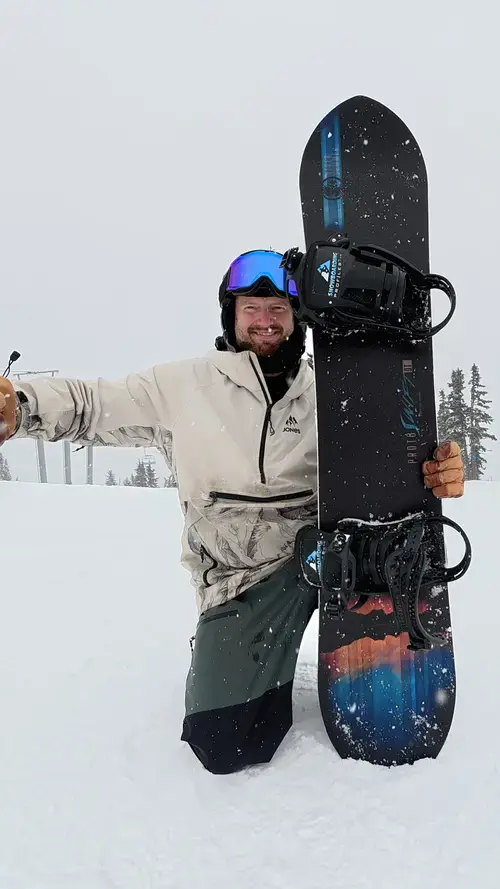
O.k. let’s take a more detailed look at what the Proto Swift DT is capable of.
Demo Info
Board: Never Summer Proto Swift DT 2027, 156cm (259mm waist width)
Date: March 25, 2026
First Impressions and Board Feel
It felt like a normal weight in hand, about the same as the Proto T3 Eclipse, which I also rode that day, along with the Proto T3 Ultra and my control board.
On snow, it also felt normal overall. Similar to the Eclipse and lighter than the Proto T3 Ultra.
I felt the flex at around 5/10. Significantly softer than the Ultra, particularly torsionally, and felt a touch softer than the Eclipse too, but only a very small difference vs the Eclipse.
The overall feel was semi-loose and surfy, without being ultra loose or anything. It had a little playfulness, but I wouldn't go as far as calling it a super playful board overall. More that it didn't need me to be aggressive to enjoy it.
Dampness felt around the middle of the range. It leaned a little more toward snappy than smooth, with easy pop and the ability to snap off quick turns. At the same time, that slightly looser, surfy feel gave it some smoothness too.
Carving
Carving was OK. It wasn't bad on an edge, but it was a clear step down from the Ultra, and a little below my YES Greats (my control board).
I'd put it a touch below the Eclipse too. I could mix some carving into a run, but turning and slashing were more enjoyable than driving hard through a carve.
Turning
Ease of Turning and Slashing
Super easy. The Swift DT took very little effort to initiate a turn, and releasing the tail for a slash felt natural.
Even easier than the Eclipse here, which is no mean feat, as that thing was an easy turner! It responded to the lightest of touches, which was one of my favorite things about it.
Maneuverability at Slow Speeds
The Swift DT was super quick edge-to-edge at slower speeds. Considerably quicker than the Ultra, and even a little quicker than the Eclipse.
I didn't need to build speed or force it around to make tight turns. It responded really well when I slowed things down, which made it particularly enjoyable in tighter terrain.
Catchiness
Catch threat was very minimal. It wasn't completely catch-free, but a lot less catch-threat than the Ultra.
That helped keep the ride chill when making slower turns, slashing or trying things out.
Speed
Stability at speed was decent without being a strength. It felt close to the Eclipse, but just a touch less stable.
I preferred the Swift DT when making lots of turns rather than letting it run for long stretches. It could handle some speed, but that easy response at slower speeds lead to a more twitchy feel when hitting higher numbers on the speedometer.
Uneven Terrain
Crud and Chunder
The Swift DT was more easily pushed around than the Eclipse through rough snow. Not by a huge amount, but it felt a little looser and less stable when the snow got messy.
It was decent enough here, but nothing amazing. I liked its easy maneuverability more than its ability to hold a line through crud.
Trees and Moguls
No surprise that this was one of its strongest areas. The quick, low-effort turns made trees and bumps really enjoyable and low effort.
It was easy to get it turning in a small space without feeling like I had to wrestle it around.
I'd say it would be good in powder through trees too.
Powder
The Swift DT felt pretty decent in the powder available on the day. Its deeper-powder performance should be good too, without being top-tier or anything, based on the specs and overall feel.
Never Summer lists this as having a directional twin shape – it’s even in the name “DT”. But it doesn’t fit the definition, at least not how I would define directional twin. It has a centered reference stance and a nose longer than its tail. Even if it was setback and had the longer nose, I’d still say Directional Twin, but it has a directional camber profile, directional sidecut – and most compelling to not label it directional twin, in my books, 5mm of taper.
But however you label it, those directional aspects, plus blower stance inserts, so you can set back further on powder days, should help it fare well in deeper powder.
Not going to be a specialist for the deepest days but those directional aspects in addition to the surfy feel and low-effort maneuverability made it super fun in the powder we had and would help it to handle deeper days pretty well too, IMO.
Jumps
The Swift DT was good for jumps, with easy access to pop and a useful balance of stability and maneuverability. It felt very similar to the Eclipse overall for jumps.
Pop
Pop was really easy to access. Easier than on the Ultra, and about the same as my control board and the Eclipse.
There was a good amount of total pop too, though less than on the Ultra. Total pop felt similar to my control board.
Approach
Approaches had a good mix of stability and maneuverability. For me, that balance was better than on the Ultra, which was more stable for fast approaches for bigger jumps, but didn't have the same ease of adjustment.
The Swift DT felt stable enough coming in, while still letting me make easy adjustments.
Landings
Landings had a good mix of being fairly solid and forgiving of errors. They didn't feel overly punishing when I didn't get things quite right.
Tail-heavy landings weren't ideal, but not bad either.
Side Hits
The quick maneuverability and easy pop made the Swift DT good for side hits. Getting lined up didn't take much effort, and it didn’t require a big effort to get airborne.
Switch
Switch transitions were easy, but the shape still made riding tail first less than ideal.
I'd put it a touch better than the Eclipse, but it still not ideal.
Spins
Setting up and landing nose first felt nice and easy. Switch takeoffs and landings weren't as good, though they were still decent enough to use.
The swing weight felt good, and overall I thought it was a little better for spins than the Eclipse. I noticed maybe a hint of it wanting to continue spinning after landing, but nothing significant enough to worry about.
Butters
The nose and tail were reasonably easy to press. Similar to my control board for the effort involved, but with a more noticeable difference between the nose and tail.
It felt very similar to the Eclipse, though a little more even between the two ends. It was easier to butter than the Ultra and good enough for mixing some presses into a run.
Jibbing
Jibbing was pretty decent for a directionally shaped board. Not ideal, but much more doable than on the Ultra.
Fine for including the occasional feature, rather than something I'd choose specifically for rails and boxes.
Edge Hold
Edge hold was decent, but it was the weakest of the boards I rode that day in this area.
Not something I’d specifically choose for really hard or icy conditions but handled patches well enough. Its easier turning and surfy feel were bigger strengths than outright grip.
Score Breakdown and Final Verdict
Check out the breakdown of the score in the table below.
| FACTOR | Rating (/5) | Weighted |
|---|---|---|
| Powder | 4 | 24/30 |
| Turns | 5 | 15/15 |
| Carving | 3 | 6/10 |
| Trees | 4.5 | 13.5/15 |
| Crud | 3 | 6/10 |
| Speed | 3 | 6/10 |
| Jumps | 4 | 4/5 |
| Switch | 3 | 3/5 |
| TOTAL (after normalizing): | 86.1 | 86.1/100 |
The Swift DT's easy, quick turning was the standout for me. It was super quick at slower speeds, easy to slash and really enjoyable in trees. The surfy feel made it nice and relaxed to ride - without it feeling overly soft or anything.
It also had easy pop and good jump performance. Switch riding and tail-heavy landings were less convincing but still more than doable. Carving, speed and rough-snow stability were areas where I'd want a little more if that was going to be a big part of my day – or have another board for that.
For riders who want a directional daily driver for making lots of turns, exploring tighter terrain and hitting side hits along the way, the Proto Swift DT makes a good mellow freeride option. In a quiver it would pair well with a more freestyle oriented board and/or a more hard charging option.Current Availability/Buying Options
To learn more about the Proto Swift DT, or if you're ready to buy, or if you just want to research prices and availability, check out the links below.
Prices and availability can change. Please confirm size and stock with the retailer.Where to buy
To check out some other mellow freeride snowboard options, or to see how the Proto Swift DT compares to others, check out our top rated mellow freeride snowboards by clicking the button below.

Thanks for this review, have been waiting to read this! I picked up this board hoping it would be my go daily board and also have a Nohku for real powder/tree days. Your review is interesting because others have said the board is more mid stiff, and you put at 5 (which i am happy about because i like to butter) but was surprised you gave a 3 for speed and carving, the other feedback i have seen is it is an aggressive charging board. Anyway, i guess will have to get on snow to see my self… but was hoping it was stronger for speed and carving.
Hi Nathan
Thanks for your message! I can see why those scores surprised you if you’d heard the Swift DT described as a charger. For me, 3/5 for speed and carving meant it was decent at both, but neither was a standout. I could lay down a carve and carry a reasonable amount of speed. It was when I pushed harder or let it run through rougher snow that I wanted more support and stability.
I rode the 156 (I’m around 180lbs/82kg) and felt it at about 5/10, which is also what Never Summer rates it. I rode the Eclipse and Ultra on the same day, and the DT felt a touch softer than the Eclipse and considerably softer than the Ultra, especially for torsional flex. Size, rider weight and what you’re used to riding can all change that impression, so you may well find it feels firmer than I did.
I’d still give it a fair shot as your daily. The flip side of that easier flex was how little effort it took to make quick turns, pop off side hits and work in a few butters. With the Nokhu for your deeper days, I can see the DT being fun for everyday laps where you want to carve a bit and play around. If most of those laps turn into fast, committed carves, that’s where I’d be more likely to want something burlier.
I’d be interested to hear what size you picked up and how it feels to you once you’ve had a few days on it!