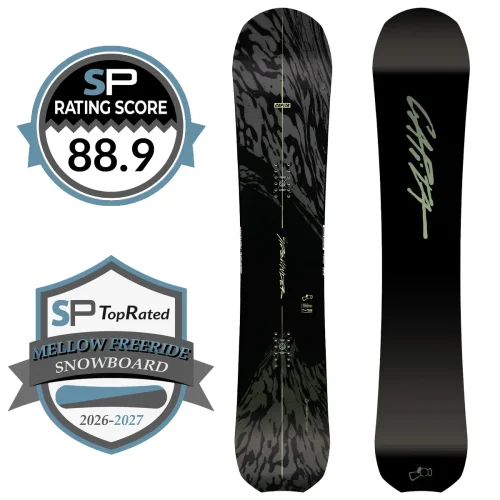
The CAPiTA Sidewinder is a light, surfy and highly agile board. It has an energetic personality and took very little effort to move around, whether I was making quick turns, buttering, spinning or popping off side hits.
That effortless feel came with some trade-offs. It wasn’t particularly stable when I opened it up, and it didn’t hold onto aggressive carves super well. But for cruising around, weaving through tight terrain and generally keeping things playful, it was a ton of fun.
In this review, I will take a look at the Sidewinder as a mellow freeride snowboard.
As per tradition here at SnowboardingProfiles.com I will give the Sidewinder a score out of 100 (based on several factors) and see how it compares with other mellow freeride snowboards.
Overall Rating
Board: CAPiTA Sidewinder 2027
Price: $549
Style: Mellow Freeride
Flex Rating: Medium (5.5/10)
Flex Feel on Snow: Medium (4.5/10)
Rating Score: 88.9/100
Compared to other Men’s Mellow Freeride Boards
Of the 28 current model mellow freeride snowboards that we tested:
❄️ The Sidewinder ranked 7th out of 28
Overview of the Sidewinder'S Specs
Check out the tables for the Sidewinder's specs and available sizes.
STYLE
Mellow Freeride
PRICE
$549 - BUYING OPTIONS
Ability Level
flex
feel
DAMPNESS
SMOOTH /SNAPPY
Playful /aggressive
Edge-hold
camber profile

Traditional Camber
TRADITIONAL CAMBer - but with some flat zones before the contact points. Capita's "Alpine V3 Directional"
SHAPE
setback stance
Setback 0.8" (20mm)
BASE
SINTERED - Capita's "Quantum Drive"
weight
Camber Height
7mm
Sizing
LENGTH (cm) | Waist Width (mm) | Rec Rider Weight (lb) | Rec Rider Weight (kg) |
|---|---|---|---|
153 | 254 | 120-180 | 54-82 |
156 | 256 | 130-190 | 58-86 |
159 | 258 | 145-205 | 65-92 |
162 | 260 | 155-215 | 70-97 |
Who is the Sidewinder Most Suited To?
The Sidewinder is best suited to someone looking for a lightweight, easy-turning and playful directional board rather than a powerful, hard-charging freeride deck.
It would work particularly well for someone who rides a lot of trees, likes making quick turns and prefers a surfier feel. It was super easy to maneuver at slower speeds, so it didn’t need to be ridden aggressively to come alive.
It also has enough freestyle ability to suit someone who likes finding side hits, spinning and buttering around the mountain. Certainly not a freestyle board as such, but it has that ability more than the typical freeride board.
Those wanting to bomb at high speeds or lay down deep, aggressive carves may find it wanting for their purposes. But for intermediate riders and up who value agility and ease over power and stability, it has plenty going for it.
TEST/REVIEW DetailS FOR THE Sidewinder
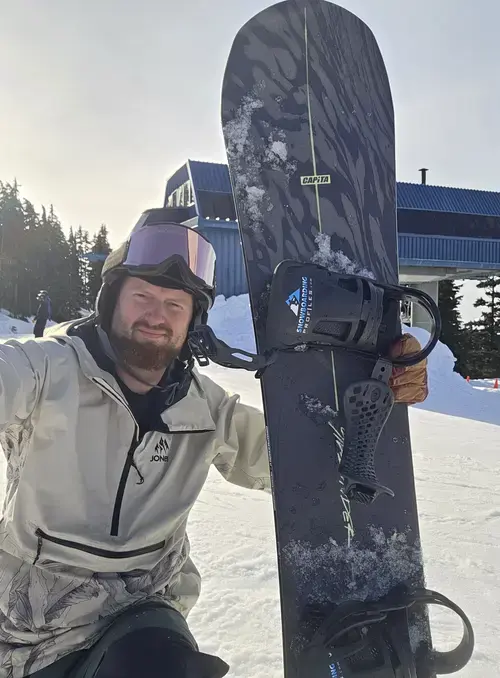
O.k. let’s take a more detailed look at what the Sidewinder is capable of.
Demo Info
Board: Capita Sidewinder 2027, 159cm (258mm waist width)
Date: February 4, 2026
Board Feel/Personality
The Sidewinder felt lighter than normal in hand and was noticeably light once I got it on snow. That lightness contributed significantly to its personality.
It had a semi-loose feel overall. It wasn’t so loose that it felt unpredictable all the time, but it was certainly more surfy and free-moving than locked-in.
It was also noticeably snappier than it was smooth. It responded quickly and energetically, rather than giving me a slower, more dampened response.
For dampness, it was about average. It wasn’t excessively chattery, but it didn’t absorb vibrations or impacts particularly well either.
On the playful-to-aggressive scale, it leaned more playful, but it wasn’t an ultra-soft noodle that folded whenever I pushed into it.
Flex
I felt the Sidewinder at around a 5.5 out of 10 for flex. It was soft enough to be easy going, but it still had enough structure that I didn’t feel like I was going to overpower it every time I leaned into it.
That flex combined with its lightweight construction to make it feel very easy to manipulate. It didn’t take much input to bend it, twist it or change direction.
Turning
Ease of Turning and Slashing
This was one of the Sidewinder’s biggest strengths. It felt really easy and effortless to turn. It immediately felt surfier and more agile than both the Black Snowboard of Death (which I also rode that day) and my control board (Yes Greats).
I could initiate turns on it with very little effort and was it was super easy to release the tail and slash around. I didn’t have to put much force through it to get it moving, which made it relaxing and intuitive when I was riding at slower or more moderate speeds.
Maneuverability at Slow Speeds
The Sidewinder was super quick from edge-to-edge and required very little effort to maneuver. That quickness made it easy to negotiate narrow lines, adjust my line at the last second and move through tighter areas without having to muscle the board around and without getting fatigued.
Catchiness
Strangely, despite its loose and surfy personality, there was some catchiness in the tail. I noticed it when I deliberately looked for it, but there were also a few times when I wasn’t looking for it and still felt the tail threaten to catch during transitions.
The caveat to this though, is that this was in the slushy, messy areas, which made it much easier for an edge to grab, that this feeling came in the most.
Carving
High speed carving wasn’t the Sidewinder’s strongest area. It wasn’t terrible, and I could still put it on edge and have some fun with it, but it wasn’t super stable for higher speed carves. It could become washy when I tried to push hard through a carve, particularly when I was carrying more speed.
I would have scored it a bit lower, except that it did feel really nice for moderate speed carves. If it carried that feel into higher speed carves, it would score really well here - but it’s just that when trying to drive through aggressive, high-speed carves, it fell apart a bit. Riders who mostly want to do moderate speed carves and surfy turns should love it, but anyone wanting a board that really locks into a high speed, long arc carve may want more support.
- Note that only after I had tested and rated this board did I notice that Capita touts it as a carving-first board. While I don’t disagree it was fun for lower speed carves, particularly sharper radius ones, if you want your carving of the more drawn out, high-speed variety, you may not get what you’re after here, based on my experience with it.
Speed
While its lightweight, softer (for a freeride board) and semi-loose feel made it easy to move around, those same characteristics worked against it when I picked up speed on it. It became less composed as speed increased and didn’t give me the confidence to really open it up.
That said, it was able to handle moderately fast speeds, without issue, but it had a limit that came it at not-super-fast speeds.
Its glide did feel really good though. So, getting enough speed wasn’t a problem and keeping up speed when needing to get through a flat/uphill area was good, but not a board I would choose primarily for bombing.
Uneven Terrain
Trees and Moguls
The Sidewinder’s agility made it particularly well suited to trees, moguls and other tight terrain.
Its ability to move quickly from edge-to-edge helped me navigate narrow spots without much effort. It was easy to redirect and correct, which meant I could concentrate more on choosing my line and less on forcing the board to follow it.
I would expect that maneuverability to translate well into powdered trees too, though I didn’t get the opportunity to test it in powder.
Crud and Chunder
In chopped-up snow, the Sidewinder got bumped around relatively easily but wasn’t a rag-doll or anything. It lacked the weight and dampness to really smash through rough snow, though.
The positive was that it was really easy to correct. Even when it got knocked away from my intended line, its lightweight and agile feel made it easy to bring back under control.
It wasn’t a crud destroyer, but it wasn’t hopeless either – and it was forgiving enough to manage messy snow without becoming too difficult to ride.
Powder
I didn’t have any powder during the test, so I wasn’t able to assess its float directly.
Based on how surfy, maneuverable and easy to slash it felt, and on its specs, I’d say it should be really decent. Its personality certainly felt more naturally suited to quick powder turns and weaving through trees than high-speed groomer charging.
Jumps
The Sidewinder was a lot of fun on side hits and smaller jumps. Its pop was easy to access. It took very little effort to load up, and its light feel made getting into the air feel almost automatic and gave full value for effort.
Total pop wasn’t huge, but it was still decent.
It was easy to adjust my speed and line on approaches, though it didn’t feel especially stable when carrying tons of speed. Landings could feel a little loose as well, but that didn’t come into play on smaller features.
Side hits were where it felt best. The easy pop, low swing weight and quick adjustability made it well suited to finding natural hits around the mountain.
Switch
The Sidewinder rode switch surprisingly well for a board in this category. It felt light and easy to control in either direction, though certainly didn’t feel the same riding tail first. Transitions weren’t without catch-threat, but were mostly good.
Spins
Its lightweight feel made spins easy. It came around quickly in the air, and the easy-access pop made initiating spins feel straightforward, though landing and taking off switch wasn’t ideal.
It wasn’t necessarily built as a freestyle-focused board, but it had a naturally playful and airborne personality.
Butters
The Sidewinder was pretty easy to butter. The nose and tail were easy to flex, but they weren’t so soft that I felt like I would accidentally over-flex them. That gave it a nice balance between being accessible and still offering some support.
The nose and tail felt a little different but not worlds apart.
Transitions between presses felt quick and energetic, helped by the board’s light and snappy overall feel.
Jibbing
Its softer flex, low weight and easy pressability all worked well for jibs. The main thing holding it back was the bit of catchiness I experienced from the tail.
It wasn’t something I would buy specifically for riding rails and boxes, but it was capable enough for the occasional jib line venture through the park.
Score Breakdown and Final Verdict
Check out the breakdown of the score in the table below.
| FACTOR | Rating (/5) | Weighted |
|---|---|---|
| Powder | 4.5 | 27/30 |
| Turns | 4.5 | 13.5/15 |
| Carving | 3.5 | 7/10 |
| Trees | 4.5 | 13.5/15 |
| Crud | 3 | 6/10 |
| Speed | 3 | 6/10 |
| Jumps | 4 | 4/5 |
| Switch | 3 | 3/5 |
| TOTAL (after normalizing): | 88.9/100 |
The Sidewinder was surfy, lightweight, with an effortless maneuverability. It felt at its best at slower to moderate speeds, whether carving, popping off rollers, side-hits, or weaving through tight spots. It didn’t feel as at home at high speeds and while it felt good carving tight to moderate radius carves at moderate speeds, it didn’t perform as well when aggressively carving at high speeds.
I didn’t get a chance to ride it in powder, but based on its feel and specs, it should feel really at home in fresh powder.
Its lightweight construction, softer flex and snappy personality made it incredibly easy to turn, butter, pop and spin and preferred when I kept things playful, made quick turns and looked for side hits or tight lines.
Not the board I would choose if bombing, smashing through crud or laying down high speed powerful carves was your mainstay. But for riders who value maneuverability, playfulness and a surfy directional feel over stability and outright power, the Sidewinder offered a really fun and effortless ride.Current Availability/Buying Options
To learn more about the Sidewinder, or if you're ready to buy, or if you just want to research prices and availability, check out the links below.
Prices and availability can change. Please confirm size and stock with the retailer.
To check out some other mellow freeride snowboard options, or to see how the Sidewinder compares to others, check out our top rated mellow freeride snowboards by clicking the button below.

Leave a Reply