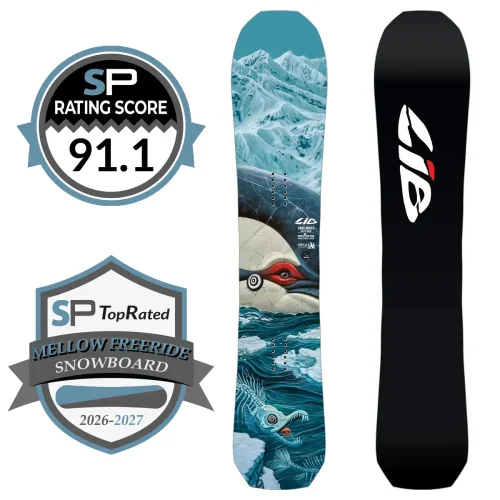
I had a blast riding the Lib Tech T.Rice Orca II. It was surfy, quick edge-to-edge, easy to pop and capable of turning on a dime. It was particularly good in powder and trees, but it also handled everything else I encountered surprisingly well.
In this review, I will take a look at the Orca II as a mellow freeride snowboard.
As per tradition here at SnowboardingProfiles.com I will give the Orca II a score out of 100 (based on several factors) and see how it compares with other mellow freeride snowboards.
Overall Rating
Board: Lib Tech T.Rice Orca II 2027
Price: $749
Style: Mellow Freeride
Flex Rating: Mid-Stiff (7/10)
Flex Feel on Snow: Medium (5.5/10)
Rating Score: 91.1/100
Compared to other Men’s Mellow Freeride Boards
Of the 28 current model mellow freeride snowboards that we tested:
❄️ The Orca II ranked 1st out of 28
Overview of the Orca II'S Specs
Check out the tables for the Orca II's specs and available sizes.
STYLE
Mellow Freeride
PRICE
$749 - BUYING OPTIONS
Ability Level
flex
feel
DAMPNESS
SMOOTH /SNAPPY
Playful /aggressive
Edge-hold
camber profile

Directional Hybrid Rocker
Directional Hybrid Rocker - Lib Tech's "Directional C2X".
SHAPE
setback stance
Setback 2" (50mm)
BASE
SINTERED - Lib Tech's "Sintered Knife Cut"
weight
Camber Height
6mm
Sizing
LENGTH (cm) | Waist Width (mm) | Rec Rider Weight (lb) | Rec Rider Weight (kg) |
|---|---|---|---|
138 | 247 | 90+* | 45+* |
144 | 250 | 100+ | 50+ |
147 | 252 | 110+ | 55+ |
150 | 255 | 120+ | 60+ |
153 | 267 | 130+ | 65+ |
156 | 267 | 140+ | 70+ |
159 | 267 | 150+ | 75+ |
162 | 269 | 160+ | 75+ |
*weight recommendations are according to Lib Tech - and in this case not particularly useful, in my opinion.
Who is the Orca II Most Suited To?
The Orca II is best suited to riders who want a surfy, quick-turning freeride board that excels in trees and powder but that doesn’t feel overly demanding when the terrain flattens out or the snow became more tracked.
It would work particularly well for anyone who prioritizes maneuverability over maximum stability. It was ridiculously quick turning in tight spaces and required very little effort to change direction, but it could still handle some speed and lay down a decent carve.
Not the board I would choose for riding a lot of switch, hitting bigger jumps or carving groomers at full tilt. But for someone looking for a fun, easygoing powder and tree board that’s capable across the rest of the mountain, it offers a really appealing balance.
TEST/REVIEW DetailS FOR THE Orca II
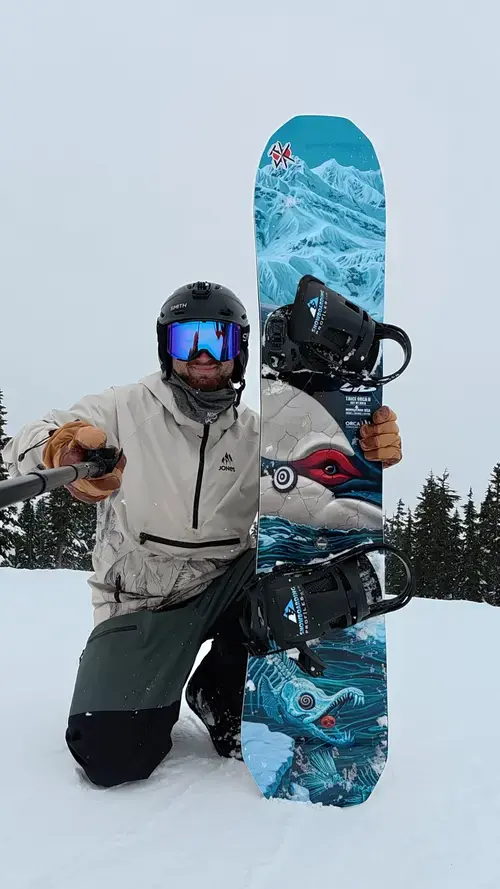
O.k. let’s take a more detailed look at what the Orca II is capable of.
Demo Info
Board: Lib Tech T.Rice Orca II 2027, 153cm (267mm waist width)
Date: February 25, 2026
The Orca II’s Personality
The Orca II had a semi-loose, surfy feel. It definitely wasn’t fully loose, and there was still enough stability there to stop it from feeling unpredictable.
It felt slightly damper than the average board without being super damp. There was some chatter, but never enough to become distracting or make it feel flimsy.
I felt it right in the middle of the smooth-to-snappy scale, but that’s not to say that it was neither or some kind of middle ground between the two. Instead it’s there, because it was both. It had the ability to feel smooth when I wanted to cruise, but it also snapped quickly from edge-to-edge and had a lively, easily accessible pop.
Neither or Both?
Some boards have a personality that sits in the middle of smooth and snappy because its neither – in this case it’s because its both. I have recently created graphics that hopefully better visually express this. In the smooth to snappy graphic in the specs table above, it would be a narrow band right in the middle if it was better described as neither snappy nor smooth. In the case of those that can do both, like the Orca II, there is a wide band, to show that it can be either smooth or snappy depending on what you’re looking to get out of it.
It was similarly balanced between playful and aggressive. I could ride it casually and slash around, but it also handled a reasonably aggressive input. It wasn’t ultra-playful or built for all-out charging, but it switched between those two riding styles really well.
Again, like with the snappy-to-smooth scale, the Orca II was capable of going quite far in both directions – hence the wider band on the graphic above – I’ve found some boards to be in the middle but not necessarily in a good way, like the Orca II is – in those cases a narrow band in the middle of the scale would indicate that the board wasn’t good at handling an aggressive input but also didn’t feel playful.
Powder
The Orca II felt sick in the powder! No surprise there. The snow wasn’t deep enough to really test its limits, but it floated easily in the six to eight inches we had and felt surfy, nimble and natural. It required very little effort to keep the nose up or change direction.
While I couldn’t confirm how it would have handled truly deep snow from that test alone, everything I felt suggested that it would have held up well as the snow became deeper – and the specs back this up too.
Powder was clearly one of its biggest strengths.
Turning
Ease of Turning and Slashing
The Orca II was super easy to initiate turns on. It released into slashes with very little effort and made changing direction feel intuitive.
There was just a tiny hint of grab in the tail, which was the only reason I stopped short of giving it a perfect score. It was subtle and I only really noticed it when I was deliberately trying to find it. During normal riding, it wasn’t present enough to be an issue.
Maneuverability at Slow Speeds
This was one of the quickest-turning boards I’ve ridden. It snapped from edge to edge and could turn on a dime without requiring much energy or commitment. That allowed me to concentrate on choosing my line rather than having to work to get the board around.
Unsurprisingly, that translated extremely well to trees, moguls and other tight terrain.
Carving
Given how loose and slashy the Orca II felt, it carved better than I expected. It wasn’t a carving beast, and riders who want to drive hard through long, aggressive carves would have found better options. But it could still hold a good edge and produce some satisfying carves at moderate to fairly high speeds.
Its carving performance felt particularly impressive because of how easy it was to ride slowly and how little effort it took to release the tail.
Speed
Like its carving performance, the Orca II was more stable at speed than you’d expect, based on it’s surfy, quick turning performance at slow speeds.
It wasn’t a speed demon, and I wouldn’t pick it primarily for bombing steep groomers. But it remained composed at some pretty decent speeds and didn’t suddenly become nervous when I opened it up.
The base also seemed to glide well. I didn’t notice it feeling slow or getting held back noticeably anywhere on the mountain.
Uneven Terrain
Trees and Moguls
This was where the Orca II really shone. Just like the original Orca, it felt right at home weaving through trees. Its quick edge-to-edge response, easy turn initiation and surfy feel made tight terrain ridiculously fun.
It was excellent in trees with powder, but it didn’t need fresh snow to work well there. Even when things became tracked or bumpy, I could make quick adjustments and put it exactly where I wanted it.
Crud and Chunder
The Orca II wasn’t immune to being thrown around in rough snow, but it wasn’t a noodle either.
It held its own reasonably well through chopped-up conditions, and its quick maneuverability made correcting my line really easy whenever I did get knocked off course.
Its slightly damper-than-average feel also helped prevent the ride from becoming too chattery.
Jumps
The Orca II had really easy-to-access pop. It took very little effort to get it into the air, and loading it up produced a decent amount of extra spring as well.
Approaches were mostly good. It could feel slightly loose at times, but it was easy to adjust my speed and line and felt stable enough for the kind of jumps it was best suited to.
Landings could also feel a little loose, and the directional shape didn’t provide a huge amount of tail for tail-heavy landings. However, it was fairly forgiving when I didn’t land perfectly straight, so long as I wasn’t too tail heavy.
It was especially fun on side hits, where its easy pop, low-effort maneuverability and relatively light riding feel worked really well together.
Switch
Switch was never going to be one of the Orca II’s strengths. Its directional shape made riding in the opposite direction feel noticeably less natural than it did on my control board or the GNU T.R.E I rode later that day.
That said, it was decent enough when I needed it. Transitions didn’t feel particularly catchy, and I could ride switch without it becoming a major struggle. It simply wasn’t something I would want to spend a large portion of the day doing.
Spins
The directional shape also made the Orca II less than ideal for spins, particularly anything that involved taking off or landing switch.
However, it performed better than its shape might have suggested. I didn’t notice any significant catchiness on takeoff, it didn’t have a strong tendency to overspin and it was easy to correct an underspin.
Its light riding feel and easy spring, particularly from the tail, also helped it get around.
Jibbing
Jibs obviously weren’t what this board was designed for.
But considering its freeride-focused shape, it wasn’t terrible. Its easy pop and relatively catch-free feel made basic jib features manageable.
Not a board I’d recommended to someone who spent a lot of time down the jib line in the park, but it could handle the occasional feature without feeling completely out of place.
Butters
The nose and tail were both fairly easy to flex. It felt about as easy to press as my control board, and I could get into butters without having to force it. The flex wasn’t so soft that I felt like I was going to over-flex it, though.
As expected from the directional shape, the nose and tail felt quite different, so certainly not ideal, but wasn’t terrible for butters, overall.
Score Breakdown and Final Verdict
Check out the breakdown of the score in the table below.
| FACTOR | Rating (/5) | Weighted |
|---|---|---|
| Powder | 4.5 | 27/30 |
| Turns | 4.5 | 13.5/15 |
| Carving | 3.5 | 7/10 |
| Trees | 5 | 15/15 |
| Crud | 3.5 | 7/10 |
| Speed | 3.5 | 7/10 |
| Jumps | 3.5 | 3.5/5 |
| Switch | 2 | 2/5 |
| TOTAL (after normalizing): | 91.1/100 |
The Lib Tech T.Rice Orca II was super fun in the conditions I rode it in. It was surfy, snappy edge-to-edge and capable of turning on a dime. It floated super well in the powder we had, slayed tight tree lines and provided easy access to its pop.
What impressed me most was how well it handled areas outside its obvious strengths. It carved and rode at speed better than its loose, easy-turning feel suggested it would. It also managed chopped-up snow well and remained fun on side hits.
It wasn’t ideal for switch riding, bigger jump landings, jibs or aggressive high-speed carving, but none of those things are what it’s designed for.
For riders looking for a mellow freeride board that prioritized powder, trees, quick turns and a surfy feel, while remaining capable enough for cruising the rest of the mountain, the Orca II is well worth considering.
I mean, this board was already sick in the 1.0, now it’s next level sick!Current Availability/Buying Options
To learn more about the Orca II, or if you're ready to buy, or if you just want to research prices and availability, check out the links below.
Prices and availability can change. Please confirm size and stock with the retailer.
To check out some other mellow freeride snowboard options, or to see how the Orca II compares to others, check out our top rated mellow freeride snowboards by clicking the button below.

Leave a Reply