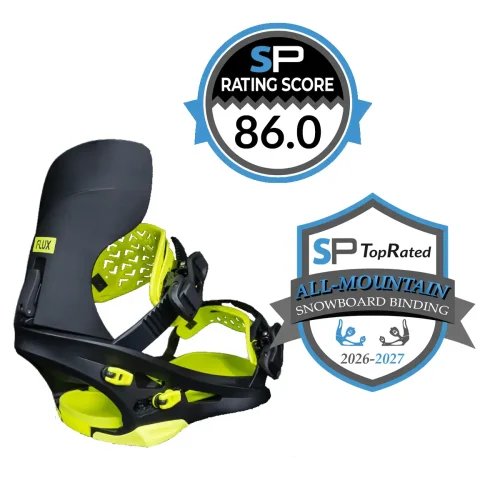
Overall, I really enjoyed riding the Flux CX. They provided the strong ankle support I’d come to expect from Flux, while still giving me good board feel and plenty of agility at slower speeds.
They didn’t have quite the same carving power as the stiffer Flux XF and XF Plus, which I’d tested the previous day, but they were easier-going and more versatile. They also felt very similar to the Flux DS, which I rode on the same day, though the CX felt just a touch stiffer.
In this review I will take a look at the CX as all-mountain snowboard bindings.
As per tradition here at SnowboardingProfiles.com I will give the CX a score out of 100 (based on several factors) and see how they compare with other all-mountain bindings.
Overall Rating
Bindings: Flux CX 2027
Price: $399 (USD recommended retail)
Style: All-Mountain
Flex Rating: Medium (6/10)
Flex Feel: Medium (6/10)
Rating Score: 86.0/100
Compared to other Men’s All-Mountain Bindings
Of the 30 current model men's all-mountain bindings that we tested:
❄️ The CX ranked 10th= out of 30
Overview of the CX’s Specs
Check out the tables for the CX’s specs and available sizes.
Specs
STYLE:
All-Mountain
PRICE:
$399 - BUYING OPTIONS
Ability Level:

flex:

weight:
FELT normal
Mounts to:
2x4 | 4x4 | Channel
Sizing
SIZE | US BOOT SIZE | EURO BOOT SIZE | MONDO |
|---|---|---|---|
XS | 3-5.5 | 34-37.5 | 21-23.5 |
S | 4.5-7.5 | 36-40.5 | 22.5-25.5 |
M | 7-9.5 | 40-42.5 | 25-27.5 |
L | 9+ | 42+ | 27+ |
Who are the CX Most Suited To?
The CX are best suited to riders looking for medium-flexing bindings with a supportive, secure feel but without the more demanding ride of stiffer bindings.
They had enough response for carving and riding at speed, but they were also easy to maneuver when I slowed things down. That makes them a versatile option for riders who wanted to explore the whole mountain and do it casually sometimes, rather than focus entirely on hard carving or aggressive freeriding.
The standout feature was their ankle support. They held my boots extremely well without creating pressure points or feeling uncomfortable. Riders who like a locked-in, supportive feel around the ankles - but still want some freedom to move - should get on well with them.
They are best suited to intermediate to advanced riders, IMO. They wouldn’t be completely unmanageable for a less experienced rider, but beginners will likely find something a little softer and more forgiving easier to learn in.
I see them matching best with boards in roughly the 4/10 to 7/10 flex range, with the best match with boards around 5/10 to 6/10.
Test/review details for the CX

O.k. let’s take a more detailed look at what the CX are capable of.
Demo Info
Binding: Flux CX 2027, M
Date: March 6, 2026
Test Conditions
The conditions were quite soft during my test, which made it more difficult than usual to get a precise feel for areas such as carving response and shock absorption.
I had tested the stiffer Flux XF and XF Plus the previous day in conditions that were more suitable for laying down deeper carves. I therefore kept the difference in snow conditions in mind when comparing them with the CX.
I also tested the Flux DS on the same day as the CX. The DS provided a particularly useful comparison because the conditions were the same and the two bindings had a very similar overall feel.
Flex
On snow, I felt the CX were around a 6/10 flex.
They felt slightly stiffer than my Burton Malavita control bindings, but there really wasn’t much in it. They were noticeably less stiff than the XF and XF Plus, which I put at around 7/10 and 7–8/10 respectively.
Compared with the DS, the CX felt just a touch stiffer. Again, it was a fairly subtle difference rather than something that completely changed how the two bindings rode.
The flex gave the CX a nice middle-ground feel. They had enough structure to feel supportive when I put more energy into them, but they didn’t feel overly rigid or demanding. I could still move naturally in them, and they didn’t make slower or more relaxed riding feel like hard work.
Responsiveness
Slower Speeds
The CX felt very similar to my control bindings when riding at slower speeds.
They transitioned from edge-to-edge easily and didn’t require much effort to make shorter or sharper turns. They felt agile enough for navigating tighter terrain and making quick adjustments without having to put a lot of force through them.
This was one of the reasons they felt so versatile. Some bindings that offered this level of ankle support could feel a little restrictive or sluggish when riding slowly, but that wasn’t the case with the CX.
The DS felt very similar in this area. I couldn’t separate the two by much in terms of their slow-speed agility.
Carving
The CX also performed well for carving. I felt they gave me a little more carving response than my control bindings. They provided good support and transferred energy into the board cleanly when I leaned into a turn.
They weren’t as impressive for carving as the XF or XF Plus had been the previous day. Those bindings had made a much more noticeable difference to how deeply I could carve and how long I could hold onto a carve.
However, the conditions during the CX test were softer and weren’t as well suited to carving, so it wasn’t a completely even comparison.
Based on what I could feel, I would still put the CX below the XF and XF Plus for outright carving performance. But they traded some of that power for a more accessible, versatile ride. For the average all-mountain rider, the CX still provided more than enough carving support.
Board Feel
Board feel was good overall. The CX felt similar to the Flux bindings I’d tested the previous day and also very similar to my control bindings. I could feel the board flexing pretty naturally underneath me, and the bindings didn’t create a big dead or disconnected sensation.
That helped with presses and more freestyle-oriented riding, but it also contributed to their agility. They allowed the board to move without feeling overly loose or sacrificing too much response.
They weren’t ultra-soft, surfy bindings with maximum freedom of movement, but for bindings with a 6/10 flex and such good ankle support, I thought their board feel was impressive.
The DS were once again very similar in this area. There may have been small differences between the two, but neither had a clear advantage during my testing.
Pop and Ollie Power
I didn’t notice much difference between the CX and my control bindings when it came to ollies.
They felt just as easy to load up and initiate, and I didn’t have to put any extra effort into getting the board off the snow. At the same time, I didn’t feel like they added a noticeable amount of extra pop or power.
That wasn’t necessarily a negative. Bindings often didn’t make a huge difference to the total amount of pop a board produces. The more important thing was that the CX didn’t get in the way or make ollies feel more difficult.
Shock Absorption
Shock absorption wasn’t one of the CX’s stronger areas.
The soft snow made this particularly difficult to test because there weren’t many firm impacts or rough, chattery sections to expose the limits of the cushioning. However, based on what I could feel - and my experience with other Flux bindings using a similar overall setup - they didn’t feel especially plush or damp.
They weren’t unbearably harsh, and the conditions meant that shock absorption wasn’t a major problem during the test. But over a full day in firmer, rougher conditions, I could see the lack of cushioning becoming more noticeable.
Riders who prioritize maximum impact protection for larger jumps, hard landings or chopped-up terrain could find better options. For general all-mountain riding, the cushioning was adequate, but it wasn’t a highlight.
Ankle Support
Ankle support was arguably the strongest feature of the CX, typical of Flux bindings.
My boots felt extremely well supported, and there was very little unwanted movement inside the bindings. I felt secure when driving into turns, but the support didn’t come at the expense of comfort.
That strong ankle hold was something I noticed across all four Flux bindings I tested (and all Flux bindings I’ve tested in the past). The XF and XF Plus were particularly impressive, but the CX weren’t far behind.
The CX provided that supportive Flux feel in a more moderate-flexing package. For riders who dislike loose-feeling ankle straps or who want to feel firmly connected to their bindings, this should be a major plus.
Comfort
I found the CX comfortable overall. I didn’t experience any obvious pressure points, and the ankle straps spread pressure evenly across my boots. Considering how securely they held my ankles, I was impressed (but not surprised based on previous experience with Flux bindings) that they didn’t feel overly tight or restrictive.
There was no calf bite that I noticed, and nothing caused any irritation during the test.
The less-than-stellar shock absorption prevented them from being among the most comfortable bindings I’ve ridden overall. But in terms of strap comfort and how they wrapped around my boots, they performed very well.
Weight
The CX felt normal in terms of their weight while riding. I didn’t notice any meaningful difference between them and my control bindings. They didn’t feel exceptionally light, but they also didn’t give me a heavy or cumbersome feeling underfoot.
Their weight didn’t interfere with their slow-speed agility, presses or ollies, so it quickly became something I stopped thinking about once I started riding.
Entry and Exit
Getting in and out of the CX was fine overall, though I had a little difficulty engaging the toe strap ladder on my left binding, when first strapping in.
Trying to do it while holding a camera in one hand doesn’t make it easy though, so I wouldn’t consider it a significant issue. Once everything was lined up, the ratchets worked without causing any major frustration.
There wasn’t anything particularly fast or special about the entry and exit process, but there also wasn’t anything seriously wrong with it. It was a typical, traditional two-strap experience.
Score Breakdown and Final Verdict
Check out the breakdown of the score in the table below.
| Factor | Rating (/5) | Weighted |
|---|---|---|
| Carving | 4 | 16/20 |
| Slow Speed Response | 4 | 16/20 |
| Board Feel | 4 | 12/15 |
| Shock Absorption | 3 | 6/10 |
| Adjustability | 4.5 | 9/10 |
| Comfort | 4 | 8/10 |
| Ankle Support | 4.5 | 9/10 |
| Entry/Exit | 4 | 4/5 |
| TOTAL (after normalizing): | 86/100 |
Overall, I really liked Flux's CX bindings. They provided a well-balanced ride, with good board feel, easy slow-speed response and enough carving performance for general all-mountain riding. Their ankle support was excellent, and they remained comfortable despite holding my boots so securely.
They didn’t have the powerful carving performance of the XF or XF Plus, but they were also less stiff and more accessible. Riders who want high end carving power would be better served by one of those stiffer options.
The CX and DS felt particularly similar. The CX were slightly stiffer, but the difference was subtle, and both offered a comparable blend of agility, board feel, comfort and support.
Their biggest weakness was shock absorption. Anyone wanting a highly cushioned, damp ride might want to look elsewhere. Entry and exit was normal, but not a standout feature.
For intermediate to advanced riders looking for a medium-flexing all-mountain binding with excellent ankle support, good board feel and a balanced response, the Flux CX are worth looking at.
More Info, Current Prices and Where to Buy Online
If you want to learn more about the CX, are ready to buy or want to research prices and availability, check out the links below.
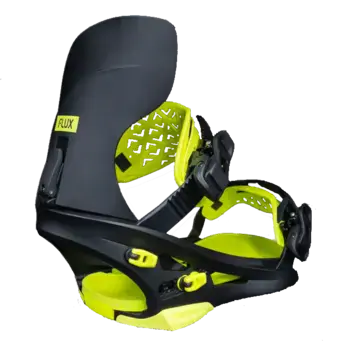
If you want to see how the CX compares to other men’s all-mountain bindings or want to check out some other options in that category, check out the next link.

Leave a Reply