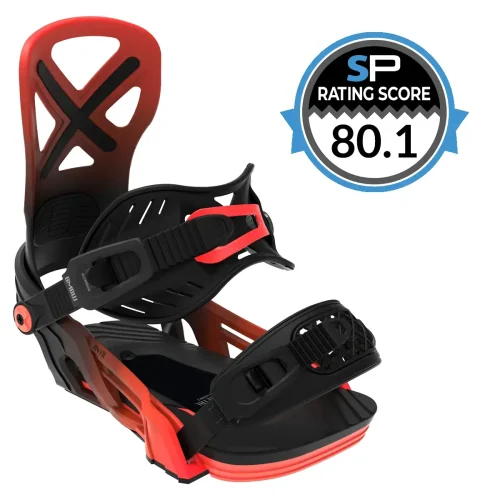
Overall, I found the Bent Metal Anvil to be a comfortable, versatile pair of medium-flexing bindings with a nice balance between low-speed maneuverability and carving support.
They weren’t as powerful, stable or capable of driving really deep carves as the stiffer Transfer Pro, but they were less demanding and a little easier to maneuver at slower speeds. That made them better suited to riders who want an adaptable all-mountain binding rather than something built primarily for more aggressive riding.
In this review, I took a closer look at the Anvil as traditional two-strap, all-mountain snowboard bindings.
In this review I will take a look at the Anvil as all-mountain snowboard bindings.
As per tradition here at SnowboardingProfiles.com I will give the Anvil a score out of 100 (based on several factors) and see how they compare with other all-mountain bindings.
Overall Rating
Bindings: Bent Metal Anvil
Price: $279 (USD recommended retail)
Style: All-Mountain
Flex Rating: Medium (6/10)
Flex Feel: Medium (6/10)
Rating Score: 80.1/100
Compared to other Men’s All-Mountain Bindings
Of the 30 current model men's all-mountain bindings that we tested:
❄️ The Anvil ranked 34th out of 30*
* based on 2025/2026 but will be 34th out of 37 (we tested a bunch of new all-mountain bindings in the winter) when this is updated for 2026-2027 list.
Overview of the Anvil’s Specs
Check out the tables for the Anvil’s specs and available sizes.
Specs
STYLE:
All-Mountain
PRICE:
$279 - BUYING OPTIONS
Ability Level:

flex:

weight:
FELT normal
Mounts to:
2x4 | 4x4 | Channel
Sizing
SIZE | US BOOT SIZE | EURO BOOT SIZE | MONDO |
|---|---|---|---|
S | 5-8 | 36.5-40 | 23-26 |
M | 8-11 | 40-44 | 26-29 |
L | 11-14 | 44-48 | 29-32 |
Who are the Anvil Most Suited To?
The Bent Metal Anvil are best suited to intermediate and advanced riders looking for versatile, medium-flexing bindings that don’t feel overly stiff or demanding and come in under the average price for bindings around its flex range.
I found they had enough response and support to carve well and ride at moderately high speeds, but they were also agile enough for tighter turns, trees and more casual riding. That balance makes them a good match for riders who liked to explore the whole mountain and regularly change up their riding style.
They could also handle side hits, ollies and some freestyle riding. Board feel wasn’t exceptional, but it was good enough that the bindings didn’t feel overly restrictive for presses and more playful riding.
I would pair them with boards in roughly the 4/10 to 7/10 flex range, and even more ideally around 5/10 to 6/10.
Test/review details for the Anvil

O.k. let’s take a more detailed look at what the Anvil are capable of.
Demo Info
Binding: Bent Metal Anvil 2027, M
Date: February 24, 2026
Test and Comparison Details
I tested the Anvil alongside the Bent Metal Transfer Pro and T-Zero and compared all those against my Burton Malavita control bindings, as always.
Flex
In Hand
The Anvil’s highback felt surprisingly flexible during my in-house testing. It had a lot of twist and could almost be folded over on itself. They also had considerably more pullback flex than the Transfer Pro and T-Zero highbacks, which barely moved in that direction.
The ankle strap had a little more structure than the highback might have suggested. It was slightly softer through both the middle and outside sections than my Malavita strap, but the overall difference wasn’t massive.
The toe strap was stiffer around its outer structure but quite soft through the middle.
On Snow
They felt stiffer on snow than the highback might have suggested during the in-house flex test. I felt the Anvil at around 6/10 overall.
They were definitely softer than the Transfer Pro, which I felt at closer to 8/10. However, the Anvil still felt a little stiffer than my control bindings, but not by much.
That medium flex help to make the Anvil nice and versatile. They had enough structure that I could lean into them and generate a reasonable amount of power, but they didn’t require the same energy input as something like the Transfer Pro.
Slow Speed Responsiveness
The Anvil were nicely agile at slower speeds. They felt similar to my control bindings in this area, though not quite as quick and precise as the Transfer Pro.
That result was interesting because the Transfer Pro were considerably stiffer. In some situations, stiffer bindings can feel cumbersome at slower speeds, but the Transfer Pro still changed edges very efficiently. The Anvil didn’t quite match that level of immediate response, but they never felt sluggish and required less energy.
I had no trouble making shorter turns, changing direction or riding at a more relaxed pace. Their softer overall feel made them a little less demanding than the Transfer Pro, even if the Transfer Pro had a slight advantage in outright edge-to-edge performance.
Carving and High-Speed Response
I found the Anvil carved at least as well as my control bindings. They supplied enough support for regular resort carving and allowed me to put a decent amount of pressure into the board.
However, they didn’t have the same upper limit as the Transfer Pro.
With the Transfer Pro, I could lean harder, get lower into a carve and feel more support coming back from the bindings. They also felt more stable when I increased my speed.
The Anvil started to feel less planted when I pushed them in the same way. They were still perfectly capable for everyday carving, but they didn’t have that same powerful, locked-in sensation.
That was the main trade-off between the two. The Anvil had a more forgiving and versatile ride, while the Transfer Pro provided more support for aggressive carving and faster riding.
Board Feel and Butterability
Board feel was good without being a major standout.
They felt close to the Transfer Pro, but I thought the Transfer Pro had a small advantage.
The Anvil uses a full-sized disc rather than the mini-disc found on the Transfer Pro. Full-sized discs can sometimes create a slightly more disconnected feel underfoot, but the Anvil didn’t feel especially dead or cumbersome – but also not particularly great - for board feel. Middle of the road, I would say.
I could still flex the board and get into presses without them fighting me too much. They wouldn’t be my first choice for highly technical freestyle riding, but they supplied enough board feel for side hits, butters and occasional park laps.
Pop and Ollie Power
The Anvil performed well for ollies. They transferred energy efficiently and gave me enough support to load up the board without making the movement feel difficult.
They didn’t create a dramatic springboard effect, but I find that bindings rarely transform a board’s natural pop to that extent. More importantly, the Anvil didn’t get in the way. They supplied enough structure to drive energy into the board while remaining forgiving enough to make ollies pretty easy to initiate.
Shock Absorption
Shock absorption was solid. On snow, I didn’t notice any meaningful difference between the Anvil and Transfer Pro.
The Anvil had a reasonable amount of padding underneath the toe and heel. However, they didn’t have the additional X-shaped heel gel found in the Transfer Pro and T-Zero. That gel felt softer and more reboundy during my in-house testing, but its absence didn’t produce a noticeable disadvantage while I was riding the Anvil – at least no in the short term. It could make some difference over the longer term.
They weren’t the most heavily cushioned bindings I’ve used, but they absorbed general chatter and everyday impacts well. For resort riding, side hits and regular-sized jumps, they provided enough dampening to keep the ride from feeling harsh.
Riders frequently hitting larger features or prioritizing maximum impact absorption might have wanted something plusher, but the Anvil did a good job for general all-mountain use.
Comfort
I found the Anvil very comfortable. I didn’t experience any calf bite, pressure points or other discomfort. The straps held my boots securely without creating excessive pressure, and the bindings maintained that comfort throughout the test.
The highback has less padding than the Transfer Pro. Rather than being fully padded, it has a smaller cross-shaped section through the middle and some padding toward the bottom. Despite that more minimal design, I didn’t notice any discomfort from the highback while riding.
The footbed was also canted at three degrees, which provides a more natural alignment.
Overall, comfort was one of the Anvil’s stronger areas.
Ankle Support
Ankle support was good but felt a touch lower than it did in the Transfer Pro.
My boots felt secure, and I had enough support to drive turns without feeling like my ankles were moving around excessively. At the same time, theydidn’t feel overly restrictive.
That suited their more adaptable all-mountain personality. They offered enough hold for carving and faster riding while still allowing some lateral movement for tweaks, presses and more relaxed riding.
Riders who prefer an extremely locked-in feel might want extra support. For me, though, the Anvil struck a useful balance.
Adjustability
The Anvil has reasonable adjustability, but there are a few limitations.
The full-sized disc provides good stance-width adjustment, and the disc could be rotated to prioritize either stance-width adjustment or boot centering.
The highbacks can also be rotated, with three available positions. Forward lean is adjustable, though not tool-less.
The toe strap has two mounting positions, while strap-length adjustments could be made without tools (as with most bindings these days). They’re also compatible with Burton’s Channel system.
There’s no adjustable heel cup, gas-pedal extension, heel-ramp adjustment or ankle-strap position adjustment.
That gives the Anvil enough adjustability for most riders, but they aren’t among the most customizable bindings available.
Weight
The Anvil felt about the same as the Transfer Pro and my control bindings while riding.
They didn’t disappear underneath my feet like an ultralight binding, but their weight never became distracting either. Their softer flex also helped them feel less beefy and demanding than the Transfer Pro, despite there not being an obvious difference in their on-snow weight.
I would describe riding weight as normal overall.
Entry and Exit
Entry and exit were straightforward and worked better for me than they did on the Transfer Pro.
The ankle-strap ladders guided into the ratchets smoothly and were among the smoother Bent Metal straps I tested. The toe straps were a little stiffer to move, but they still operated cleanly and weren’t grabby.
The biggest advantage over the Transfer Pro (and T-Zero) was that the Anvil’s toe strap opened fully. Oddly, the Transfer Pro and T-Zero’s toe straps didn’t come completely out of the ratchet, which made getting my boot out more awkward. Not sure if that’s designed or the particular ones I had weren’t working properly.
The Anvil didn’t use any special entry system, but the traditional two-strap setup was smooth, uncomplicated and easy to use.
Score Breakdown and Final Verdict
Check out the breakdown of the score in the table below.
| Factor | Rating (/5) | Weighted |
|---|---|---|
| Carving | 3.5 | 14/20 |
| Slow Speed Response | 4 | 16/20 |
| Board Feel | 3.5 | 10.5/15 |
| Shock Absorption | 4 | 8/10 |
| Adjustability | 3.5 | 7/10 |
| Comfort | 4 | 8/10 |
| Ankle Support | 3.5 | 7/10 |
| Entry/Exit | 4 | 4/5 |
| TOTAL (after normalizing): | 80.1/100 |
Overall, I found the Anvil to be solid, comfortable and versatile all-mountain bindings. Nothing that wowed, but at their price point they offer good value-for-money. Competent but nothing that made me excited to run out and buy them.
They didn’t provide the same carving power, stability or locked-in support as the Transfer Pro, but that’s not what they were designed to do. Their softer flex made them less demanding and better suited to riders who wanted to mix carving and faster riding with slower turns, side hits and more playful riding.
Board feel was decent, ollie power was good, shock absorption was solid and I had no comfort issues.
For riders looking for a traditional two-strap binding that sits around the middle of the flex spectrum and can handle a little bit of everything, and don’t impact your bank balance as much as others in the flex-range, the Anvil were a dependable all-mountain option.
More Info, Current Prices and Where to Buy Online
If you want to learn more about the Anvil, are ready to buy or want to research prices and availability, check out the links below.
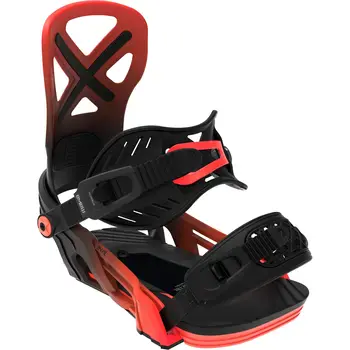
If you want to see how the Anvil compares to other men’s all-mountain bindings or want to check out some other options in that category, check out the next link.

Leave a Reply